Whether a Samoyed Can Ever Be Off Leash
That dream of seeing your Samoyed romp freely, a fluffy cloud gliding effortlessly across a wide-open field, responding instantly to your call—it’s a beautiful vision, isn’t it? Many of us Samoyed guardians yearn for that kind of unrestrained joy and connection. But the reality can feel a lot different, often filled with anxiety, frantic chases, and the sinking feeling that your beloved Sammy might just decide to go on an adventure without you. This guide will dive deep into the unique challenges and possibilities of off-leash freedom for Samoyeds, helping you understand their powerful instincts and explore strategies for a safer, more connected experience.
Understanding the Samoyed's Deep-Seated Instincts
Before we even talk about training, we have to acknowledge the magnificent creature that is the Samoyed. These aren't golden retrievers or labradors bred over generations for biddable, close-working companionship. Samoyeds come from a lineage of self-sufficient, nomadic working dogs, and those instincts are etched deep into their DNA. Wishing them away won't work; understanding and respecting them is the first step toward any off-leash success.
The Irresistible Call of Wanderlust and Prey Drive
Imagine living for centuries alongside a semi-nomadic people, where your job involved ranging far and wide to herd reindeer, acting as a guard against predators, and occasionally pulling a sled. That's the Samoyed's heritage. This isn't just a dog that likes to walk; it's a dog that is hardwired to cover ground. Give a Samoyed an open space and a whiff of something interesting—a rabbit darting into the brush, a distant bird, or even just the scent of another dog that passed by hours ago—and their instinct to pursue or explore can override everything else. Their prey drive, while perhaps not as intense as a sight hound's, is certainly present and potent enough to turn a casual stroll into a full-blown chase across dangerous territory. Why a Samoyed's Recall Cannot Be Trusted hits on this perfectly.
This powerful combination means that for a Samoyed, the thrill of the chase or the joy of exploration often outweighs the desire to return to you, especially if you haven't painstakingly built a recall that rivals the allure of a fleeing critter. It’s not that they don’t love you; it’s that their ancient brain is shouting a louder, more primal command. Many owners recount stories of their Samoyed, seemingly well-behaved in the backyard, suddenly transforming into a white streak disappearing over the horizon the moment a gate is accidentally left ajar.
The Independent Nature of a Northern Breed
Samoyeds are intelligent, no doubt about it, but their intelligence often comes with a strong streak of independence. They are problem-solvers who learned to make decisions on their own while working with their nomadic companions, often without direct human supervision. This isn't stubbornness in the malicious sense; it's self-reliance. When you ask a Samoyed to do something, especially something they perceive as less interesting than what they're currently doing (like sniffing that particularly exciting patch of grass), they'll often weigh the pros and cons. "Is coming back right now really worth it? Or can I just finish this sniff and then maybe, maybe, I’ll consider it?"
This inherent independence means that training a Samoyed for off-leash reliability is not a one-and-done affair. It requires constant reinforcement, high-value rewards, and an understanding that they are always assessing the situation. They aren't looking to please you quite as unconditionally as some other breeds; they're looking to partner with you, and sometimes that partnership involves them taking the lead on an exciting new scent trail.
The Reality of "Off-Leash" for a Samoyed
When most people picture an off-leash dog, they envision a seamless connection, a dog trotting by their side, glancing back for reassurance, and returning on command. For a Samoyed, this ideal is rarely achieved without significant, ongoing effort and, crucially, a highly controlled environment.
Rarely Truly "Off-Leash" in Public
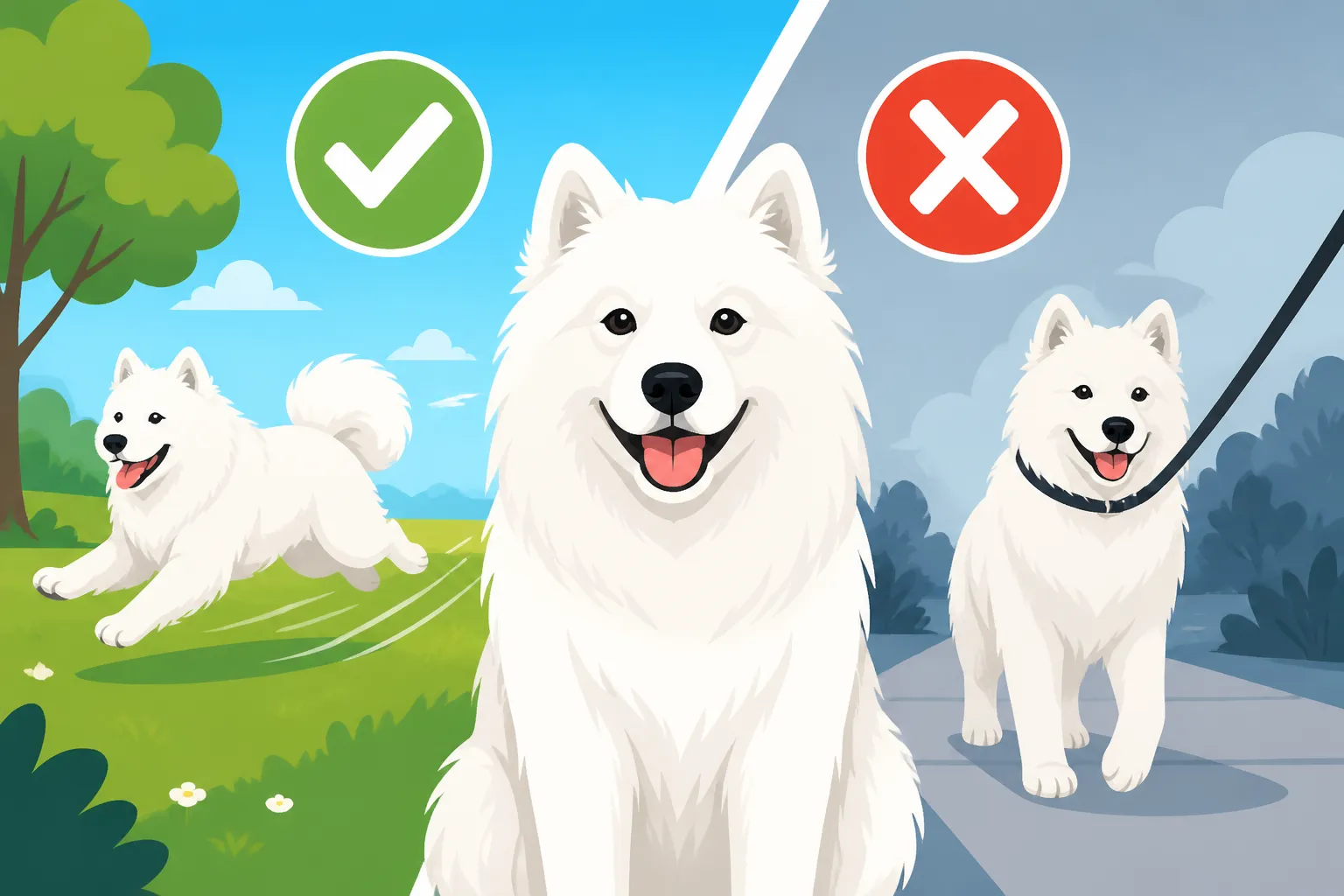
Let's be brutally honest: for the vast majority of Samoyeds, true off-leash freedom in an unfenced, public space is simply too dangerous. The risks are immense and often life-threatening. Cars, other dogs, cyclists, children, even just getting lost in an unfamiliar area—these are all real possibilities when a Samoyed's wanderlust kicks in and their recall fails. It's a heartbreaking truth that many Samoyed owners learn the hard way.
Imagine being in a park, thinking your Sammy is having a grand time sniffing around, when suddenly a jogger passes by. Before you can even utter "come," your Samoyed is off, convinced this human is a fun new friend to chase, or perhaps their herding instinct kicks in. The Herding Instinct Nobody Expects From a Samoyed can lead to some surprising (and potentially dangerous) behaviors. The thought of your beautiful white dog darting into traffic or getting into an altercation with an unfriendly dog is enough to make any responsible owner keep that leash firmly in hand.
Safe Off-Leash Means Secure Environments
So, does this mean no off-leash time ever? Absolutely not! It means redefining what "off-leash" looks like for your Samoyed. For most Samoyeds, safe off-leash time happens in a truly secure, fenced environment. Think large, privately rented dog parks, a friend's securely fenced property, or even a very well-maintained community dog park where you are confident in the fencing and the temperament of other dogs present.
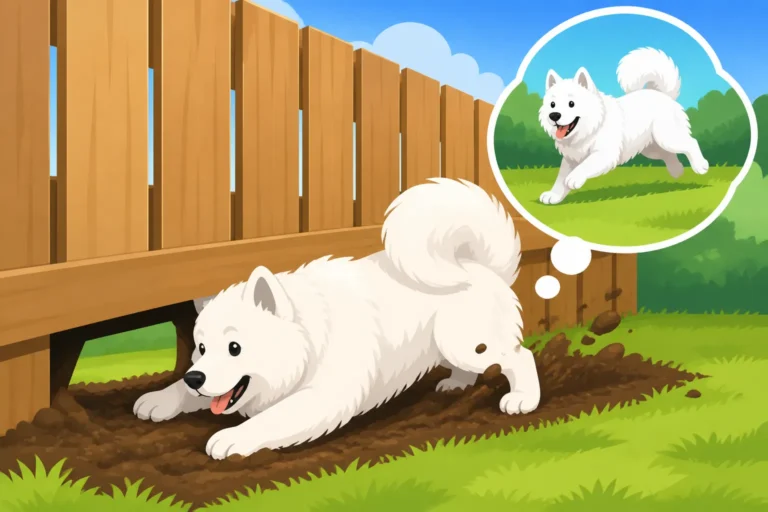
Even in these environments, constant vigilance is key. Always check fences for gaps or weak spots—a determined Samoyed is an escape artist extraordinaire. How a Samoyed Gets Out of Anything You Build is not an exaggeration. Some Samoyeds are talented climbers, others are expert diggers. The Digging a Samoyed Does Because It Is Hot shows their motivation for digging. If you're using a community dog park, observe the energy levels and interactions of the other dogs before letting your Samoyed off. Your beautiful, friendly Sammy might be a target for less sociable dogs, or might unwittingly over-stimulate a reactive dog.
Building a Rock-Solid Recall and Impulse Control
If you're determined to maximize your Samoyed's off-leash potential in appropriate settings, a bulletproof recall is non-negotiable. This isn't just about yelling "come" and hoping for the best; it's about making coming back to you the most rewarding thing in the world, every single time.
Training the "Here" Command with High Value
Forget "come." Start with a fresh, unambiguous command like "Here!" or "Touch." This command needs to be the absolute gold standard in your training repertoire. It means dropping whatever they are doing, no matter how exciting, and returning to you immediately. And when they do, they hit the jackpot. This isn't just a pat on the head; this is a tiny piece of boiled chicken, liverwurst, cheese, or whatever is their absolute favorite, coupled with enthusiastic praise.
Start this training in a completely distraction-free environment, like your living room. Then, slowly introduce minor distractions. Practice in the backyard, then in a quiet park on a long line. Proofing a Samoyed's Recall is a process, not a single lesson. The goal is to build an unshakeable association: "When I hear 'Here,' something amazing happens right next to my human." Remember, a Samoyed needs clear, consistent motivation. They will evaluate if it's worth it.
The Power of the Long Line
A long line (think 20-50 feet of sturdy leash) is your best friend in building off-leash reliability for a Samoyed. It allows them to experience a sense of freedom while still giving you control. It’s a bridge between being fully leashed and being truly off-leash. Use it in safe, open areas where you want to practice your recall. Let your Samoyed explore, and then randomly call them back. If they hesitate, a gentle but firm tug on the long line reminds them of the expectation.
Many owners find great success with high-quality long lines that can be easily found on platforms like Amazon. They come in various lengths and materials. Start shorter and gradually increase the length as your Samoyed's recall improves. This isn't just a training tool; it's a safety net. It allows you to intervene before your Samoyed practices a "self-rewarding" chase, which makes it even harder to break the habit later.
Tools and Strategies for Safer Off-Leash Experiences
Even with the best training, Samoyeds require additional safeguards and thoughtful planning for any off-leash adventures.
Secure Fencing and Escape Prevention
For many Samoyed owners, a securely fenced yard is the only place their dog can truly be "off-leash" with peace of mind. But even then, a standard fence might not be enough. Samoyeds are notorious escape artists. They can jump surprisingly high; How High a Samoyed Can Jump a Fence might surprise you. They can dig under fences with astonishing speed. And some are remarkably adept at figuring out gate latches.
Consider a six-foot fence, preferably solid or with small gaps that are difficult to climb. Bury chicken wire or a similar barrier along the bottom perimeter to prevent digging. Double-check all gate latches and consider adding extra security. If you have a particularly clever Samoyed, you might even look into L-footer fencing that extends inwards at the bottom to prevent digging out. Remember, the cost of enhancing your fence pales in comparison to the emotional and potential financial cost of a lost or injured dog.
GPS Trackers: A Modern Safety Net
For those moments when a Samoyed's independent spirit leads them astray, a GPS tracker can be an absolute lifesaver. These devices attach to your dog's collar and allow you to track their location in real-time via an app on your phone. While they don't replace training or secure environments, they add a crucial layer of reassurance.
Think of it as an insurance policy for your peace of mind. If your Samoyed does manage to slip out during an unexpected moment, or if you're exploring a new, large, and securely fenced property, a GPS collar can help you quickly locate them. There are many reliable brands on the market, and you can often find a good selection on sites like Amazon. Knowing What a GPS Collar for a Samoyed Costs can help you budget for this essential safety tool.
Continuing Education and Professional Guidance
Even experienced dog owners can find Samoyeds a unique challenge. Their combination of intelligence, independence, and strong natural instincts means that generic training advice might not always cut it. Don't be afraid to seek out professional help. A good dog trainer, especially one experienced with northern breeds, can provide invaluable insight and tailor training methods specifically for your Samoyed's personality.
Look for trainers who use positive reinforcement and understand the motivations of a Samoyed. Online resources, like the comprehensive programs offered by BAXTER & Bella, can also provide structured guidance for building a strong foundation of obedience and impulse control. Investing in What Training Classes Cost a Samoyed Owner or Whether a Samoyed Owner Needs a Professional Trainer is an investment in your Samoyed's safety and your relationship.
Weighing the Risks: Is True Off-Leash Worth It?
Ultimately, the decision of whether and how to allow your Samoyed off-leash rests with you. It's a balance between providing them with enrichment and ensuring their safety.
Assessing Your Samoyed's Individual Personality
While general breed characteristics are helpful, every Samoyed is an individual. Some might have a slightly lower prey drive, or be more naturally inclined to stick close. Others might be adrenaline junkies, always seeking the next great adventure. Observe your dog closely.
Consider the following:
| Characteristic | Off-Leash Risk Level | Impact on Off-Leash |
|---|---|---|
| High Prey Drive | High | Prone to chasing small animals; easily distracted. |
| Strong Wanderlust | High | Prone to exploring, wandering far from owner, getting lost. |
| Selective Hearing | Medium to High | May ignore commands when focused on something else. |
| High Sociability | Medium | May run to greet strangers or other dogs, potentially crossing roads. |
| History of Escaping | High | Indicates a strong drive to explore boundaries. |
| Weak Recall in Distraction | High | Cannot be relied upon when something more interesting appears. |
| Anxiety/Fear | Medium (different risks) | May bolt if startled, harder to recover. |
| Strong Bond with Owner | Lower | More likely to check in and return. |
| High Food Motivation | Lower | Easier to motivate with high-value treats for recall. |
Be honest about your Samoyed's tendencies. If they consistently test boundaries, dart through open doors (The Samoyed That Bolts Through an Open Door), or ignore you when a squirrel appears, then true off-leash in public is likely an irresponsible choice.
Accepting the Limitations for Their Safety
It’s okay to acknowledge that your Samoyed might never be the kind of dog you can trust completely off-leash in every environment. In fact, for most Samoyeds, this is the responsible conclusion. Instead of mourning the ideal, celebrate the possibilities within safe parameters.
This might mean:
- Embracing the long line: Allowing supervised "freedom" on a 30-foot line in a field.
- Utilizing secure dog parks: Taking them to well-maintained, fully fenced facilities for vigorous play.
- Exploring specific activities: Engaging in activities like canicross or bikejoring where they can run and pull, satisfying their drives while being securely attached to you. The Age a Samoyed Can Start Pulling is important to know for these activities.
- Creating a stimulating home environment: Ensuring their yard is secure and filled with enriching toys and activities to satisfy their urge to explore and dig within safe bounds.
Your Samoyed's happiness and safety are paramount. While the vision of a free-roaming Samoyed is lovely, the reality of their genetics often dictates a more structured approach to off-leash activities. By understanding their needs, respecting their instincts, and implementing smart training and safety measures, you can still provide your beloved Sammy with plenty of joyful, secure "off-leash" experiences.
Disclaimer
This article is for general informational purposes only and does not constitute professional advice. Laws, prices and regulations vary by location and change over time. Consult a qualified professional for guidance on your specific situation.