Whether a Samoyed Knocks Children Over
It's a common scenario: you picture your beautiful, fluffy Samoyed, the epitome of a gentle family dog, but then you remember their sheer enthusiasm and size. Many Samoyed owners, especially those with young children, worry about the accidental bump, the enthusiastic greeting, or the sudden zoomie that might send a little one tumbling. This guide is here to realistically explore why Samoyeds might unintentionally knock over children and offer practical, empathetic strategies to ensure safe and happy interactions for everyone in your household.
Understanding the Samoyed's Energetic Nature
Samoyeds are glorious, active dogs, and their zest for life is one of their most charming qualities. However, this same vibrant energy, when not properly channeled or understood, can sometimes lead to unintentional tumbles, especially when they're interacting with smaller, less stable individuals like children. It's not about malice; it's pure, unadulterated Samoyed joy colliding with physics.
The "Sammy Zoomies" and Puppy Enthusiasm
Anyone who has lived with a Samoyed puppy, or even a young adult, knows the phenomenon of the "Sammy Zoomies" – those sudden, explosive bursts of energy where they tear around the house or yard at top speed, often with a goofy grin plastered on their face. It’s absolutely delightful to watch, but if a small child happens to be in the trajectory of a four-legged furry missile, it can quickly turn into an unintended collision. This isn't them being aggressive or even clumsy on purpose; it's simply a momentary loss of spatial awareness coupled with an abundance of excitement.
These zoomies are often triggered by moments of high excitement: coming home from work, a new toy appearing, or simply an overflow of pent-up energy. Imagine a typical evening: you walk through the door, and your Samoyed, who has perhaps been patiently waiting all day, erupts in a joyous greeting. They might launch themselves forward, tail wagging furiously, bouncing off furniture, and spinning in circles. If a child is also running to greet you, the chance of them getting bowled over by this happy, bouncy dog goes way up. It’s a classic example of an enthusiastic greeting gone awry due to sheer puppy energy.
Size, Strength, and Momentum
Let's be honest, Samoyeds are not small dogs. While they might look like giant fluffy clouds, under all that luxurious coat is a powerful, sturdy canine built for hard work in harsh climates. An adult male Samoyed can easily weigh 45-65 pounds, and a female usually comes in around 35-50 pounds. Now, picture that weight, combined with strong leg muscles and the momentum of a dog moving quickly or jumping enthusiastically.
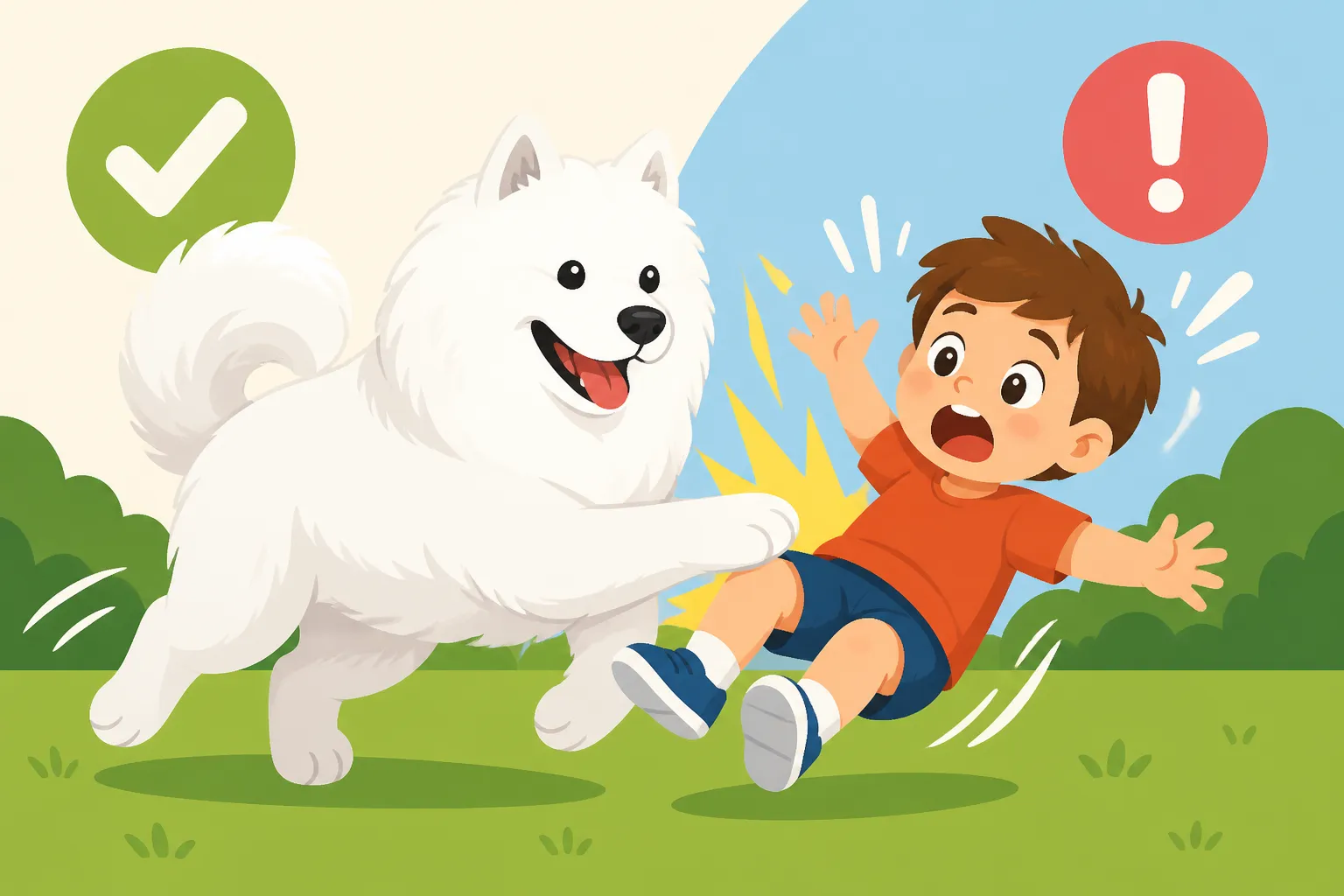
Even a slight bump from a Samoyed can be enough to destabilize a small child, whose center of gravity is higher and who weighs significantly less than the dog. A child who weighs 30 pounds doesn't stand a chance against a 50-pound Samoyed doing an excited butt-wiggle. When your Samoyed decides to launch itself into a "hug" or simply leans against a child for affection, the sheer force can be enough to send them sprawling. It’s not about aggression, but rather a lack of understanding on the dog's part about its own strength and how it impacts a much smaller, more fragile human. This is why managing those excited moments is so crucial for safety.
Instincts That Can Influence Interactions with Children
Beyond their sheer size and boundless energy, Samoyeds also possess certain innate instincts that, while completely natural for them, can inadvertently lead to children being knocked over. These behaviors stem from their heritage and how they interact with their world, not from a desire to harm. Understanding these underlying instincts is key to anticipating and managing their interactions with the littlest members of the family.
The Herding Tendency
It might surprise some, but Samoyeds were originally bred to herd reindeer, a task that required them to move quickly and decisively to guide large animals. This strong herding instinct, though often dormant in modern pet Samoyeds, can surface unexpectedly, especially when children are running and playing. They might see a group of running children as a "flock" that needs to be gathered or directed.
When this instinct kicks in, a Samoyed might nip at heels, body-check a running child, or cut off their path in an attempt to "herd" them. This isn't aggressive behavior in the traditional sense; it's a dog fulfilling a deeply ingrained purpose. However, a child who is suddenly nipped at the heels or abruptly cut off by a powerful dog can easily lose balance and fall. It's a prime example of how a Samoyed's inherent traits can lead to accidental tumbles if not properly understood and managed. For more on this, check out The Herding Instinct Nobody Expects From a Samoyed.
Greeting Behavior and Affection
Samoyeds are famously friendly and affectionate dogs. They absolutely adore their people and tend to greet everyone with a joyful exuberance that's hard to resist. The classic "Samoyed smile" is often accompanied by a full-body wiggle, happy vocalizations, and, frequently, a desire to get as close to your face as possible. While charming for adults, this can be problematic for small children.
Many Samoyeds express their affection by jumping up, either to get attention or to offer a happy lick. A dog launching itself onto a child, even gently, can easily knock them off their feet. Imagine your Samoyed, thrilled to see a child after a nap, bounding over and trying to put its paws on their shoulders. For a toddler, this is like being tackled by a furry linebacker. It’s a clear case where good intentions—the Samoyed wanting to be loving and close—can lead to unintended consequences because they don’t understand their own strength or the child’s fragility. They just want to be in the room with you, and often, right on you!
| Samoyed Behavior Trait | Potential Impact on Children (Accidental) | Prevention & Management Strategies |
|---|---|---|
| High Energy/Zoomies | Running into children, knocking them over during play or greetings. | Consistent exercise, controlled play sessions, "place" command during high excitement. |
| Large Size/Strength | Leaning, jumping, or bumping causes loss of balance. | Teach "four on the floor," manage greetings, discourage jumping. |
| Herding Instinct | Nipping at heels, body-checking running children. | Interrupt and redirect herding behaviors, supervise play closely, teach "leave it." |
| Affectionate Jumping | Paws on shoulders, attempts at "hugs" leading to falls. | Consistent "off" command, reward calm greetings, use gates for separation when needed. |
Strategies to Prevent Accidental Knock-Overs
Preventing accidental knock-overs isn't about curbing your Samoyed's natural joy, but rather about teaching them appropriate ways to express it, especially around children. It’s a two-pronged approach that involves consistent training for your dog and smart management of their environment and interactions. With a breed as intelligent and people-oriented as the Samoyed, these strategies can make a huge difference in ensuring a harmonious household.
Early Training and Impulse Control
The cornerstone of preventing accidental bumps and tumbles is solid, consistent training that starts early. For a Samoyed, patience and positive reinforcement are your best friends. Commands like "off" (meaning no jumping), "sit," "stay," and "four on the floor" (all four paws on the ground during greetings) are absolutely essential. Start practicing these in calm environments, then gradually introduce distractions. For instance, when your dog gets excited, practice asking for a "sit" before they get pets. Rewarding calm behavior extensively makes a huge impact.
It’s about teaching impulse control. Samoyeds, while smart, can be a bit selective with their obedience when excitement levels are high. Therefore, consistent repetition and high-value rewards are key. Consider enrolling in an online training program like BAXTER & Bella. Their structured approach can provide the guidance you need to instill these crucial behaviors, walking you through everything from basic manners to more advanced impulse control exercises. Remember, training isn't a one-and-done deal; it's an ongoing process, especially with a Samoyed that finds obedience negotiable.
Managing Environment and Supervision
Even the best-trained Samoyed can have an off moment, especially if they're particularly excited or if a child inadvertently triggers a burst of energy. This is where environmental management and constant supervision become your secret weapons. Think of it as setting everyone up for success. Use baby gates or pet barriers to create safe zones where your Samoyed can relax away from children, especially during busy times or when you can't offer your undivided attention. Products found on Amazon can be really helpful here, from sturdy walk-through gates to playpens for either the dog or the child.
Never leave young children unsupervised with your Samoyed, no matter how trustworthy you believe your dog to be. An adult should always be present to read both the dog's and the child's body language and intervene if necessary. During playdates or when new children visit, it's even more crucial to actively manage interactions. Perhaps your Samoyed can greet visitors calmly on a leash, or be given a special chew toy in their crate or a separate room until the initial excitement passes. This proactive approach minimizes opportunities for accidental mishaps.
Teaching Children How to Interact Safely
It’s not just about training your dog; it's equally important to teach children how to interact respectfully and safely with your Samoyed. Kids, by nature, can be unpredictable, loud, and prone to sudden movements – all things that can excite or startle a dog. Educate your children about dog body language, teaching them to recognize when a dog might be overstimulated, anxious, or simply needs space.
Teach them not to run, scream, or chase the dog. Instead, encourage calm movements, a soft voice, and how to gently pet. Show them where the "safe" petting spots are (like the chest or shoulder) and which spots to avoid (like the face or tail). Instruct them to never approach a sleeping or eating dog. When the Samoyed is calm, you can supervise "still" activities like reading next to the dog or gently stroking its fur while it's lying down. Empowering children with this knowledge helps them become active participants in safe interactions, reducing the likelihood of them accidentally being in the wrong place at the wrong time when a Samoyed's energy bursts forth.
Realistic Expectations and Ongoing Management
Living with a Samoyed and children is a wonderful journey filled with joy, laughter, and a lot of fluff! However, it also requires realistic expectations and a commitment to ongoing management. Your Samoyed is a dog, with dog instincts and dog energy, and while they can be incredibly gentle and loving, they are not immune to accidental behaviors. Accepting this reality is the first step towards creating a safe and happy environment for both your two-legged and four-legged family members.
The Importance of Consistency from Everyone
One of the biggest challenges in preventing accidental knock-overs, or any behavioral issue, is ensuring consistency across the entire household. If one family member allows jumping and another strictly enforces "four on the floor," your Samoyed will quickly become confused and will likely revert to the behavior that gets them the most attention or reward. This means every adult, and older children, need to be on the same page regarding rules, commands, and expectations.
Consistency also extends to how your Samoyed's energy needs are met. A Samoyed that isn't getting enough exercise is a Samoyed with a lot of pent-up energy, making those excited greetings even more boisterous. Regular walks, playtime, and mental stimulation are crucial. Don't underestimate the importance of How Much Exercise a Samoyed Needs to help them be calm and well-mannered indoors. A consistent routine, consistent training, and consistent enforcement of rules are the bedrock of a well-behaved Samoyed, reducing the likelihood of any accidental bumps or tumbles.
When Professional Help Might Be Needed
Sometimes, despite your best efforts, you might find that your Samoyed's enthusiastic behaviors are overwhelming, or that you're struggling to implement effective training strategies. Perhaps the jumping is getting worse, or the herding instinct is proving particularly strong around your children. This is absolutely nothing to be ashamed of, and it's a clear sign that it's time to call in a professional.
A certified professional dog trainer or a veterinary behaviorist can provide invaluable insight and tailored strategies for your specific situation. They can observe your Samoyed's interactions, identify triggers, and help you develop a comprehensive training plan that addresses the root causes of the behavior. They can also teach you advanced techniques for impulse control and provide hands-on guidance for managing your Samoyed around children. Investing in professional help early can prevent minor issues from escalating and ensure a safer, happier home for everyone involved. Don't hesitate to seek expertise if you feel overwhelmed; it's the best decision for your family and your cherished Samoyed.
Disclaimer
This article is for general informational purposes only and does not constitute professional advice. Laws, prices and regulations vary by location and change over time. Consult a qualified professional for guidance on your specific situation.