Whether a Samoyed Suits a Family With a Baby
Bringing a newborn home is one of life’s most thrilling milestones, but when you share your living space with a bouncy, vocal, high-shedding Arctic breed, anxiety naturally creeps in. You might wonder if your dog’s exuberant greeting style will endanger your infant or if the sheer volume of fur will overwhelm your nursery. This guide explores whether a Samoyed suits a family with a baby, examining temperament, real-world safety strategies, home management, and training techniques to keep everyone happy and safe.
Understanding the Samoyed Temperament Around Infants
When evaluating how a Samoyed fits into a household with a newborn, it helps to start with what makes this breed unique. Known worldwide for their brilliant white double coats and perpetual smiles, Samoyeds were originally bred by the Nenets people of Siberia. They lived inside tents, slept alongside human families to provide warmth, and worked closely with their owners in extreme conditions. Because of this historic bond, Why a Samoyed Is Gentle by Nature remains a core truth of the breed. They generally lack aggressive guard instincts and genuinely adore being surrounded by their human pack.
However, gentleness in spirit does not automatically translate to calm physical behavior. Samoyeds are working dogs built for endurance, pulling heavy loads, and staying active in harsh climates. A young, enthusiastic Samoyed does not naturally understand that a five-pound infant is fragile. Their standard way of showing love involves jumping up, leaning their body weight against you, or tossing their front paws in the air. For an adult, this is a minor inconvenience; for a parent holding a baby or a newborn resting in a bouncer, it creates a potential hazard.
Understanding this distinction is vital for any expectant parent. The risk a Samoyed poses to a baby is almost never intentional malice or territorial aggression. Instead, it stems from hyperactive affection, clumsy physical awareness, and unchanneled social energy.
High Energy and Bouncy Affection
A Samoyed’s natural response to excitement is physical expression. When you walk through the front door carrying a newborn, your dog will want to inspect the new addition with intense curiosity. Their tail will wag wildly, their body will bounce, and they may try to press their nose directly into the baby’s face or blanket.
Without established boundaries, there is a realistic risk that a dog might accidentally step on a baby who is lounging on a floor mat, or slip while trying to look into a crib. Parents often worry about Whether a Samoyed Knocks Children Over, and this concern is valid during both the infant stage and the early walking years. A forty to sixty-pound dog moving at full speed through a hallway can easily brush past an adult holding an infant or nudge a swinging bassinet with enough force to cause a scare.
Managing this energy requires recognizing your dog’s arousal triggers. If the doorbell ringing or the sound of a stroller unfolding sends your Samoyed into a spinning frenzy, those behaviors must be addressed long before the birth.
The Vocal Nature and Baby Sleep Cycles
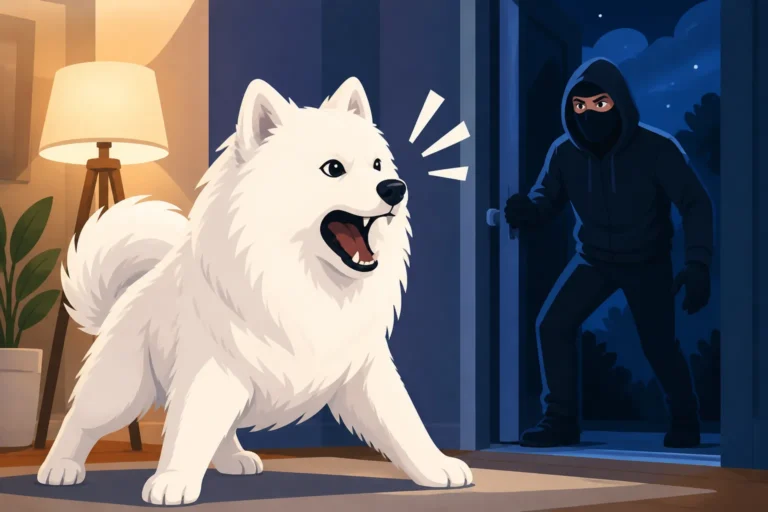
Another significant factor when mixing a Samoyed with a infant is their noise level. Samoyeds do not bark like typical guard dogs; they communicate through a wide array of vocalizations, ranging from musical yodeling and chattering to high-pitched, ear-piercing shrieks. Anyone who has lived with the breed knows Why a Samoyed Screams Rather Than Barks when they feel excited, frustrated, or eager for attention.
For a sleeping baby—and exhausted parents trying to grab a rare nap—this vocal range can present a challenge. A sudden sharp bark triggered by a passing delivery truck or a high-pitched demand scream at dinner time can instantly wake a light-sleeping infant.
The silver lining is that many infants raised around loud dogs quickly become accustomed to the noise while still in the womb and during their first few weeks at home. It is common for a newborn to sleep soundly through a dog’s vocal outburst if they hear it regularly. However, managing your dog’s demand barking through structured routines helps protect the household’s overall sanity during those sleep-deprived first months.
Herding Instincts and Impulse Control
In addition to pulling sleds, historically Samoyeds were used to herd reindeer across vast Arctic tundra. That lingering working drive can surface in subtle ways around young children. You might notice your dog circling your feet while you carry the baby from room to room, or attempting to steer your movement by leaning against your legs.
As children grow into mobile toddlers, this instinct becomes more pronounced. Whether a Samoyed Herds Children often depends on the dog’s individual drive and how much physical mental stimulation they receive daily. A bored Samoyed may view a crawling baby or a running toddler as a stray herd member, leading to behaviors like circling, blocking pathways, or gently poking with their muzzle. Recognizing these subtle actions as herding tendencies rather than play allows you to intervene early and redirect your dog toward appropriate outlets.
Practical Safety and Supervision Strategies for Babies and Samoyeds
Successfully integrating a Samoyed into a home with an infant requires proactive planning rather than reactive corrections. Long before you bring your baby home from the hospital, your environment and your dog’s routine should undergo a deliberate transition.
Establishing Boundaries and Safe Zones
The golden rule of dog and child safety is that unsupervised interaction should never occur, regardless of how friendly or gentle you believe your dog to be. Establishing clear physical boundaries inside the home allows both your Samoyed and your baby to relax without constant human intervention.
Baby gates are an indispensable tool for this process. Sturdy, tall gates ordered online through sites like Amazon allow you to section off the nursery, carpeted play spaces, or bedrooms while still keeping your Samoyed feeling included in family life. Because Samoyeds are agile and capable of jumping over shorter barriers, select gates that are tall enough to discourage leaping attempts.
Creating a dedicated safe zone for your dog is equally important. When a baby is crying incessantly or visitors are dropping off meals, a dog can easily become overwhelmed by the change in environment. A quiet room equipped with an orthopedic bed, favorite chew toys, and a covered crate gives your Samoyed a safe retreat where they can rest without infant noise.
Preparing Your Samoyed Before the Baby Arrives
Dogs thrive on predictability, and the arrival of a baby completely upends a household’s daily rhythm. If your Samoyed is accustomed to being the center of attention, receiving endless lap cuddles, and walking at exact times every day, a sudden drop in attention after delivery can cause confusion or anxiety.
Start altering your routine several months prior to your due date:
- Desensitize Baby Sounds: Play recorded sounds of infants crying, babbling, and screaming at low volumes while rewarding your dog with high-value treats for remaining calm. Gradually increase the volume over several weeks.
- Introduce Baby Equipment: Set up cribs, swings, strollers, and playpens early. Allow your Samoyed to sniff these items while teaching them a firm boundary command, such as stepping back two paces when asked.
- Adjust Walking Schedules: If walks will shift from crisp morning outings to sporadic afternoon strolls depending on sleep schedules, practice those irregular times now so the dog does not associate the baby with a lost walk.
- Refine Basic Obedience: Focus heavily on commands like “place,” “leave it,” “sit-stay,” and “loose-leash walking.”
Enrolling in structured online training programs like BAXTER & Bella can provide expectant parents with flexible, step-by-step guidance on setting up these boundaries, polishing impulse control, and managing dog-infant introductions from the comfort of home.
Managing the Mouthing Phase and Toy Sharing
If your dog is still young, you may be navigating The First Year With a Samoyed Puppy while simultaneously preparing for a human baby. Samoyed puppies use their mouths to explore the world, nip at hands, and grab loose fabric. This behavior must be completely resolved before an infant arrives, as a puppy’s needle-sharp teeth can easily scratch delicate baby skin during an overzealous greeting.
Additionally, infant toys and dog toys share many identical traits: bright colors, plush textures, and loud internal squeakers. A Samoyed will naturally assume that any soft toy left on the floor is fair game.
To prevent conflicts:
- Keep baby toys elevated in baskets or behind baby gates.
- Teach a rock-solid “leave it” command using low-value items first, progressing to high-value plush toys.
- Store dog toys in a specific basket and teach your Samoyed that they may only retrieve items from their designated box.
- Never allow your dog to play with baby pacifiers, blankets, or clothes, as these items carry intense baby scents that can increase fixated focus.
Daily Logistics of Hair, Hygiene, and Time Management
Beyond physical safety, adding a baby to a Samoyed home introduces significant logistical challenges around cleanliness and daily scheduling.
Handling Shedding and Infant Exposure
There is no escaping the reality of Samoyed coat maintenance. Anyone who has shared a home with this breed understands What Twenty Pounds of Samoyed Undercoat Does to a House during seasonal coat blows. Fine white guard hairs and soft undercoat float through the air, cling to furniture, and settle into carpets.
When you have a newborn spending time on floor mats or practicing tummy time, hair management becomes a daily priority. While dog hair is generally harmless to healthy infants, excessive fur can irritate delicate skin, collect around baby hands, or end up inside tiny mouths.
Managing fur alongside newborn care requires smart routines and the right gear:
- Robotic Vacuums: Running an automated vacuum daily keeps tumbleweeds of white hair off main walkways without taking away from your resting time.
- Air Purifiers: Placing High-Efficiency Particulate Air (HEPA) purifiers, easily found on Amazon, in both the nursery and main living space pulls floating dander and loose fur out of the air before it settles on crib sheets.
- Dedicated Play Blankets: Place a clean, hair-free blanket down for tummy time, and fold it inward when picking it up so fur does not settle on the playing surface while unused.
- Grooming Maintenance: Stick to a consistent brushing routine. A fifteen-minute daily session with an undercoat rake prevents heavy mats and keeps shed hair in the trash bin rather than on your clothing.
Balancing Exercise Requirements with Newborn Care
A key factor in whether a Samoyed suits your expanding family is your capacity to meet their daily physical needs. Samoyeds are not low-energy couch potatoes; an under-exercised Samoyed quickly becomes destructive, vocal, and restless.
When a newborn arrives, free time vanishes. If you are struggling with sleepless nights, finding the energy for a hour-long walk can feel impossible. Yet, if your dog sits inside all day building up pent-up energy, their bouncy behavior around the baby will inevitably escalate.
Families who navigate this successfully often rely on creative solutions:
- Stroller Walks: Introduce your Samoyed to walking alongside a stroller well before the baby arrives. Once mastered, daily walks become a great way for both parent and baby to get fresh air while burning off the dog’s energy.
- Brain Games: Mental stimulation can tire a dog out almost as fast as physical running. Lick mats, puzzle toys, and hidden treat searches keep a Samoyed’s mind active while you feed or soothe the baby.
- Support Networks: Consider using a local dog walker, doggy daycare, or family members to handle exercise duties during the intense first few weeks post-birth.
Neglecting exercise increases the likelihood of behavior problems, including demand barking, fence digging, and Separation Anxiety in a Samoyed, which occurs when a dog feels distressed by sudden isolation or changes in household attention.
Comparing Family Stages and Samoyed Management Strategies
Managing a Samoyed changes significantly as your baby grows from a helpless newborn into an active toddler. Understanding these shifting dynamics helps you prepare for every stage of childhood development.
| Child Stage | Main Samoyed Risk Factors | Key Management Tools | Primary Focus for Parents |
|---|---|---|---|
| Newborn (0 – 6 Months) | Accidental bumps, loud barking waking baby, hair on play surfaces | Baby gates, HEPA air purifiers, place training, white noise machines | Establishing safe physical boundaries and preserving dog exercise routines |
| Infant / Crawler (6 – 12 Months) | Baby grabbing dog fur/ears, dog taking baby toys, mouth-level interactions | Playpens, separate dog safe zone, online modules from BAXTER & Bella | Protecting dog’s personal space and supervising all floor interactions |
| Toddler (1 – 3 Years) | Herding behaviors, knocking over steady walkers, child dropping hazardous food | High baby gates, structured walking routines, dog chew enrichment | Teaching child proper dog handling and stopping running/chasing games inside |
| Young Child (3+ Years) | Rough play, child opening exterior doors, unmonitored leash holding | Family training sessions, designated feeding routines, secure yard latches | Involving child in positive reinforcement care, feeding, and basic tricks |
Evaluating Your Household Capacity
Before deciding if a Samoyed fits your family plans, evaluate your household bandwidth realistically. Whether a Samoyed Suits a Busy Household comes down to whether you have enough time, energy, and patience to manage both an intense dog coat and a high-needs pet while caring for a human baby.
Ask yourself the following questions:
- Are both partners committed to sharing dog care responsibilities when newborn exhaustion sets in?
- Do you have space in your home to set up physical barriers like gates and playpens without feeling trapped?
- Are you comfortable managing high levels of dog hair on baby clothes, blankets, and furniture?
- Is your current Samoyed reasonably well-trained, or are you currently battling major behavioral issues like fence jumping or leash pulling?
If your dog already has solid basic manners and you are prepared to enforce strict management protocols, a Samoyed can be a wonderful, loving companion for a growing child. Many children raised with Samoyeds form deep bonds with their gentle white giants, creating memories that last a lifetime.
Preparing for the Toddler Years
While the infant stage requires managing space and noise, the toddler stage introduces brand-new social dynamics. Once your child starts walking, running, and exploring, they will inevitably try to interact directly with the dog. Toddlers lack impulse control; they grab fur, poke eyes, fall over sleeping pets, and make unpredictable movements.
Even a dog with a reputation for being tolerant has limits. Teaching your child how to interact respectfully with pets is just as critical as training the dog.
Key guidelines for toddler safety include:
- Zero Tolerance for Disturbance: Teach your child never to approach the dog while they are eating, sleeping, or chewing on a bone.
- Gentle Touch Only: Practice open-handed, smooth petting on your dog’s shoulder or side, discouraging grabbing at tail fur or ears.
- No Riding or Hugging: Children should never attempt to sit on, ride, or tightly hug a Samoyed. Hugging puts a child’s face directly next to a dog’s mouth and can feel threatening to a pet.
- Supervised Participation: Allow toddlers to help drop kibble into the food bowl or toss balls in the yard, reinforcing positive associations between child and dog.
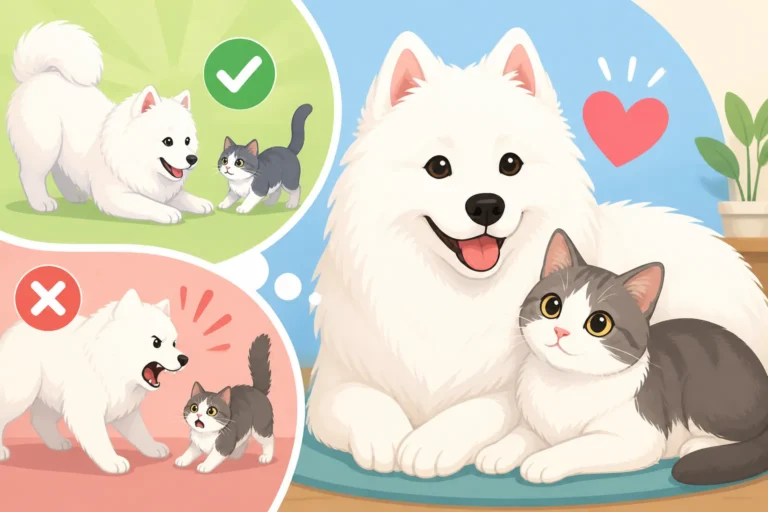
By managing both sides of the relationship with equal care, you ensure that A Samoyed With Children and Other Animals remains a safe, rewarding experience. While the combination of a high-energy, heavy-shedding Arctic dog and a new baby requires dedication, proper planning, and consistent boundaries, the result is a joyful, loving home where your child grows up alongside a devoted four-legged friend.
Disclaimer
This article is for general informational purposes only and does not constitute professional advice. Laws, prices and regulations vary by location and change over time. Consult a qualified professional for guidance on your specific situation.