Whether a Samoyed Raised With a Cat Is Safe
Bringing a fluffy Samoyed puppy into a home that already has a cherished feline friend often sparks a mix of excitement and genuine apprehension. Many of us wonder if our spirited, intelligent Samoyeds, with their historical background, can truly learn to live in peace and safety with a nimble cat, especially when they grow up side-by-side. This comprehensive guide will explore the nuances of raising a Samoyed alongside a cat, delving into breed instincts, the crucial role of early socialization, and practical strategies to foster a harmonious multi-pet household.
Understanding the Samoyed's Instincts and How They Relate to Cats
It’s natural to feel a pang of worry when you think about a breed like the Samoyed, known for its strong prey drive and boundless energy, living with a small, quick-moving creature like a cat. But it’s important to understand that a Samoyed's instincts aren't necessarily malicious; they're deeply ingrained behaviors that can be managed and redirected with the right approach.
The Herding Aspect Versus Prey Drive
Historically, Samoyeds were invaluable partners to the Nenets people, primarily herding reindeer. This means they possess an innate desire to control and move other animals, often by circling or nipping, which can sometimes be mistaken for aggression. However, they also had roles that involved hunting smaller game, giving them a distinct prey drive. This dual nature can create a tricky dynamic with cats. A cat darting across the room can easily trigger that chase instinct, not necessarily with the intent to harm, but purely out of an impulse to pursue. It's a fine line to walk, understanding that your Samoyed isn't being "naughty" but is responding to a very ancient wiring. This is why understanding The Herding Instinct Nobody Expects From a Samoyed is so vital for Samoyed owners.
When a cat dashes, that quick, erratic movement is precisely what can ignite a Samoyed's chase instinct. Imagine a flash of fur, a twitching tail, and the thrill of the chase. For a Samoyed, this isn't about being mean; it's about engaging with the environment in a way that feels natural. They might want to "herd" the cat, nudging it or blocking its path, or simply enjoy the game of pursuit. The key is distinguishing between a playful chase and a predatory one, which often comes down to the dog's body language and the cat's reaction. A Samoyed might be vocal during this, perhaps with their characteristic "scream" or "talk," adding to the chaotic impression.
Individual Samoyed Temperament Varies Greatly
While breed traits give us a general blueprint, every Samoyed is an individual, just like every human. You might have one Samoyed with a very low prey drive, who looks at a cat with mild curiosity before wandering off to chew a favorite toy. Another might be intensely fixated, every muscle tensed at the sight of a cat. This variability means that while raising them together offers the best chance, it's not a guarantee, and constant vigilance is required.
Consider two hypothetical Samoyeds: Luna and Finn. Luna, even as a puppy, might show only a fleeting interest in the family cat, preferring to chew on her rope toy. Finn, on the other hand, might eye the cat with an almost obsessive focus, his tail wagging furiously but his body language indicating a strong desire to pounce and play, perhaps too roughly. These differences are often influenced by genetics, early life experiences, and even the personality of the cat itself. A bold, dog-savvy cat might stand its ground and teach a pushy puppy a lesson, while a timid cat might become a constant target for chase, exacerbating the Samoyed's instincts. It’s critical to observe your individual Samoyed and your individual cat, rather than relying solely on generalizations about the breed. What actually motivates a Samoyed varies, and finding that key can help manage interactions.
The Power of Early Introduction and Socialization
If you're thinking about adding both a Samoyed and a cat to your home, or if you already have one and are considering the other, the timing and method of their introduction are paramount. Starting early, when both are impressionable, dramatically increases the chances of a peaceful coexistence.
Puppyhood and Kittenhood: The Best Window
Bringing a Samoyed puppy into a home with a kitten, or vice-versa, offers the best opportunity for them to bond and view each other as part of the family rather than prey or a nuisance. During their critical socialization period – typically up to 16 weeks for puppies and around 7 weeks for kittens – their brains are sponges, learning what is "normal" and safe in their world. If they learn early that a cat or dog is a friendly, non-threatening housemate, those positive associations can last a lifetime. This period is a whirlwind, and managing The First Year With a Samoyed Puppy is crucial for all aspects of their behavior.
Imagine a Samoyed puppy, still clumsy and full of puppy breath, meeting a tiny, wobbly kitten. If these initial encounters are gentle, controlled, and positive, they begin to build a foundation of trust. The puppy learns that the cat is not a toy to be chased vigorously, but a smaller, more delicate creature that deserves respect. The kitten, in turn, learns that the large, fluffy dog is not a threat, but perhaps a source of warmth or even a playmate, albeit one that needs careful management. It's about creating shared positive experiences, like supervised naps near each other or receiving treats simultaneously.
Always Supervised Interactions
Even with the best early introductions, unsupervised interactions, especially in the early stages, can be risky. It only takes one moment – a cat startling, a dog reacting too quickly – for a negative experience to occur that can set back weeks or months of progress. Always be present, observant, and ready to intervene calmly if play gets too rough or if either animal shows signs of stress or fear.
Think of it like having toddlers and infants in the same room. You wouldn't leave them alone, even if they usually get along. Similarly, with a Samoyed and a cat, you need to be the ever-present guardian. This means using baby gates, crates, or leashes to manage proximity when you can't give your full attention. If your Samoyed is known for vocalizing loudly or for being particularly exuberant, even if it's "play," the cat might not interpret it as such. Teaching your Samoyed cues like "leave it" or "settle" can be incredibly useful during these supervised sessions, reinforcing that the cat is off-limits for boisterous play. This kind of impulse control is something you might work on through an online training program like those offered by BAXTER & Bella.
Creating Safe Zones for Your Feline Friend
Cats are naturally inclined to seek high vantage points and hidden spaces. Providing these "escape routes" and "safe havens" is non-negotiable in a multi-pet home. A cat tree, shelves, or even rooms with baby gates that allow the cat to pass but not the dog, can empower your cat and reduce stress. A confident cat is less likely to feel like prey.
Imagine your cat, Mittens, feeling overwhelmed by your Samoyed, Blizzard's, boisterous advances. If Mittens knows she can leap onto a sturdy cat tree from Amazon, or dart through a strategically placed baby gate into a "cat-only" room, she retains a sense of control and safety. This significantly reduces her stress and the likelihood of her lashing out defensively or becoming constantly fearful. These zones aren't just for escape; they're vital for eating, sleeping, and using the litter box without feeling threatened. Even just a tall scratching post can provide a temporary refuge. The goal is to ensure the cat always has an out, reinforcing that it's the boss of its own space.
Managing Multi-Pet Households with Samoyeds and Cats
Once the initial introductions are successful, the work isn't over. Maintaining a harmonious environment between your Samoyed and your cat requires ongoing effort, clear boundaries, and consistent management strategies.
Respecting Boundaries: Training Your Samoyed
Training is absolutely foundational to successful cohabitation. Your Samoyed needs to understand and respect boundaries around the cat. Commands like "leave it," "stay," and a solid recall are invaluable. It teaches your Samoyed that while the cat is part of the family, it's not a plaything or something to be chased. This can be challenging because Training a Samoyed That Finds Obedience Negotiable can sometimes feel like trying to negotiate with a cloud!
Envision your Samoyed, Nimbus, excitedly pouncing towards your cat, Shadow, who is quietly napping on the sofa. This is where a firm, consistent "leave it" command comes in. If Nimbus responds by turning away and looking to you for a reward, you've reinforced the desired behavior. If he ignores you, you need to redirect him immediately with a leash or by physically blocking his access, and then reward him for calm behavior elsewhere. Consistency is key here. Every time the cat is left alone, or Nimbus respects a boundary, it solidifies the understanding. You might even use a clicker and high-value treats to mark these moments of compliance, especially when your Samoyed might Why a Samoyed Ignores a Cue It Knows when distracted.
Separate Resources: Food, Water, and Litter Boxes
This might seem obvious, but it's often overlooked. Ensure your cat's food, water, and litter boxes are in places inaccessible to your Samoyed. Samoyeds are notorious for being food-motivated and might see a cat's food as a tasty snack. Eating each other's food can lead to dietary issues, and let's be honest, no one wants their Samoyed digging in the litter box!
Picture this: your cat's fancy salmon pate, carefully placed on the floor, becomes an irresistible lure for your Samoyed, Frost. To prevent this, consider feeding your cat on a counter, shelf, or in a room secured by a pet gate that only the cat can squeeze through. This ensures your cat can eat in peace and its specialized diet remains intact. Similarly, litter boxes should be placed high up, in a cabinet with a cat flap, or in a laundry room with a baby gate that permits cat entry but blocks dog access. This prevents your Samoyed from engaging in unsavory habits and keeps the litter clean for your cat. Providing separate, dedicated resources for each animal reduces competition and potential friction.
Enrichment for Both Species
A bored Samoyed is a destructive Samoyed, and that energy can easily be misdirected towards a cat. Ensuring both your Samoyed and your cat have appropriate outlets for their physical and mental energy is vital. For your Samoyed, this means plenty of exercise, training sessions, and interactive toys. For your cat, provide scratching posts, climbing opportunities, and stimulating toys.
Think about your Samoyed, Bear, who has had a long walk and a solid training session. He's much more likely to be calm and respectful of your cat, Luna, lounging on the windowsill. If Bear is under-exercised, he might resort to chasing Luna out of sheer boredom or excess energy, leading to stress for both. Puzzle feeders from Amazon can keep your Samoyed mentally engaged, while a good game of fetch or tug can burn off physical energy. Likewise, for Luna, a tall cat tree or interactive feather toy can provide necessary enrichment. A well-exercised, mentally stimulated Samoyed is generally a happier, calmer companion, which directly contributes to a more peaceful multi-pet home. Remember, What a Bored Samoyed Does to a House can extend to interactions with other pets.
When Things Go Wrong: Addressing Challenges
Despite all best efforts, sometimes the dynamic between a Samoyed and a cat can still present challenges. Recognizing the signs of trouble early and knowing when to seek professional help are crucial for the safety and well-being of both pets.
Signs of Trouble: What to Watch Out For
It's vital to be observant and understand the subtle cues your pets give. For the cat, signs of chronic stress can include excessive grooming, hiding constantly, loss of appetite, changes in litter box habits, or becoming defensive and hissing more often. For the Samoyed, look for persistent fixation on the cat, escalating intensity in chasing, or ignoring your commands when the cat is present. A Samoyed might follow you from room to room, but if it's always fixated on the cat, that's a red flag. Why a Samoyed Follows You From Room to Room is usually about companionship, but if it turns into stalking another pet, it's problematic.
Consider your Samoyed, Fluffy, constantly staring at your cat, Mittens, even when Mittens is resting. His tail might be wagging, but his body is tense, and he never truly relaxes in Mittens' presence. Mittens, meanwhile, might start eating less, or you might find urine outside the litter box because she's too afraid to use it when Fluffy is around. These aren't just minor annoyances; they are significant indicators of distress. A cat that stops grooming itself, or an increase in aggressive swatting or hissing from the cat, means the relationship is strained. Conversely, if your Samoyed's "play" becomes increasingly rough, resulting in the cat frequently crying out, that needs immediate intervention.
When to Call in a Professional Trainer or Behaviorist
If you've implemented all the above strategies and are still seeing consistent problems – your cat is constantly stressed, your Samoyed is relentless in its pursuit, or there's any indication of actual aggression or harm – it's time to bring in a professional. A certified professional dog trainer specializing in multi-pet households or a veterinary behaviorist can assess the specific dynamics in your home and provide tailored solutions. They can offer insights into Whether a Samoyed Can Ever Be Off Leash when cats are present, and help build critical impulse control.
Don't wait until an actual injury occurs. A professional can help identify triggers you might be missing, suggest specific training techniques, or recommend environmental modifications that can alleviate tension. They might introduce specific counter-conditioning and desensitization protocols to help both animals feel safer and more comfortable. Sometimes, just having an unbiased expert observe the interactions can reveal crucial details. For instance, they might suggest using a long line for your Samoyed even indoors during supervised interactions, allowing you to regain control safely without physical confrontation. Investing in a professional early can prevent severe issues and foster a genuinely safe and happy home for everyone.
Here's a quick overview of key considerations:
| Aspect | Pros of Early Introduction | Cons/Challenges | Management Strategies |
|---|---|---|---|
| Instincts | Puppy learns cat is family, not prey | Samoyed's chase/herding drive can be strong | Consistent "leave it" training, mental stimulation for Samoyed. |
| Socialization | Builds positive associations, reduces fear | Single negative interaction can set back progress | Constant supervision, positive reinforcement. |
| Environment | Creates habits of mutual respect | Cat stress, dog obsession, resource guarding | Safe zones for cat (high places), separate feeding, enrichment. |
| Temperament | Can reveal individual dog/cat compatibility | High prey drive or timid cat can make coexistence hard | Know your pets, adapt strategies, seek professional help. |
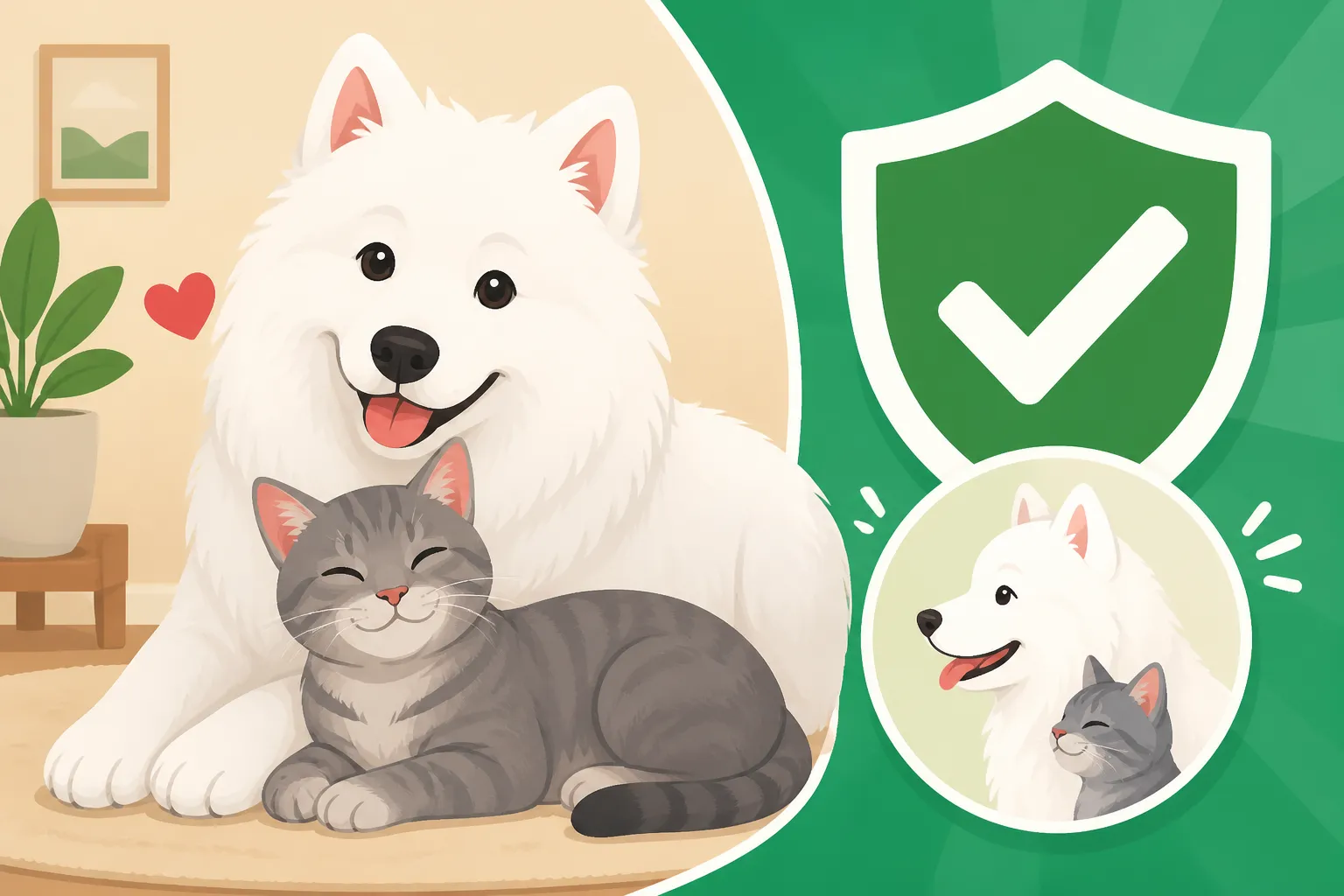
Ultimately, a Samoyed raised with a cat can be safe and harmonious, but it requires dedication, vigilance, and a deep understanding of both species' needs. When done correctly, the bond between a Samoyed and a cat can be truly heartwarming.
Disclaimer
This article is for general informational purposes only and does not constitute professional advice. Laws, prices and regulations vary by location and change over time. Consult a qualified professional for guidance on your specific situation.