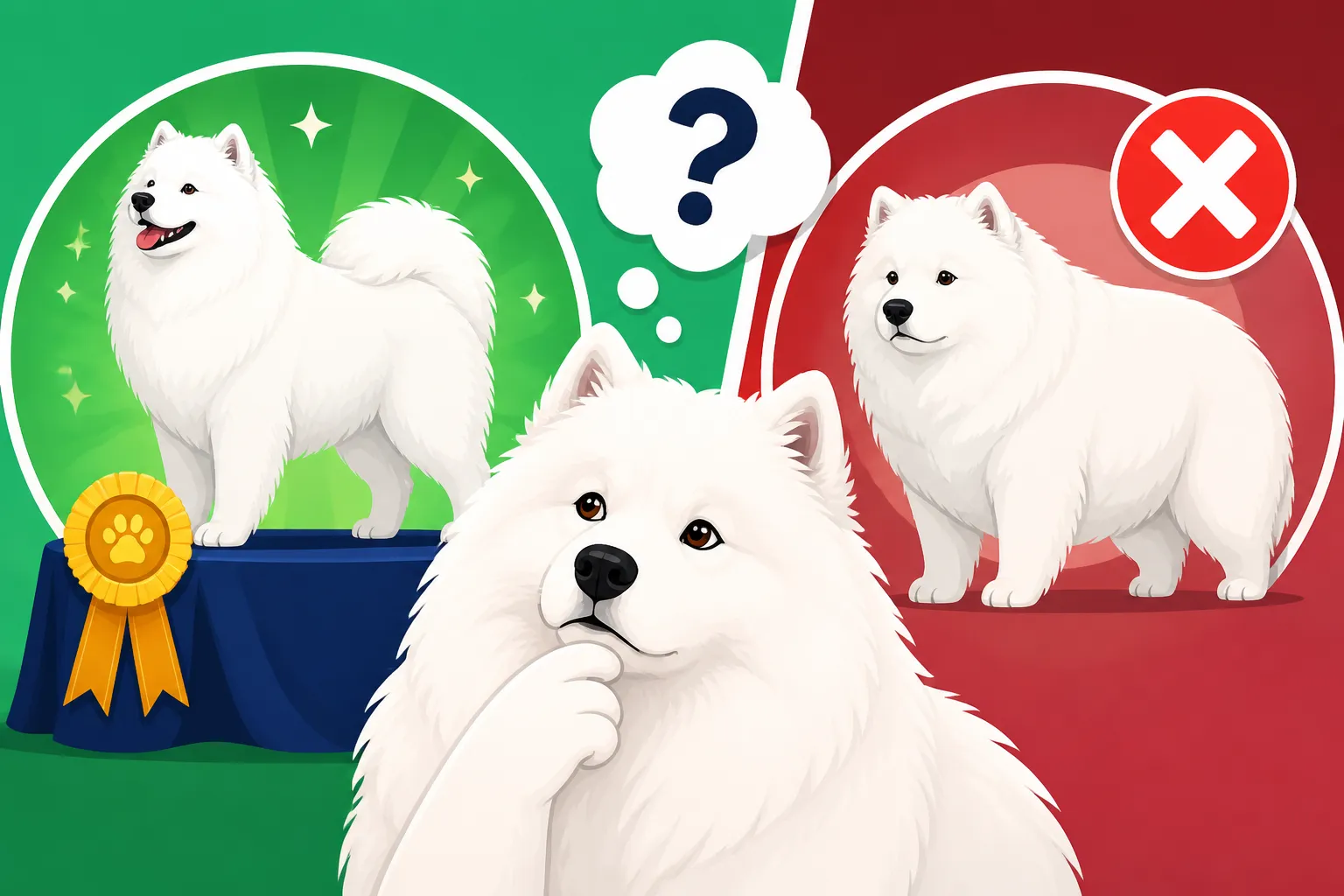
Whether an Oversized Samoyed Can Be Shown
An adult Samoyed that stands taller than expected can still enter a conformation show, but being eligible to compete is not the same as matching the breed standard. That distinction matters when you are comparing a puppy’s growth, planning a show career, or hearing that a large dog is automatically disqualified. Here’s how size is assessed and what an oversized Samoyed’s height may mean in the ring.
What counts as oversized in a Samoyed
The breed standard sets a preferred height range
In American Kennel Club conformation, the Samoyed standard gives preferred height ranges measured at the withers—the highest point of the shoulder blades. Males are 21 to 23½ inches, and females are 19 to 21 inches. The standard says dogs outside those limits should be severely penalized; being over the range is not, by itself, described as an automatic disqualification.
That wording is important. A Samoyed a little taller than the preferred range is not necessarily barred from entering. The judge assesses the dog against the full standard, including structure, proportions, movement, coat, temperament, and overall breed type. Height can count against the dog, but it is only one part of the evaluation.
The measurements are not a promise that every Samoyed will land in the middle of the range. Dogs vary, and a dog’s apparent size can be misleading beneath a full coat. For a broader sense of expected stature, see How Tall a Samoyed Stands. Height and weight are related, but they are not interchangeable: a muscular, well-conditioned dog may weigh more than a lighter dog of the same height. What a Samoyed Actually Weighs offers useful context for that distinction.
Height is not the same as a large-looking coat or heavy build
Samoyeds are substantial, heavily coated dogs, so a dog can look enormous without being unusually tall. A full ruff, abundant furnishings, a broad chest, and a thick undercoat can make the outline seem bigger than the dog’s actual frame. Conversely, a tall dog with a relatively lean coat may look less oversized at a glance.
A judge evaluates the dog’s proportions, not just the impression created by its fur. The Samoyed should have a balanced outline and a body that suits its height. Simply being heavier does not establish that a dog exceeds the height limit, and a fluffy coat does not change where the withers are.
If you are unsure whether your dog is genuinely tall or simply looks large, have an experienced breeder, handler, or veterinarian help you identify the withers and take a careful measurement. For a growing puppy, treat any single measurement as a snapshot rather than a prediction of its final adult height.
Can an oversized Samoyed enter a show
Entry eligibility and the judge’s evaluation are different questions
A Samoyed outside the preferred height range may still be eligible to enter a conformation show, depending on the rules of the registry and event. In an AKC conformation setting, the standard’s language calls for a severe penalty outside the height limits rather than stating that every over-height dog is automatically disqualified. That does not mean a height deviation will be ignored; it means the likely consequence is an unfavorable evaluation, not necessarily refusal at the entry stage.
Show rules and breed standards are specific to the organization and country. If you compete outside the United States, or in an event that uses another registry’s rules, check that organization’s current standard and regulations. Do not assume that a number or penalty used in one country applies everywhere. Whether a Samoyed Standard Differs Between Countries explains why the same dog can be assessed under different published standards.
If you are entering an event, ask the show superintendent or governing organization about entry requirements, and speak with a knowledgeable Samoyed breeder or handler about how the standard is interpreted in practice. That is more reliable than relying on a comment from a social media group or a rule someone remembers from another registry.
A measurement does not determine the whole result
Even when height is outside the preferred range, the dog’s complete presentation still matters to the judge. A Samoyed may have sound movement, good balance, and a strong expression of breed type, while another dog within the height range may have weaknesses in other areas. The standard provides a framework for judging the whole dog rather than a single-number pass-or-fail test.
Still, if you are asking whether a tall Samoyed is likely to win against dogs that closely match the standard, it is sensible to keep expectations realistic. A significant deviation can be a meaningful disadvantage, especially when the judge is comparing otherwise strong dogs. A conformation show is not a general beauty contest; the aim is to assess how closely the dog represents the breed standard.
A dog that is not an ideal conformation prospect can still enjoy training, social outings, and other dog activities. Owners sometimes feel that a show career is the only way to celebrate a well-bred dog, but a dog’s value as a companion is not decided by a ribbon.
| Question | Practical answer |
|---|---|
| What height is preferred in the AKC Samoyed standard? | Males 21 to 23½ inches; females 19 to 21 inches at the withers |
| Does exceeding the range automatically disqualify a Samoyed? | The standard calls for a severe penalty outside the limits, not automatic disqualification solely for height |
| Can a dog look oversized because of its coat? | Yes. Coat volume can make a dog appear larger than its measured height |
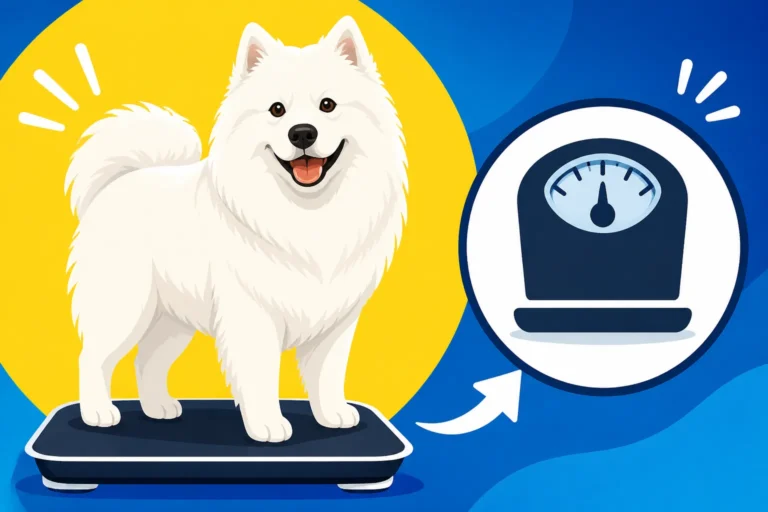
| Does weight establish whether a dog is too tall? | No. Height and weight are separate measurements |
| Should you rely on one puppy measurement? | No. A puppy is still growing, and one measurement does not establish its final adult size |
How to measure and assess your Samoyed fairly
Measure at the withers, not at the top of the fur
The withers are the point at the top of the shoulders, where the neck meets the back. A measurement taken from the floor to the top of the dog’s coat can overstate the dog’s actual height. For a more useful measurement, the dog needs to stand squarely on a level surface, with its legs positioned naturally and its head in a neutral posture.
A show-grade measuring device is designed to make this assessment more consistent. If you are measuring at home, ask someone experienced to demonstrate the correct placement rather than trying to estimate from a photo or household ruler. Small differences in stance, surface, and where the measuring point is placed can change the result.
Do not stretch, compress, or pose your dog to produce a preferred number. The goal is an honest measurement of the dog as it stands, not a workaround. If the result is close to the limit, a qualified handler or breeder can help you understand whether the variation is measurement technique or the dog’s actual height.
Give a puppy time to mature
A puppy’s height changes as it grows, and it may go through awkward stages in which its legs, body, and coat seem out of proportion. Owners can understandably become concerned when a young Samoyed looks unusually tall beside littermates, but that alone cannot settle how it will look as an adult. Whether a Samoyed Fills Out After Two discusses how a dog’s body can continue to mature after its height growth has slowed.
Avoid treating a puppy’s growth as a competition. Do not restrict food, overexercise, or use supplements in an attempt to control its height or shape. Those choices can harm health and do not provide a responsible way to alter a dog’s adult conformation. Keep the puppy on a suitable diet, follow your veterinarian’s advice, and record growth only if it helps you discuss development with a professional.
When comparing puppies, remember that littermates can mature differently. A tall puppy is not automatically unhealthy, and a puppy within the range is not automatically a future show winner. Health, sound development, temperament, and suitability for your household matter far beyond a prediction about adult height.
What to do if your Samoyed is taller than the standard
Talk with a breeder or experienced Samoyed handler
If your dog is near or above the preferred height range, start with a calm, informed conversation. A responsible breeder can explain the parents’ size, the puppy’s growth history, and whether similar traits appear in the pedigree. A conformation handler can help you understand how the dog’s proportions and movement may be viewed in the ring.
This is also a good time to ask what the breeder considers the dog’s best outlets. Some Samoyeds are more suited to companionship, sport, or working activities than to conformation competition. A dog that is leaner, more athletic, or larger-framed may have different strengths, but those qualities should be assessed individually rather than assumed from size alone. Whether a Working Samoyed Is Leaner Than a Show One explores how working and show lines can differ in appearance and build.
The breed as a whole also reflects human choices about size and appearance. If you are researching why some Samoyeds seem larger than those you have seen before, The Push to Breed Bigger Samoyeds provides useful context. The point is not to label every large Samoyed as poorly bred; it is to consider whether size is being prioritized at the expense of balance, soundness, or health.
Choose preparation for comfort, not to disguise size
If you decide to attend a show, focus on teaching your dog to stand comfortably, move calmly on a lead, accept examination, and cope with the busy environment. These skills make the experience more pleasant whether or not the dog earns a ribbon. Do not try to hide height through posture or coat styling; show presentation should not misrepresent the dog.
Coat care is part of preparing a Samoyed, but it does not change the dog’s measured height. For routine grooming supplies, you may shop through a retailer such as Chewy or a local pet-supply store; choose tools appropriate for a dense double coat and ask an experienced groomer to demonstrate safe use. A dog that is relaxed during brushing and handling will generally find preparation less stressful than one rushed into a new routine before an event.
Keep the dog’s welfare ahead of the show schedule. If travel, standing, or a crowded venue is uncomfortable for your Samoyed, take breaks or choose a different activity. For ordinary food and care supplies, Chewy is one shopping option, but your veterinarian and breeder are better sources for advice about diet and healthy growth. And if your dog simply does not enjoy show training, you do not have to keep pursuing it to prove that you love or value the dog.
Disclaimer
This article is for general informational purposes only and does not constitute professional advice. Laws, prices and regulations vary by location and change over time. Consult a qualified professional for guidance on your specific situation.