Whether Queen Alexandra’s Samoyeds Are in Modern Pedigrees
A Samoyed pedigree may seem to connect today’s dogs neatly to the breed’s earliest British admirers, including Queen Alexandra. In practice, a famous royal association is not proof of direct descent. This guide explains what is known about Queen Alexandra’s Samoyeds, how modern pedigrees are documented, and what to check before treating a historical claim as fact.
Queen Alexandra’s place in Samoyed history
She helped bring attention to the breed
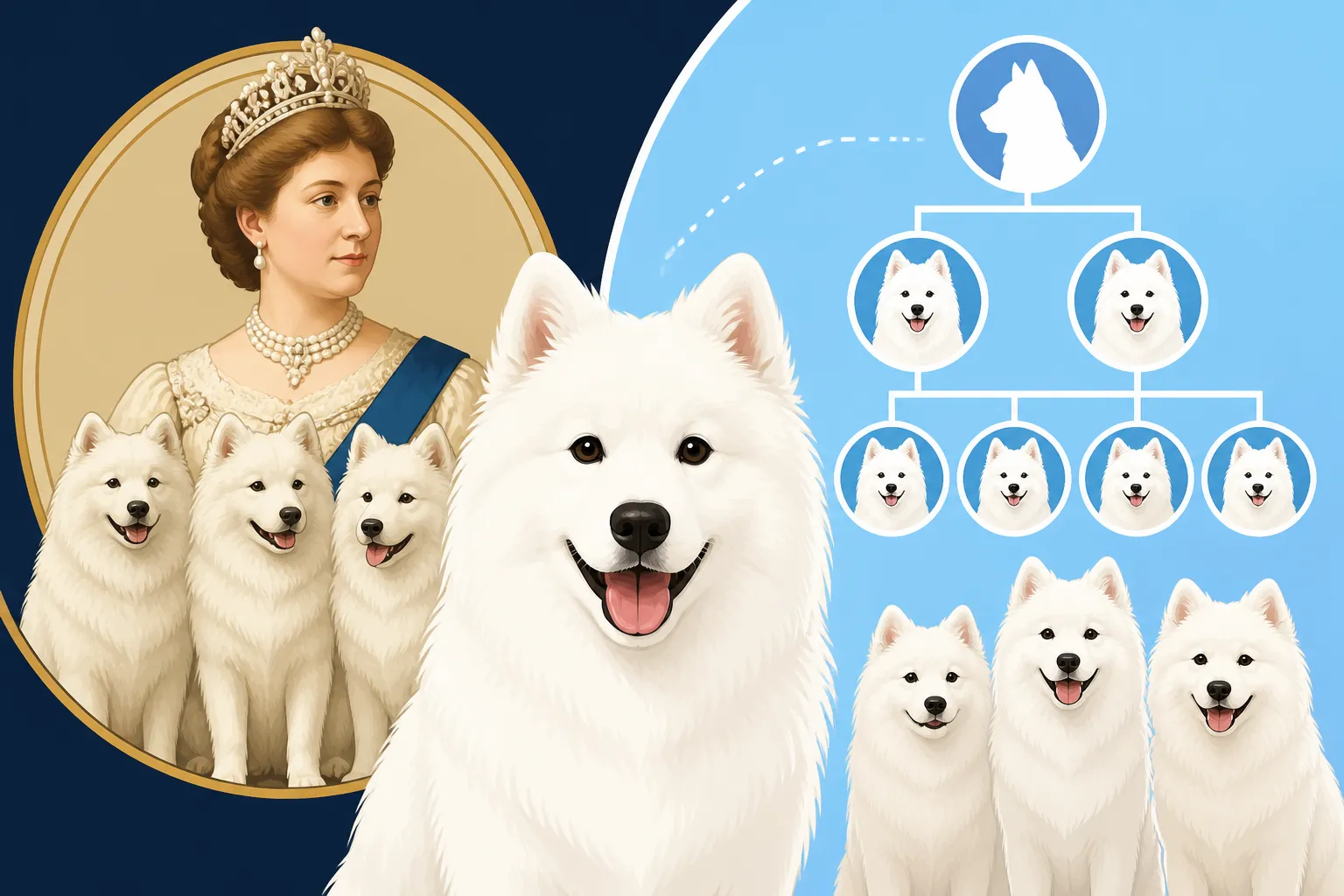
Queen Alexandra, the wife of King Edward VII, is remembered as an early admirer and supporter of Samoyeds in Britain. Her interest helped give the breed visibility at a time when it was still unfamiliar to many people outside the Arctic regions where Samoyed-type dogs had worked alongside people for generations.
That royal connection is meaningful, but it can be easy to overread it. A monarch’s ownership or patronage does not automatically mean that every Samoyed registered later descended from her particular dogs. To make that claim, there needs to be a documented chain of parentage linking a dog in her care to named descendants and then to dogs in a modern pedigree.
The wider story of the breed’s arrival in Britain includes several people, imports, and early kennels. For context on that history, see Who Brought Samoyeds Out of Siberia and The Year the First Samoyed Reached England. Those broader histories help put Alexandra’s role in perspective: she was part of the breed’s early public story, not necessarily the source of every later bloodline.
Royal ownership and registered ancestry are different things
A historical account might say that Queen Alexandra kept Samoyeds, or that she supported the breed. That establishes an association, but it does not by itself establish ancestry. A pedigree claim needs more detail: the dog’s registered name, its parents, the kennel or breeder that recorded it, and the generations that connect it to a dog alive today.
This distinction matters because royal associations are memorable. They are often repeated in breed histories, kennel descriptions, and casual conversations, sometimes without the paperwork needed to show exactly which modern families descend from which royal dogs. A claim can be broadly rooted in real history and still be too vague to support a direct-lineage conclusion.
The question Whether Queen Alexandra Kept Samoyeds is therefore slightly different from whether her dogs appear in modern pedigrees. The first concerns whether she owned or supported the breed; the second asks whether specific descendants can be traced through reliable records.
Do Queen Alexandra’s Samoyeds appear in modern pedigrees?
Some pedigrees may connect to early British dogs, but the link needs proof
It is possible for a modern Samoyed pedigree to include dogs from early British breeding history. If a particular dog owned, bred, or promoted by Queen Alexandra was recorded as a parent or ancestor, and each step after that is documented, then a modern dog could have a traceable connection to that early stock.
But “some modern Samoyeds descend from early British dogs” is not the same statement as “modern Samoyeds descend from Queen Alexandra’s dogs.” The second claim is narrower and requires a verified path through named animals. Without that chain, the most accurate wording is that the breed’s early British development was associated with Alexandra and other influential people.
There is also no single, universally recognized “Queen Alexandra line” that accounts for all contemporary Samoyeds. The breed developed through multiple dogs and breeding programs. British, European, and North American pedigrees can reflect different combinations of early stock, later imports, and subsequent breeding choices.
Historical records have limits
Modern pedigree databases can make ancestry look tidy: one name leads to two parents, then four grandparents, and so on. Older records may be less complete. Names can be spelled differently, dogs may have been known by kennel names or informal names, and records may not survive in one consistent place.
Even a well-maintained pedigree can only show what its underlying records establish. If an early dog’s parentage was unknown or recorded inconsistently, the line may reach a point where the evidence becomes uncertain. A long pedigree is not automatically a fully verified pedigree, especially when it reaches back to the first generations of a breed’s recorded history.
This is one reason historical claims should be assessed with care. The story of how imported dogs and early British breeding shaped the modern Samoyed is broader than the story of any one owner. How the English Standard Shaped the Modern Samoyed offers useful context for understanding how early breed development and later standards influenced the dogs we recognize today.
How to check a Samoyed’s pedigree for a royal connection
Start with the registered pedigree, not the sales description
If a breeder or family history says a Samoyed descends from a dog associated with Queen Alexandra, ask for the exact registered names and the generation-by-generation pedigree. A useful answer should identify the earliest dog claimed as the connection and show how each parent-child link is recorded.
A practical review looks like this:
- Ask for the dog’s full registered name. Call names such as “Fluffy” are not enough to search historical records.
- Request the pedigree with ancestors listed. Look for the names and registration details of the parents, grandparents, and more distant ancestors.
- Identify the claimed royal-era dog. Ask which specific dog is connected to Alexandra, rather than accepting a general phrase such as “royal blood.”
- Check whether each link is documented. A claim is stronger when the generations are traceable through registration records, kennel archives, or credible breed histories.
- Ask what the evidence does not show. Responsible breeders should be comfortable explaining gaps or uncertainty rather than presenting an incomplete chain as settled fact.
If the claim is important to you, compare the breeder’s pedigree with records from relevant kennel clubs or breed-history organizations. Older records may require patience, and some archives may not be searchable online. A breed club historian or experienced pedigree researcher can sometimes help interpret older names and identify where a line becomes uncertain.
Watch for wording that sounds more certain than the evidence
Phrases such as “royal blood,” “descended from the Queen’s dogs,” or “one of the original lines” can mean different things. Ask whether the claim refers to a direct documented ancestor, a broader connection to early British breeding, or simply the breed’s association with a well-known historical figure.
A direct ancestor should be traceable through a sequence of recorded parentage. A broad historical influence may be true without proving descent from a specific dog. And a marketing phrase without named dogs or documentation is not enough to establish either one.
| Pedigree claim | What it can reasonably mean | What to ask for |
|---|---|---|
| “Queen Alexandra kept Samoyeds” | A historical ownership or breed-support association | A credible account identifying the dogs or describing the association |
| “This dog descends from her Samoyeds” | A claimed line of descent from a particular dog | The dog’s name and a documented chain of parentage |
| “This is an early British line” | An ancestry connected to early British breeding | Registered ancestors and records showing where the line begins |
| “Royal blood” | An informal phrase that may not identify any specific ancestor | The exact dog and the evidence supporting the claim |
Historical pedigree research can also reveal how interconnected the breed’s ancestry is. Some lines may share dogs several generations back, while others may reflect different combinations of imported and locally bred stock. For broader context, see How Narrow the Samoyed Gene Pool Is and How Many American Samoyeds Trace to Expedition Dogs. These topics illustrate why a breed’s shared history is not the same as a direct connection to one celebrated owner or one famous dog.
What the royal connection means for today’s Samoyed owner
It is an interesting historical detail, not a health guarantee
A connection to an early breeder or royal owner does not tell you whether a particular dog is healthy, well socialized, or a good fit for your household. Those questions depend on the individual dog, its care, its temperament, and the choices made by the breeder across generations.
When choosing a puppy, prioritize clear health information, responsible breeding practices, and honest answers about the parents and relatives. Ask to see the documentation relevant to the litter, and take time to understand what each record can—and cannot—tell you. A famous name in a pedigree should not replace thoughtful questions about the dogs behind the litter.
Nor does a historical connection necessarily make one Samoyed more authentic than another. The breed’s development involved many dogs and people, and its modern identity reflects generations of selection and shared work. Alexandra’s association is part of that story, but it is only one piece of it.
Treat a well-supported connection as a piece of the breed’s story
If a pedigree does document descent from a dog associated with Queen Alexandra, that can be a fascinating detail. It offers a way to connect a family’s dog with the early history of Samoyeds in Britain. The most satisfying version of that story is one you can follow through names and records, rather than one that depends on an impressive but unexplained phrase.
If the evidence stops short of a direct line, the history is still worthwhile. A Samoyed may be connected to early British breeding generally, or to the wider history of imported dogs and developing breed standards, without being provably descended from Alexandra’s own animals. That distinction does not diminish the dog. It simply keeps the history honest.
For readers exploring the breed’s origins more broadly, Where in Russia the Samoyed Comes From and The Century the Samoyed Appeared provide additional context. Together, these histories help separate the breed’s long cultural and working background from the narrower question of documented pedigrees.
Disclaimer
This article is for general informational purposes only and does not constitute professional advice. Laws, prices and regulations vary by location and change over time. Consult a qualified professional for guidance on your specific situation.