Whether a Samoyed Is Easier to Train Than a Malamute
A Samoyed may learn a cue quickly, then decide that the interesting thing across the park matters more; a Malamute may understand the same cue and calmly weigh whether it is worth responding. Neither breed is automatically easy to train. This guide compares their typical strengths and challenges, then shows how to build a practical training plan around the individual dog in front of you.
How Samoyeds and Malamutes Differ in Training
Both breeds are independent working dogs
Samoyeds and Alaskan Malamutes were bred to work alongside people in demanding conditions, but neither was developed to repeat obedience exercises just because a person asks. That history can show up at home as curiosity, initiative, and a willingness to find their own entertainment. It can also look like stubbornness when a dog has learned a cue but sees no reason to respond.
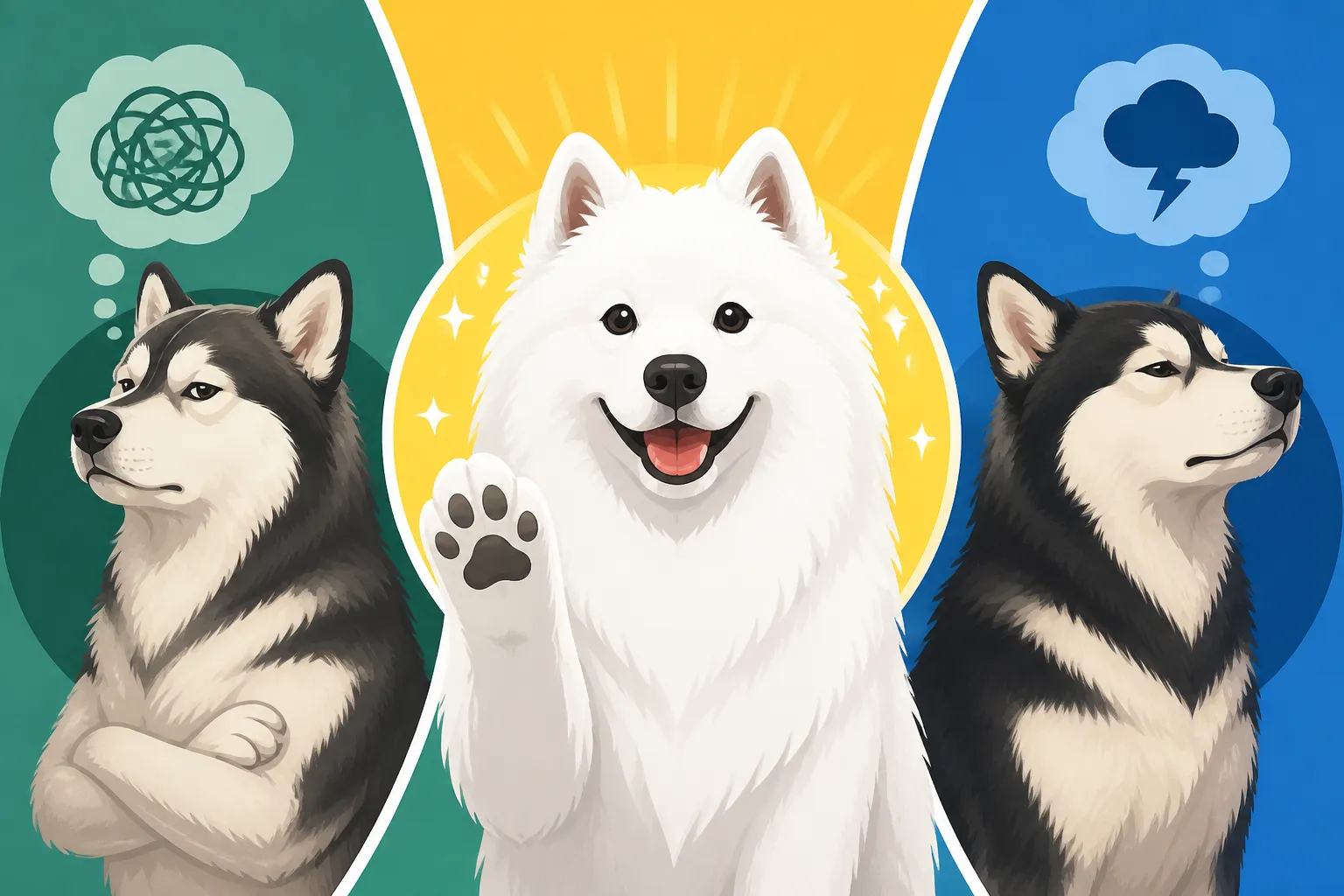
A Samoyed may be socially engaged and quick to join in, yet easily distracted by people, dogs, or a lively environment. A Malamute may be equally bright but more inclined to make decisions independently. These are broad tendencies, not rules. Two dogs of the same breed can differ dramatically depending on temperament, early experiences, motivation, and training history.
The breeds also differ in size and physical strength. A determined Malamute can be particularly challenging to manage on leash if pulling has become a habit. A Samoyed can pull enthusiastically too, especially when excited. In both cases, a strong dog who has learned that pulling gets them where they want to go needs patient, consistent leash training—not a harsher correction.
Is a Samoyed easier to train than a Malamute?
For some everyday behaviors, a Samoyed may feel more responsive because many are highly people-oriented and enjoy interaction. That can make attention, engagement, and reward-based practice easier to establish. But friendliness is not the same as obedience. A Samoyed may happily greet a stranger instead of coming back when called, or turn a training session into a noisy negotiation.
Malamutes are often described as more independent, which can make it harder to get reliable responses when the dog is distracted or unmotivated. But an individual Malamute who is strongly interested in food, play, or a particular activity can make excellent progress with a thoughtful training plan. A Samoyed with little motivation for the rewards on offer may be harder to teach than a keen Malamute.
So, if “easier” means more likely to check in with a person during short, upbeat sessions, a Samoyed may have an advantage in some households. If it means reliable recall, loose-leash walking, or doing a cue around distractions, neither breed should be assumed easy. For a wider comparison of their temperaments and working backgrounds, see The Samoyed Against the Husky and the Malamute.
Why independence is not the same as low intelligence
When a dog does not respond, it is tempting to conclude that the dog is being deliberately difficult. But the cue may not be well learned in that setting, the environment may be too distracting, or the reward may not matter enough. A dog who sits in the kitchen may not yet understand that “sit” applies at a busy park, too.
This is especially important with dogs whose working instincts include making independent choices. Rather than expecting automatic compliance, aim to make the desired behavior clear and worthwhile. If a cue works at home but falls apart near other dogs, go back to a quieter location and practice at a distance where your dog can still focus.
The Samoyed’s independent streak is explored in Whether a Samoyed Is a Primitive Breed. For the familiar experience of giving a cue your dog clearly knows and watching it go unanswered, Why a Samoyed Ignores a Cue It Knows offers a related perspective.
What Training These Breeds Usually Takes
Motivation matters more than breed labels
Before deciding that your dog is unmotivated, try a few reward options. Some dogs will work for kibble in the living room but need something more appealing outdoors. Others prefer a tug game, a chance to sniff, or enthusiastic praise. Keep rewards small and easy to deliver so you can reinforce the behavior without interrupting the session for long.
For instance, if your Samoyed walks nicely beside you for a few steps, you might reward with a treat, then release the dog to sniff a patch of grass. If your Malamute responds to a recall in the yard, reward generously and then allow a return to a safe activity. The reward is not a bribe; it’s a way to teach your dog that responding to you predicts something worthwhile.
It can help to keep a simple record of what works. Note the reward, location, distance from distractions, and behavior you practiced. If your dog suddenly seems uninterested, compare the setting with the last successful session. A quiet room and a crowded trail are not equivalent training environments. For more ideas about finding a dog’s preferred rewards, see What a Samoyed Will Work For.
Short sessions, clear cues, and steady practice
A few focused minutes can be more productive than a long session in which the dog gets bored or distracted. Choose one or two skills, make the steps easy enough for your dog to succeed, and stop while things are still going well. If your dog is struggling, reduce the difficulty rather than repeating the cue louder or more often.
Use the same cue consistently across the household. If one person says “come,” another says “here,” and a third calls the dog’s name repeatedly, the dog may have trouble working out which response is expected. Agree on the words and reward the behavior you want. Then practice in gradually more challenging places: indoors, in the yard, on a quiet street, and eventually near manageable distractions.
If you are assembling basic training supplies, a treat pouch or food-dispensing toy can make rewards easier to deliver. Chewy is one place owners may look for those everyday items, but choose gear that suits your dog’s size and chewing habits. The most useful equipment is the equipment you can use comfortably and consistently.
Positive training and fair boundaries
Reward-based training is a practical way to teach desired behaviors and build cooperation. It does not mean allowing a dog to do anything it wants. Clear boundaries matter: prevent rehearsals of unwanted behaviors where possible, reward appropriate alternatives, and make household rules predictable.
For example, if your dog jumps on visitors, ask for a behavior the dog can perform—such as keeping four paws on the floor—and reward that before greeting begins. If the dog is too excited to respond, create more space and lower the difficulty. Repeatedly letting the dog rush forward and then scolding after the fact is confusing and may not teach the behavior you want instead.
Harsh corrections can create fear or conflict without addressing why the dog is pulling, jumping, or ignoring a cue. A calm, consistent approach is more useful: manage the situation, teach an alternative, and reinforce it. For a closer look at this balance, see Whether Positive Training Alone Works on a Samoyed.
The Skills That Can Be Most Challenging
Recall and off-leash reliability
Recall is a common frustration with both breeds. A dog may come running in the backyard, then ignore the same cue when there is a rabbit, another dog, or an exciting smell nearby. That does not necessarily mean the dog has forgotten the cue. The distraction may simply be more rewarding than returning, especially if recall has been practiced only in easy settings.
Start close to your dog in a quiet, secure area. Say the recall cue once in a cheerful voice, move away if that encourages the dog to follow, and reward generously when the dog reaches you. Gradually increase distance and distractions. If your dog hesitates or fails, make the next repetition easier instead of calling over and over.
For safety, use a secure enclosed space or a long line while practicing. A long line gives the dog room to explore while preserving your ability to prevent a dangerous dash. It is not a substitute for supervision: keep it away from people, other dogs, and obstacles where it could tangle. Many owners find that a well-fitted harness and long line are more manageable than relying on a collar for outdoor practice. Chewy may be one source for comparing available leash and harness options; check fit and construction carefully before using them.
Neither breed should be trusted off leash simply because it responds well at home. Roads, wildlife, and unfamiliar dogs can turn a small training gap into a serious risk. Whether a Samoyed Can Ever Be Off Leash explains why secure management remains important even for a dog with a strong recall.
Leash manners and pulling
Pulling can become self-reinforcing: the dog leans forward, reaches an interesting spot, and learns that pulling works. The solution is not to expect a dog to stay beside you for an entire walk from day one. Begin in a low-distraction place and reward the dog for walking near you with a loose leash. When the leash tightens, pause or change direction calmly, then reward when your dog reconnects with you.
A strong dog may need a well-fitted harness that gives the handler better control without causing discomfort. But equipment alone does not teach loose-leash walking. Practice short stretches, build in sniff breaks, and consider a separate cue that signals when the dog may explore on a longer leash. If every walk becomes a tug-of-war, reduce the difficulty: practice near home before attempting a busy route.
Pulling is connected to the breeds’ working history, though a pet dog’s walk is not the same as a pulling sport. Pulling: What a Samoyed Was Actually Bred to Do explores that distinction and why the instinct can be strong. If your dog enjoys pulling activities, structured training can help channel that energy safely rather than letting the leash become the only outlet.
Distraction, excitement, and apparent stubbornness
A Samoyed who greets everyone enthusiastically may have difficulty settling enough to learn in a crowded setting. A Malamute may become absorbed in a scent or activity and seem to tune out the handler. In either case, distance is a useful training tool. Begin far enough from the distraction that your dog can still eat, respond, and look back at you.
Reward the small moments of attention: a glance in your direction, a pause before moving forward, or choosing to follow you away from a distraction. These are building blocks for more reliable behavior. If your dog cannot take a treat or respond to a familiar cue, the setting may be too difficult right now. Move farther away, wait for a calmer moment, or return to an easier location.
Owners sometimes describe this behavior as stubbornness, but that label does not tell you what to change. A dog may be bored by repetitive drills, overwhelmed by the environment, or unsure what earns a reward. Whether a Samoyed Is Stubborn or Bored helps separate those possibilities.
Choosing a Training Approach for Your Dog
Match the plan to the individual dog
Use your dog’s interests and difficulty areas to shape training rather than following a breed stereotype. A people-focused Samoyed might thrive on quick games with frequent social rewards. A food-motivated Malamute might respond best to small treats delivered at the right moment. Another dog may prefer sniffing, tug, or the chance to move forward as a reward.
Here is a simple comparison to guide your expectations:
| Training area | Samoyed tendency | Malamute tendency | Useful approach for both |
|---|---|---|---|
| Engagement with people | Often sociable and keen to interact | Can be more independent | Reward check-ins and attention |
| Response to repetition | May lose interest in dull drills | May disengage if the task feels pointless | Use short, varied sessions |
| Recall around distractions | Can be tempted by people, dogs, or activity | Can become absorbed in scents or independent exploration | Practice on a long line in safe areas |
| Leash walking | May pull when excited | Strength can make pulling difficult to manage | Teach loose-leash skills gradually |
| Motivation | Varies by dog | Varies by dog | Test food, play, praise, and access to sniffing |
This table describes common training considerations, not guaranteed outcomes. An individual dog’s past experience may matter more than its breed. A Samoyed who has practiced polite greetings since puppyhood may be easier to manage around visitors than a Malamute who has never been taught what to do. The reverse can be true, too.
Keep expectations realistic as your dog matures
Young dogs often have brief attention spans and uneven impulse control. A dog may appear to understand a skill one day and struggle with it the next, especially when the setting changes or excitement rises. Keep practicing the basics as your dog grows, and avoid treating a temporary setback as proof that training has failed.
Maturity does not automatically create obedience. Consistent practice, adequate activity, and opportunities for rest all help a dog succeed. If you are wondering when a Samoyed becomes more settled, The Age a Samoyed Finally Matures explores how development can influence expectations. Also consider your dog’s daily activity needs; a restless, under-stimulated dog may find it harder to focus. How Much Exercise a Samoyed Needs offers related guidance.
If you shop for enrichment toys or treat-dispensing puzzles, Chewy may be a convenient place to compare options, but choose puzzles that match your dog’s ability and supervise their use. A toy should make it easier to engage your dog, not frustrate them or encourage unsafe chewing. Rotate activities, too: an item that is exciting every day can become ordinary, while a fresh sniffing or searching game can make a short training session more appealing.
When to seek help
If your dog’s pulling, fear, reactivity, or difficulty settling feels unmanageable, ask your veterinarian about possible health factors and consider working with a qualified, reward-based trainer. Pain, anxiety, or other changes in comfort can affect behavior, and a professional can help identify whether the challenge is skill-building, management, or something that needs further support.
A trainer can also observe details that are easy to miss at home: whether the leash tightens before the dog surges, which distance triggers barking, or whether a reward is arriving too late. Share your goals clearly, such as walking without pulling, greeting visitors calmly, or practicing recall safely. A good plan should be specific enough to use in daily life and flexible enough to adjust as your dog improves.
The most realistic answer is that a Samoyed may be easier to engage in some situations, while a Malamute may require more patience around independent choices. Neither is a shortcut to effortless obedience. With clear cues, motivating rewards, safe management, and regular practice, both can learn useful household skills—and the right approach is the one that fits your dog, not just its breed.
Disclaimer
This article is for general informational purposes only and does not constitute professional advice. Laws, prices and regulations vary by location and change over time. Consult a qualified professional for guidance on your specific situation.