How Narrow the Samoyed Gene Pool Is
A Samoyed’s familiar look can make the breed seem genetically uniform, but appearance alone can’t tell you how much genetic diversity sits behind a pedigree. If you’re researching Samoyed ancestry, breeding choices, or health risks, the key is to understand what “narrow gene pool” means—and what it does not mean—before treating it as a reason to panic about an individual dog.
What a narrow Samoyed gene pool means
Gene pool, founder effect, and population bottlenecks
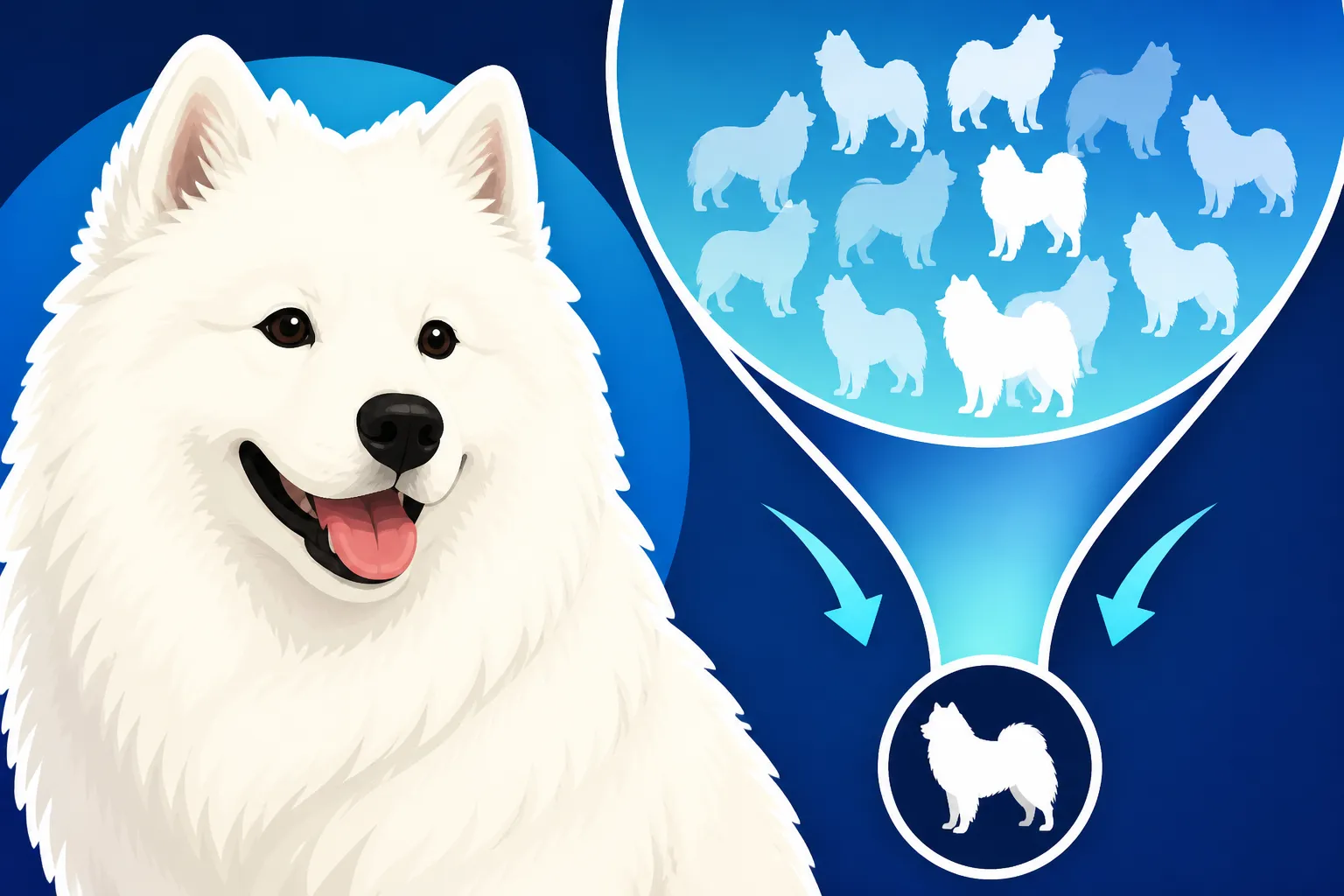
A breed’s gene pool is the collection of genetic variants carried by its breeding population. A gene pool is called narrow when a relatively small range of variants is represented, often because a breed was established from a limited number of ancestors or because only a subset of dogs contributed substantially to later generations.
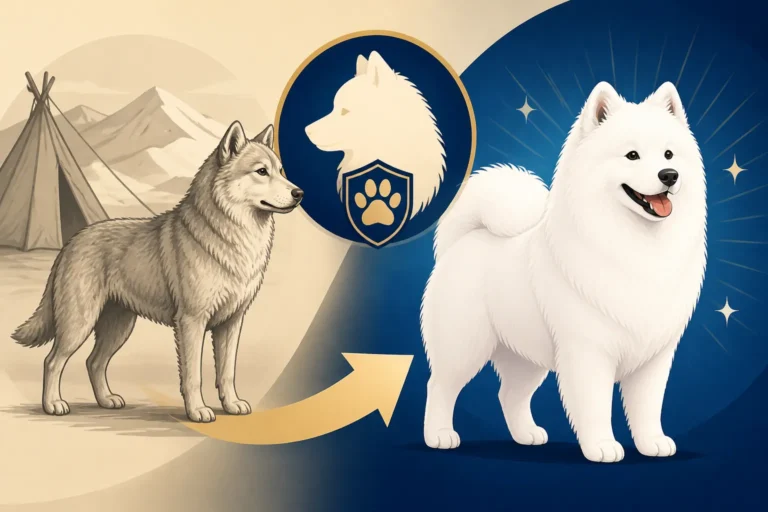
That pattern can arise through a founder effect. Imagine a large population of dogs from which only a small group is used to establish a distinct breed. The new population inherits only some of the genetic variation present in the larger one. If that early group is followed by a population decline, a show or working trend that favors a small number of dogs, or repeated breeding within related lines, the range of variants may narrow further.
A population bottleneck is a sharp reduction in the number of dogs contributing to future generations. Even if the breed later becomes numerous, the expanded population may still descend from a limited set of ancestors. The issue is not simply how many Samoyeds exist today; it is how many contribute genetically, and how closely related those contributors are.
Why breed history matters
The Samoyed developed as a working dog in northern Eurasia, with close ties to the Nenets people and their way of life. Its history is part of why the modern breed has a recognizable type, but historical descriptions alone can’t give a precise genetic measurement. The Nenets of the Yamal Peninsula Bred the Samoyed offers more context on those origins, while How Polar Explorers Took Samoyeds Out of Siberia explores how dogs from a geographically specific population entered wider breeding circles.
As Samoyeds became established outside their original working communities, the dogs used in formal breeding came from a limited historical population compared with the full range of dogs that may have existed across the region. Later preferences for particular appearances or working traits could also make certain families more influential than others. That is a general population-genetics pattern, not evidence that every Samoyed today is closely related to every other one.
Breed history can point to plausible sources of limited diversity, but it should not be treated as a substitute for genetic analysis. To understand the breed’s present-day diversity, researchers need data from the dogs being studied and a clear description of how the sample was selected. A pedigree, a breed origin story, and a DNA study answer different questions.
Narrow diversity is not the same as poor health
A narrower gene pool can make it more likely that some inherited variants become common, especially if dogs carrying the same variant are bred together. But it does not mean every dog has a genetic disorder, nor does it tell you that an individual Samoyed is unhealthy. Many dogs in breeds with limited diversity live healthy lives; risk depends on the particular genes and breeding patterns involved.
It also helps to separate breed-level diversity from an individual dog’s inbreeding. Two Samoyeds can belong to a breed with a restricted historical population yet have different degrees of shared ancestry in their recent pedigrees. Conversely, a dog may come from a breed with greater overall diversity but still have close relatives on both sides of its own pedigree.
That distinction matters when reading alarming claims online. “The gene pool is narrow” is not, by itself, a diagnosis, a prediction of lifespan, or a reason to reject a puppy. It is a population-level concern that makes careful breeding decisions and reliable health testing especially important.
How researchers assess genetic diversity
Pedigrees and inbreeding estimates
A pedigree records known ancestry and can reveal repeated ancestors, popular family lines, and close matings. A coefficient of inbreeding, often abbreviated COI, estimates the probability that two copies of a gene in a dog are identical by descent from a shared ancestor. It is useful, but it is not a complete genetic health score.
A pedigree-based COI depends on the information available and the number of generations included. If records are incomplete, relatedness farther back may be missed. Two calculators may also report different values if they use different pedigree depths or methods. For a meaningful comparison, the breeder should explain what data the calculation includes rather than presenting a number without context.
Most importantly, a COI does not identify every harmful variant, and a low reported figure does not guarantee that a dog is free of inherited disease. It helps describe ancestry patterns; genetic tests and veterinary assessments address other questions. For buyers, The Health Tests Both Samoyed Parents Should Have is a useful companion topic because health screening involves more than a single measure of relatedness.
DNA studies and genomic diversity
Genomic studies can compare genetic markers across many dogs. Depending on the methods used, researchers may estimate how much variation is present, identify population structure, or examine how closely sampled dogs are related. These studies can reveal patterns that pedigrees alone do not capture, particularly when records are incomplete or lines have crossed over time.
However, study results depend on the sample. A small group of dogs from one country, kennel group, or family line may not represent all Samoyeds. Researchers also use different measures of diversity, so one study’s result should not be casually compared with another unless the methods and populations are comparable.
For owners, consumer DNA tests can be helpful for certain purposes, but they should not be mistaken for a full assessment of breed-wide diversity or an all-purpose health clearance. A report may address selected variants, ancestry estimates, or traits; what it covers depends on the test. If a test result could affect breeding decisions or medical care, discuss its meaning with a veterinarian or a qualified veterinary genetics professional.
| Measure | What it can help show | What it cannot establish on its own |
|---|---|---|
| Pedigree | Known shared ancestors and family relationships | Unrecorded ancestry or the presence of every disease variant |
| Pedigree COI | Estimated inbreeding across the generations included | Overall health, genetic fitness, or certainty that a dog is disease-free |
| Genomic data | Patterns of relatedness and variation in the sampled dogs | The status of every Samoyed if the sample is limited |
| Disease-specific DNA test | Whether a dog carries a particular tested variant | Whether the dog has every inherited condition |
| Veterinary examination | Current clinical findings and health needs | Complete genetic risk or future health outcomes |
Why one number rarely tells the whole story
It is tempting to ask, “How narrow is the Samoyed gene pool?” as though there were one universally agreed figure that answers the question. In practice, the result depends on what population was studied, which genetic measures were used, and whether researchers were looking at pedigree relationships, genomic variation, or specific disease-causing variants.
A useful interpretation therefore includes the method and its limits. Ask whether a reported estimate is based on a defined group of dogs, how ancestry was measured, and whether the result applies to a national population, a kennel line, or the breed more broadly. A figure without that context can sound more definitive than it is.
This is one reason breed-wide statements should be handled carefully. A paper about a sample of Samoyeds can offer valuable evidence, but it does not automatically describe every regional population or every current breeding line. How the English Standard Shaped the Modern Samoyed provides historical context for changes in breed development, while a genetic study would be needed to measure the consequences of particular breeding choices.
What a narrow gene pool can mean for Samoyed health
Recessive conditions and carrier status
Some inherited disorders are caused by variants that can be passed quietly through a family. In a recessive condition, a dog may carry one copy of a variant without showing the disease. If two carriers are bred, puppies may inherit two copies. The risk is tied to the particular disorder and inheritance pattern, not simply to the fact that the breed has a limited gene pool.
Samoyed hereditary glomerulopathy is one example for which breeding decisions and genetic testing matter. A dog’s status for a known disease variant should be interpreted using the test’s stated inheritance pattern, and results should be verified with appropriate documentation. The COL4A5 Test Every Samoyed Buyer Should Ask About explains why a disease-specific result can be important, while How a Samoyed Breeder Avoids Producing Affected Males focuses on the breeding implications.
A carrier result does not automatically mean a dog is ill or should never be bred. The responsible decision depends on the disease, the dog’s overall qualities, available mates, and a plan that avoids producing affected puppies. Removing every carrier from a small population without considering the wider consequences can reduce genetic diversity further. That is why a breeder should work from a clear testing and pairing strategy rather than reacting to one result in isolation.
Health testing is not a promise of perfect puppies
A health test addresses the condition it was designed to detect. It does not guarantee that a puppy will never develop another inherited disease, an acquired illness, or a problem that has not yet been identified. Even a carefully selected pairing cannot eliminate every uncertainty in biology.
When discussing a litter, ask what tests were performed on both parents, what the results mean, and whether the breeder can show the records. It is reasonable to ask how the breeder considers family history and whether close relatives have experienced health problems. A clear, specific answer is more useful than broad claims such as “the line is healthy” or “the parents are clear.”
A responsible breeder may also use tools such as pedigrees, health records, and genetic counseling to balance disease prevention with maintaining variation. Whether a Samoyed Breeder Tests Every Generation explores the ongoing nature of testing, and The Push to Breed Healthier Samoyeds looks at the broader effort to improve health without reducing the conversation to appearance alone.
Why removing every risk can backfire
When a breed has limited diversity, excluding every dog with any possible risk can have unintended effects. If many dogs are removed from breeding at once, the remaining population may become more closely related, and a different set of inherited risks may become more common. This does not mean breeders should ignore serious disease. It means decisions need to account for both disease prevention and the genetic health of the wider population.
A careful breeding plan aims to avoid producing affected puppies while keeping a sufficiently broad range of healthy dogs in the breeding population. Depending on the condition, that may involve choosing a genetically suitable mate for a carrier rather than excluding the carrier entirely. The details should be guided by the inheritance pattern and by qualified expertise—not by an online rule applied to every condition.
For prospective owners, the practical takeaway is to look for thoughtful explanations, not perfection claims. A breeder who can discuss both test results and the limits of testing is generally offering more useful information than one who presents a single certificate as proof that no risk exists.
What Samoyed buyers and owners can do
Ask for records and explanations
When you speak with a breeder, ask which health tests were completed for both parents and request the results in a form you can review. Ask what the breeder knows about the health of close relatives, how the pairing was selected, and how any carrier findings were considered. If you are unsure how to interpret a result, ask your veterinarian whether referral to a veterinary genetics professional would help.
Keep copies of test reports, veterinary summaries, vaccination history, and pedigree information together. If routine pet-care purchases are made through a retailer such as Chewy, keep those receipts separate from official health and genetic records; a purchase history is not proof of screening. Chewy may be part of a household’s ordinary supply routine, but it cannot replace the breeder’s test documentation or a veterinarian’s interpretation.
For a puppy buyer, Whether a Samoyed Puppy Should Be Tested Before Purchase and Whether a Breeder Should Show the Samoyed Kidney Results address practical questions about what to request and how to think about documentation. If a breeder does not have a result available, ask whether the test was never done, is pending, or is not relevant to the specific pairing. Those are different explanations.
Keep records useful over time
A simple health file makes it easier to give a veterinarian accurate history and to understand patterns in a dog’s health. Record the date and provider for each test, the exact condition tested, and the result as written on the report. Avoid copying only a summary such as “clear,” because it may not identify which variant or test was involved.
If you use Chewy for food or other routine supplies, a record of purchases can help you remember when a diet or product changed, but it should sit alongside—not replace—medical records. Note significant changes in weight, appetite, thirst, or energy in a dated log, and bring that information to appointments. These observations do not diagnose genetic disease; they help your veterinarian see what has changed.
For breeding decisions, records should be even more precise. Save the parents’ test reports, pedigree details, and any professional guidance about the proposed pairing. If a report is confusing, do not rely on a seller’s paraphrase alone. Ask the testing provider, veterinarian, or genetics professional what the result means for that dog and for potential puppies.
Think beyond the phrase “narrow gene pool”
The phrase is useful only when it leads to better questions. It should prompt curiosity about how genetic diversity is measured, whether a claim applies to the whole breed or a subset, and how health testing is incorporated into breeding—not assumptions that every Samoyed is genetically fragile.
If you already share your home with a Samoyed, there is no reason to treat a breed-level concern as a prediction about your dog’s future. Continue routine veterinary care, share known family history with your veterinarian, and follow up on symptoms as you would for any dog. When adopting or buying, look for transparent records and a breeder or rescue that welcomes reasonable health questions.
Chewy and other general pet retailers can help with everyday care logistics, but they are not a source of a dog’s genetic history. The most useful picture comes from combining dependable records, appropriate testing, informed breeding choices, and veterinary care. That approach respects the real concern behind a narrow gene pool without turning population genetics into a frightening label for an individual dog.
Disclaimer
This article is for general informational purposes only and does not constitute professional advice. Laws, prices and regulations vary by location and change over time. Consult a qualified professional for guidance on your specific situation.