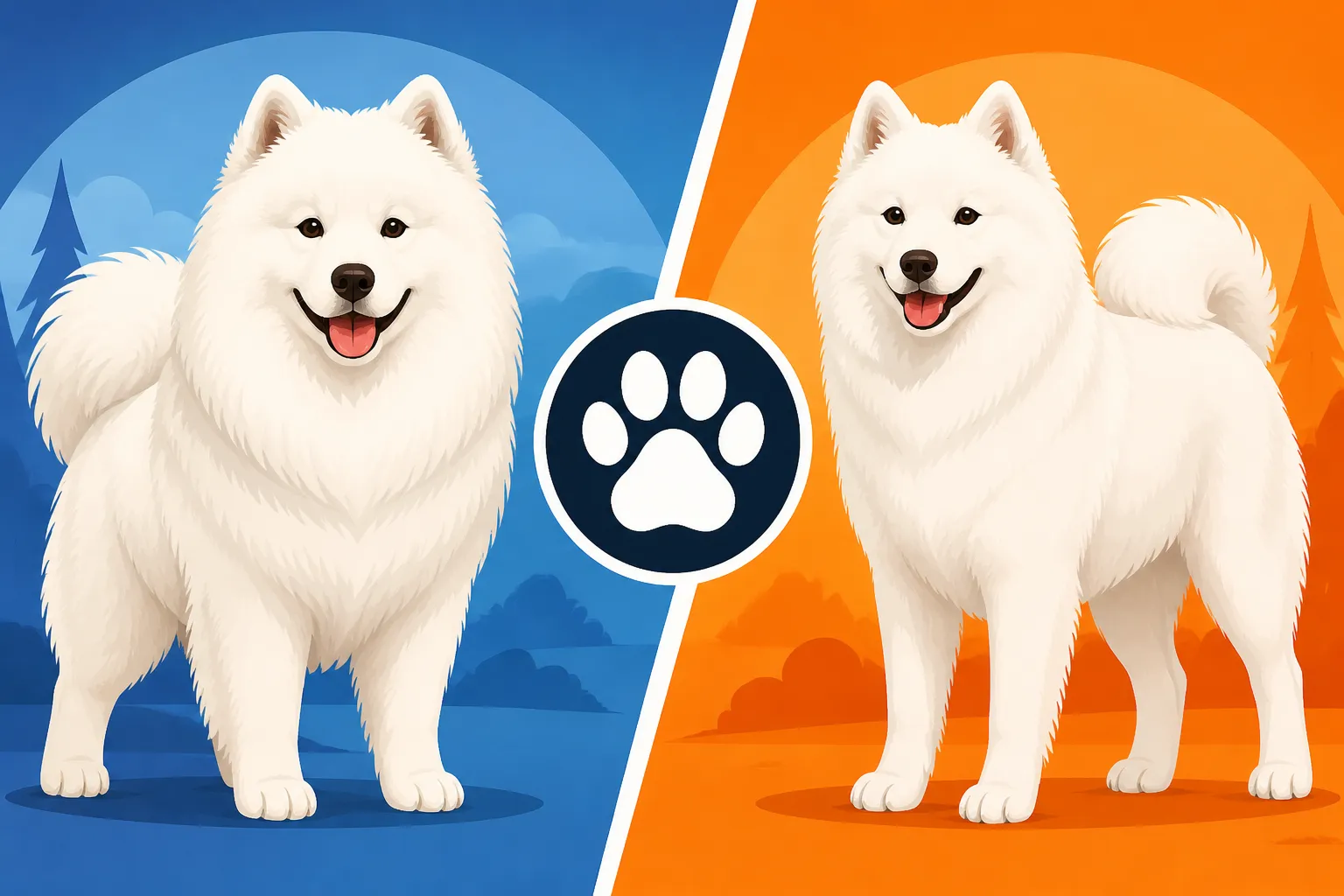
Whether an English Samoyed Differs From an American One
An English Samoyed and an American Samoyed are not separate breeds, but their appearance can seem different because breeders and judges work within different national standards and traditions. If you are comparing puppies, photos, or pedigrees, those differences can be confusing. This guide explains what “English” and “American” usually mean, what may vary, and what matters more than a label.
What English and American Samoyed Usually Mean
They are regional types, not separate breeds
“English Samoyed” usually means a Samoyed bred or shown in the United Kingdom, while “American Samoyed” usually refers to one bred or shown in the United States. The terms describe a dog’s background and the breeding environment around it, not a recognized division into two breeds.
Both are Samoyeds: northern working dogs known for a dense double coat, a curled tail, and a sociable temperament. Their similarities are more important than the shorthand suggests. A dog’s individual build, coat, movement, and personality depend on its parents and broader family line, not simply which side of the Atlantic it comes from.
The distinction can still be useful when discussing pedigrees, show records, or a breeder’s goals. But it is not a dependable way to predict that a particular dog will be bigger, quieter, easier to groom, or more suitable for a certain household. Those traits vary among individual dogs in both countries.
National standards influence show preferences
Breed standards describe the ideal Samoyed for that registry or country. The American Kennel Club, the UK Kennel Club, and international organizations each publish standards, and their wording and emphasis are not identical. The overall picture is still of a strong, balanced, functional dog suited to work in cold conditions.
Small differences in written standards may influence which details judges notice most. A breeder who shows dogs in one country may select for features that align with that country’s interpretation of the ideal. A breeder elsewhere may prioritize slightly different details. These are tendencies in selection, not guarantees that every dog from a region will look alike.
For a closer look at how standards vary, see Whether the Samoyed Standard Differs Between Countries. It helps to remember that a standard is a guide for breeding and judging, not a checklist that makes every puppy from one country uniform.
“English type” and “American type” are informal labels
People sometimes use “English type” or “American type” to describe a general impression of a dog’s outline or presentation. Those labels can be handy in casual conversation, but they are not precise measurements and may mean different things to different breeders.
For example, one person might use “English type” to describe a dog they perceive as more moderate, while another might be referring to a particular family line or show kennel. A third person may use the same label simply because the dog’s ancestors were registered in Britain. Without seeing the pedigree and the dog, the phrase tells you very little.
When a breeder uses one of these labels, ask what they mean specifically. Are they talking about the dog’s country of birth, registration, lineage, show record, or physical characteristics? A clear answer is more useful than a broad label.
How Their Appearance May Compare
Overall shape and proportions
You may hear claims that English Samoyeds are more compact or that American Samoyeds are larger or heavier. Treat these as impressions rather than reliable rules. A dog’s size and outline depend on its sex, genetics, maturity, and the particular breeding line. There can be substantial variation within either country.
A photograph can make that variation look even more dramatic. A thick coat may create the impression of a broader body, and camera angle, posture, grooming, and age can change how a dog appears. A young Samoyed may still be filling out, while an adult in full coat can look more substantial than the same dog during a coat change.
If size matters to your household, ask about the parents and other mature relatives. Request adult measurements if the breeder has them, and ask how the line tends to develop. Even then, a puppy’s eventual size cannot be promised exactly.
Coat, color, and grooming
Both regional types have the Samoyed’s characteristic double coat. The outer guard hairs and dense undercoat require regular care, and either dog can shed heavily during seasonal coat changes. No regional label makes the coat low-maintenance.
Coat shade can range from white to biscuit or cream-toned areas within the breed’s accepted colors. How bright or warm a coat looks in a photo can be affected by lighting, age, dirt, and the amount of undercoat. A slightly biscuit-colored dog is not automatically a different type, and a very white coat does not prove that a dog is American or English.
Grooming needs are best judged by the coat in front of you, not its country of origin. Ask the breeder how often the dogs are brushed, how they handle coat changes, and whether the puppy has been introduced to grooming. When gathering supplies, you might compare a suitable comb or brush at a local pet shop or Chewy, but choose tools for the dog’s coat and your grooming routine rather than a regional label.
For more context about the breed’s development and appearance, read How the English Standard Shaped the Modern Samoyed and The Colors a Samoyed Comes In.
Movement and working background
Samoyeds were developed as working dogs, and the ideal dog should be capable of moving comfortably and efficiently. Show preferences may differ in subtle ways between countries, but sound movement and a functional build matter regardless of where a dog was bred.
A show photograph is not enough to judge movement. If you are evaluating a breeder’s dogs, ask whether you can see them moving at a natural pace, ideally in a video or in person. Look for a dog that moves comfortably and appears balanced rather than judging one snapshot or an exaggerated pose.
If you are interested in pulling sports, hiking, or other activities, ask about the line’s actual experience and health. A dog’s country of origin does not tell you whether it enjoys work or has the fitness and temperament for your plans. The practical question is what the individual dog can safely and happily do.
What Matters More Than the Country Label
Breeder priorities and health information
A responsible breeder should be able to explain the purpose of a breeding and talk plainly about the health and temperament of the dogs involved. Ask about recommended breed health screening, the parents’ health histories, and how the breeder evaluates puppies before placing them. The answers matter more than whether the breeder calls the litter English or American type.
Ask to see relevant records and clarify what each test does and does not establish. A health test is not a promise that a dog will never become ill, but transparent records help you understand the risks being considered. You can explore broader recommendations in The Health Tests Both Samoyed Parents Should Have.
Temperament deserves the same attention. Ask how the parents behave at home and around unfamiliar people, what the puppies have experienced, and how the breeder matches puppies with homes. A confident, friendly Samoyed may be a better fit for your family than a dog whose appearance closely matches a particular regional ideal.
Pedigree and registration
A pedigree can show where a dog’s ancestors were registered and may reveal dogs from different countries in its background. It does not, by itself, prove that a puppy has a certain build or temperament. Nor does an English ancestor automatically make a puppy “English type” in a meaningful, predictable way.
If a breeder describes a dog as English, ask whether that means the puppy was born in England, has British-registered ancestors, or was bred to reflect a particular show tradition. The same questions apply to “American.” Registration paperwork and pedigree details are more precise than marketing language.
If you are comparing imported dogs or international pedigrees, ask how records are recognized by the registry where you live. A breeder should be able to explain the paperwork they provide and help you understand any relevant registration steps. For background on how the breed developed in Britain, see The Year the First Samoyed Reached England.
Questions to ask before choosing a puppy
A useful conversation with a breeder is specific and calm. You do not need to challenge every claim; simply ask for the facts behind it. If someone says their dogs are a particular regional type, ask what visible or pedigree qualities they mean and how those qualities support health and function.
Consider asking:
- Which registries are the parents recorded with, and can I review their pedigrees?
- What health screening has been completed, and can I see the results?
- How do the parents behave in everyday situations?
- What are the mature size and coat-care needs of related adult dogs?
- How are puppies socialized and matched with homes?
- What support is available if questions come up after the puppy comes home?
A breeder who answers thoughtfully is more reassuring than one who relies on a label to sell a puppy. You can also compare the breeder’s explanation with What Samoyed Owners Wish They Had Known and Whether a Samoyed Suits a First Time Owner to think through the realities of living with the breed.
Choosing the Right Samoyed for Your Home
Match the individual dog to your routine
Whether a Samoyed is described as English or American, expect a social, active dog with a substantial coat and a need for regular interaction. Consider how much time you can give to exercise, grooming, training, and companionship. A national type does not remove the everyday responsibilities of owning the breed.
A family that enjoys outdoor activity may be drawn to a lively puppy, while someone seeking a calmer adult companion may prefer to ask a rescue or breeder about a dog whose personality is already more established. Neither route depends on country of origin. The key is getting an honest picture of the individual dog’s needs.
It can also help to talk with owners who have Samoyeds from different lines. Ask what daily life is actually like: how much brushing they do, what the dog is like when left alone, and how it behaves around visitors. Firsthand descriptions can bring the abstract labels down to earth.
Focus on evidence rather than marketing language
A “rare English line” or “classic American type” description may sound appealing, but the phrase alone does not establish quality. Look for clear records, sound breeding decisions, healthy and well-cared-for dogs, and a breeder who is willing to discuss both strengths and limitations.
If you are buying from a breeder in another country, take extra time to understand transport, registration, health documentation, and ongoing support. Confirm what paperwork will be provided and who you can contact after the puppy arrives. These details are more consequential than whether the dog fits someone’s informal idea of English or American appearance.
Care needs will be broadly similar either way. If you need to stock up on grooming basics, a pet retailer such as Chewy may be one option, alongside local shops and breed-club recommendations. For food, follow the breeder’s transition guidance and your veterinarian’s advice rather than switching based on a regional stereotype. Chewy can also be a convenient place to compare routine supplies, but the right choice depends on the individual dog and your household.
The most accurate answer is simple: English and American Samoyeds are the same breed, with differences shaped by standards, breeding lines, and individual variation. Use the label as a prompt to ask better questions, not as a shortcut for judging the dog. Chewy or another retailer can help with ordinary supplies, but thoughtful breeder research and a good match are what set you up for a successful relationship.
Disclaimer
This article is for general informational purposes only and does not constitute professional advice. Laws, prices and regulations vary by location and change over time. Consult a qualified professional for guidance on your specific situation.