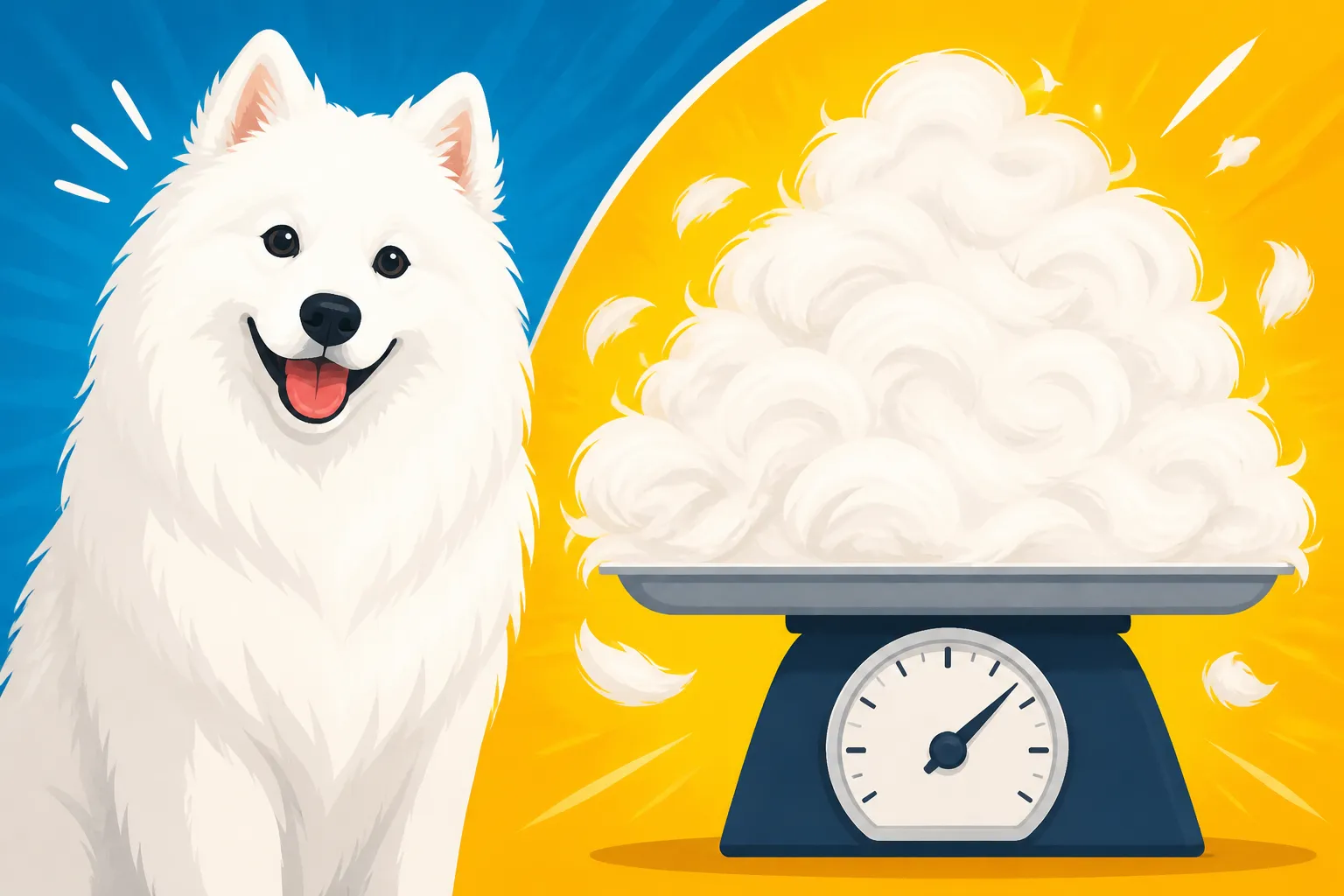
The Grooming Bill on Twenty Pounds of Samoyed Undercoat
Owning a cloud-like Samoyed brings endless joy, but it also confronts you with an overwhelming reality: a mountain of snow-white fluff blowing through your living room every single season. Many new owners are shocked by the sheer physical volume of undercoat and the staggering price tag attached to keeping it maintained. This comprehensive guide breaks down the true financial and practical reality of managing twenty pounds of Samoyed undercoat, from professional salon pricing to DIY home equipment and budget-saving coat care strategies.
The Anatomy of the Samoyed Double Coat and Why It Costs So Much
Guard Hairs versus Undercoat Architecture
To understand why a professional groomer lets out a soft sigh when a adult Samoyed walks into their lobby, you first have to understand what is happening beneath that striking white coat. The Samoyed possesses a classic Arctic double coat engineered for extreme conditions. The outer layer consists of long, coarse guard hairs that are harsh to the touch and act as a water-repellent, dirt-resistant shield. Beneath those guard hairs sits a dense, woolly inner layer known as the undercoat. This inner layer is extremely soft, tight, and extraordinarily thick, designed by nature to trap body heat against the skin when arctic winds howl.
The structural relationship between these two layers creates a unique challenge during routine maintenance. Because the guard hairs sit closely on top of the undercoat, shed fur does not simply fall to the living room carpet like it would from a short-haired breed. Instead, dead undercoat hairs fall out of the follicle and immediately tangle themselves inside the surrounding dense wool. If you do not actively extract that loose fluff using specialized tools, it remains suspended beneath the outer coat, compacting with every step the dog takes, every roll in the grass, and every drop of moisture absorbed from the air.
This architectural density is precisely why standard pet salon visits fail to handle a Arctic breed properly. A superficial brushed-over coat looks pristine on the surface while hiding a thick mattress of trapped dead hair directly against the skin. When groomers calculate the time required to work through a double coat, they are not pricing out a simple wash and brush; they are charging for the physically demanding labor of parting dense wool square-inch by square-inch across a fifty-pound animal to reach the base of the skin.
The Physics of Coat Blowing and Seasonal Shedding
Twice a year, or roughly every six months, a intact Samoyed undergoes an event affectionately known among owners as blowing coat. Spayed females and neutered males may shed somewhat differently, but almost every adult dog experiences massive seasonal hair releases. During a coat blow, the hair follicles in the undercoat layer release almost simultaneously over the course of three to six weeks. What was once a firmly rooted thermal insulator transforms overnight into twenty pounds of loose, floating, highly static wool looking for an escape route.
The sheer volume produced during a seasonal blow defies normal expectations. As the coat detaches from the dermis, it expands significantly beyond its compacted space on the dog’s body. You can brush out a bag full of white fluff, look back at your dog, and realize they look virtually unchanged. The physics of this process mean that friction, ambient humidity, and natural body movement force loose undercoat upward toward the tips of the guard hairs, creating a temporary lion’s mane appearance followed by heavy tufting around the pants, neck ruff, and behind the shoulders.
Managing a coat blow requires repeated interventions rather than a single session. If an owner attempts to handle a coat blow with a basic slicker brush from a local supermarket, the tool will barely penetrate past the guard hair layer, skimming uselessly over the surface while dead undercoat accumulates underneath. Left unattended for even two weeks during a peak blow, the dense undercoat compresses into tight felting, locking the guard hairs into place and transforming what should be a routine deshedding into a labor-intensive dematting nightmare.
How Mats Form and Why Groomers Charge Dematting Fees
Matting in a double-coated breed is not merely a cosmetics issue; it is a mechanical process that accelerates rapidly once initiated. When loose undercoat sits trapped beneath guard hairs, ambient moisture from rain, humidity, or baths causes the barbed micro-structures of individual wool fibers to interlock. Add the physical friction of a collar, harness, or the dog resting on its side, and those interlocked fibers twist into tight, solid sheets of felted fur. Once felting occurs, air can no longer circulate to the dog’s skin, trapping moisture, dander, and bacterial particles against the dermis.
Professional salons operate on tight schedules, typically allocating a specific block of time per dog based on size and coat condition. When a double coat arrives with dense matting behind the ears, under the armpits, or along the thighs, the groomer must painstakingly tease apart those felted masses without tearing the delicate skin beneath. This process requires specialized dematting sprays, specialized splitters, patience, and physical strength. Because dematting places immense stress on the groomer’s hands, wrists, and equipment while extending the appointment by hours, salons apply steep dematting fees on top of standard package rates.
Many owners feel frustrated when presented with a bill that includes an extra dematting charge, but from a professional perspective, the charge reflects non-standard manual labor. If a coat is severely felted across large portions of the torso, dematting becomes humane-impractical, leaving the groomer with no option but to carefully clip the hair beneath the mats. Preventing these financial surprises requires a clear understanding of what salon services involve and how home care mitigates the need for emergency dematting interventions.
Professional Grooming Costs and What You Are Actually Paying For
The Breakdown of a Standard Salon Visit
When you drop your white fluffball off at a high-end salon or mobile unit, you are paying for far more than a bath and a quick towel dry. A proper appointment begins with a thorough pre-bath coat assessment, checking for hidden mats, tick bites, or skin lesions. Next comes a long pre-brushing session designed to remove as much loose, dry undercoat as possible. Bathing a double-coated dog before removing loose hair is a critical mistake; wet undercoat shrinks and tightens, locking loose fibers into solid knots that are nearly impossible to remove later.
Once the initial dry hair is removed, the bathing process itself requires a huge volume of specialized product and water pressure. A double coat naturally repels water, meaning a standard showerhead stream simply bounces off the top guard hairs. Salons utilize high-pressure bathing systems or mixing valves that force diluted shampoo deep past the outer shield into the woolly root system. The dog must be lathered completely, often requiring multiple rounds of clarifying and whitening formulas, followed by a heavy application of deep conditioner to restore moisture to the skin and hair shafts.
Understanding What Grooming a Samoyed Costs Each Visit helps owners plan their monthly budget realistically. Because a standard appointment consumes anywhere from two to four hours of continuous hand care, base rates reflect the dedicated time of a trained professional. When factor in energy usage for industrial drying equipment, specialized coat products, and physical handling, the cost per visit aligns with high-skill trade services rather than routine pet care. Determining How Often a Samoyed Needs a Professional Groom depends heavily on how much brushing you accomplish at home, but most owners find a four to six-week salon cadence necessary to keep the coat manageable.
Deshedding Treatments and High-Velocity Blowouts
The single most critical step in professional care—and the primary justification for high salon bills—is the high-velocity blowout session. High-velocity dryers do not rely on high heat to dry the hair; instead, they use powerful motors to blast air through narrow nozzles at incredible speeds. When directed properly against the grain of the hair, the air stream shears water off the coat while physically blasting trapped undercoat right out of the hair follicles.
HIGH-VELOCITY BLOWOUT MECHANICS
Air Stream at High Speed –> Pierces Dense Guard Hair Outer Layer
Moisture & Fluff Ejection –> Blasts Dead Undercoat Out at Roots
v
| v | |
| Vibrational Pressure –> Separates Interlocked Wool Fibers | |
During a seasonal shed, a high-velocity blowout converts the drying room into a localized snowstorm. Dead hair flies out in massive sheets, covering walls, floors, and the groomer from head to toe. This step requires personal protective equipment, including respirators, goggles, and hearing protection, as the noise levels and flying dander are intense. Learning What a Coat Blow Costs at a Samoyed Groomer often reveals that deshedding upgrades are worth every penny, as doing this at home without commercial setup leaves your bathroom coated in a fine layer of white wool for weeks.
The physics of the blowout also serve a crucial diagnostic function. The air stream parts the coat down to the pink skin beneath, allowing the groomer to spot hot spots, tick bites, or early signs of skin infections hidden under the dense guard hair. This level of thoroughness cannot be replicated with a hand-held hair dryer, which lacks the air force needed to penetrate deep layers and often generates excessive heat that can damage sensitive skin.
Mobile Groomers versus Traditional Salons
Deciding between a traditional storefront salon and a mobile grooming van involves evaluating convenience, dog stress levels, and cost structures. Storefront salons generally offer lower base pricing because they operate with multiple bathing stations and can handle several dogs concurrently. However, a traditional salon environment can be loud, chaotic, and stressful for a sensitive dog. Your pet may spend hours in a holding crate between washing, drying, and hand-finishing while surrounded by barking dogs and busy staff.
Mobile groomers bring a fully equipped salon on wheels directly to your driveway. Powered by onboard generators and warm water tanks, mobile units eliminate crate time and provide one-on-one attention from start to finish. For a large, double-coated breed that requires hours of blowing and brushing, this calm, low-stress environment is ideal. However, mobile operators must cover vehicle maintenance, fuel, specialized generators, and reduced daily capacity, which translates to significantly higher service fees per appointment.
When deciding which route fits your lifestyle, evaluate whether your dog experiences anxiety in busy environments and whether your budget can accommodate mobile surcharges. When asking Whether a Groomer Charges Extra for a Samoyed, the answer across both business models is almost universally yes. The size, coat density, long drying times, and cleanup requirements mean that double-coated Arctic breeds sit in the highest tier of grooming pricing structures.
The True Cost of DIY Home Grooming Supplies
Essential Equipment: From Force Dryers to Rakes
For owners determined to manage their Samoyed’s coat at home, investing in professional-grade equipment is non-negotiable. Trying to brush out a heavy double coat with human hairbrushes, cheap slickers, or standard hair dryers will lead to frustration, sore wrist joints, and a matted dog. The absolute centerpiece of any home setup is a commercial dual-motor high-velocity force dryer. Investing in a proper unit allows you to perform thorough blowouts in your garage or yard, saving hundreds of dollars in salon trips over the dog’s lifetime.
Equally important are the manual hand tools required for line-brushing and undercoat removal. Your toolkit should include:
- A sturdy undercoat rake with long, rotating metal pins to slip past guard hairs without cutting them.
- A large, firm-backed slicker brush with long wire pins that can reach deep into the coat density.
- A heavy-duty metal greyhound comb featuring both coarse and fine pin spacing to check your work down to the skin.
- A pair of curved safety shears for trimming long foot fluff between toe pads.
ESSENTIAL DIY GROOMING TOOLKIT
| Tool Type | Primary Function | Target Area |
|---|---|---|
| Force Dryer | Blasts water & loose wool | Entire Body |
| Undercoat Rake | Extracts trapped undercoat | Thighs, Neck, Sides |
| Long-Pin Slicker | Teases apart light tangles | Outer Coat, Ruff |
| Greyhound Comb | Checks work down to skin | Behind Ears, Pants |
| Curved Shears | Tidy toe pads & feet | Paws & Pads |
Calculating What a Force Dryer Costs a Samoyed Owner against repeated professional appointments demonstrates how quickly quality home equipment pays for itself. Similarly, evaluating What an Undercoat Rake Costs a Samoyed Owner shows that a small upfront purchase prevents costly dematting fees at the salon later. Choosing tools made with stainless steel pins and ergonomic rubber handles protects your hands from strain during two-hour grooming sessions.
Bathing Products, Conditioners, and Whitening Solutions
Maintaining that radiant white appearance requires specialized shampoos designed specifically for double coats. Standard grocery store dog shampoos lack the concentration to break through dirt trapped in thick wool and often contain harsh detergents that strip natural skin oils, leaving the skin dry and prone to itching. High-quality double-coat formulas use gentle, high-dilution surfactants that penetrate thick fur easily and rinse clean without leaving soap residue deep in the undercoat.
Whitening shampoos are another crucial component of coat care, particularly for dogs that love running through mud or sliding across wet grass. Quality optical whitening formulas do not rely on bleaching agents; instead, they use purple or blue enzymatic dyes that neutralize yellow undertones caused by urine, mud, or tear staining. Following a whitening wash with a heavy-duty, leave-in or rinse-out conditioner is vital to restore elasticity to the guard hairs and prevent static buildup during future brushing sessions.
Ordering large, concentrated gallon jugs of shampoo and conditioner from online retailers like Chewy provides significant cost savings over small retail bottles. Diluting concentrated products with warm water in mixing bottles before application ensures the soap spreads evenly through the dense wool rather than clumping in one spot. Factoring high-volume product consumption into your initial budget helps maintain a consistent bathing routine without unexpected expenses.
Maintaining the Home Grooming Station and Vacuum Upgrades
Creating a dedicated grooming space at home transforms an exhausting chore into an organized, efficient routine. Brushing or drying a fifty-pound dog on the living room floor leads to severe back pain and endless slipping. Investing in a heavy-duty hydraulic or folding grooming table with an adjustable arm and safety loop keeps the dog elevated at a comfortable height, securing them safely while you work on complex areas like the underbelly and hind legs.
The secondary hidden cost of DIY care is managing the sheer volume of fur that escapes into your home environment. Standard household vacuums quickly clog when faced with long guard hairs and fine, woolly undercoat, leading to overheated motors and snapped drive belts. Owners must invest in high-performance vacuums equipped with tangle-free brush rolls, HEPA filtration systems, and large dust capacity bins to handle daily cleanup without breaking down.
HOME GROOMING STATION SETUP LAYOUT
Heavy-Duty Vacuum / HEPA <—> Grooming Table with Arm & Loop
High-Velocity Dryer Unit <—> Wall-Mounted Tool Storage Rack
v
Upgrading to rubber brooms, sticky pet hair rollers, and dedicated HVAC filters becomes a routine reality of life with a white arctic breed. Replacing furnace filters monthly during coat-blowing season protects your home’s air quality and prevents shed wool from working its way into household ventilation systems. When you calculate these home infrastructure adjustments alongside initial equipment purchases, the true investment required for home maintenance comes into clear focus.
Lifetime Grooming Budget and Cost Comparison
Comparing Professional Salon Care to Complete DIY Setup
Choosing between a purely professional grooming routine and a home setup comes down to balancing time investment against direct out-of-pocket expenses over a dog’s twelve-to-fourteen-year lifespan. A dog maintained entirely through professional salons requires six to ten full-service visits per year, plus additional deshedding treatments during spring and autumn coat blows. Over a decade or more, this approach represents a major, recurring financial commitment that must be factored into the overall cost of ownership.
Conversely, establishing a full DIY setup requires a higher upfront financial investment during your puppy’s first year. Purchasing a commercial dryer, heavy table, professional shears, stainless steel combs, and high-volume shampoos requires upfront capital. However, once those baseline tools are acquired, ongoing costs drop dramatically, consisting primarily of replacement shampoos, conditioners, and minor tool upgrades over the course of many years.
Understanding What a Full Groom on a Samoyed Costs across various regions allows prospective owners to build realistic financial models before bringing a puppy home. While home grooming saves thousands over a lifetime, it requires hours of physical effort every single week. Many owners settle on a hybrid approach: handling routine weekly brushing and monthly baths at home while booking professional blowouts during heavy bi-annual coat blows to save time and energy.
Comparative Lifetime Expenses Overview
The following table outlines projected expenses over a ten-year period, comparing a complete professional salon strategy against an exclusive home DIY approach. Figures reflect estimated cumulative cost categories over a decade of ownership.
| Cost Category | Complete Salon Care Plan | Exclusive Home DIY Setup |
|---|---|---|
| Initial Equipment & Setups | $0 (Salon provides) | $600 – $1,200 (Dryer, table, tools) |
| Routine Bath & Brush Fees | $8,000 – $14,000 (80+ salon visits) | $0 |
| Seasonal Deshed Upgrades | $1,500 – $3,000 (Bi-annual blows) | $0 |
| Shampoo, Conditioner & Supplies | $0 (Included in fees) | $1,200 – $2,500 (Bulk products) |
| Vacuum & Home Maintenance | $500 – $1,000 (Standard wear) | $1,000 – $2,000 (Heavy-duty replacements) |
| Estimated 10-Year Total | $10,000 – $18,000 | $2,800 – $5,700 |
Hidden Expenses, Coat Damage Repair, and Emergency Cleanups
Beyond predictable maintenance schedules, unexpected coat incidents can quickly impact your wallet. A classic scenario involves a loose dog discovering a muddy creek, swampy retention pond, or field filled with burrs and sticky seeds. Removing hundreds of cockleburs tightly matted into twenty pounds of wet undercoat can easily turn into a four-hour emergency salon visit or a multi-day home recovery project using specialized detangling oils and pin combs.
Another hidden cost stems from managing skin complications that arise under a dense coat. Hot spots—acute moist dermatitis—can develop in a matter of hours if wet undercoat fails to dry completely after a swim or bath. Trapped moisture allows normal skin bacteria to overgrow, creating painful, raw lesions beneath the fur that require immediate veterinary intervention, topical medications, and localized clipping to heal.
Managing these unexpected medical and grooming intersections highlights the value of comprehensive health protection. Maintaining a solid pet health policy through providers like Healthy Paws offers financial peace of mind when coat-related skin infections, severe hot spots, or allergic dermatitis require veterinary care and prescription treatments. Factoring emergency cleanup kits and medical safeguards into your long-term plan ensures you are never caught unprepared by surprise expenses.
Daily and Weekly Coat Maintenance Routines to Save Money
The Line-Brushing Method and Preventing Mat Catastrophes
The single most effective way to eliminate costly dematting fees at the salon is mastering the line-brushing technique at home. Line-brushing is a deliberate, systematic method of combing through a double coat to ensure no mats hide near the skin. Instead of brushing over the surface of the guard hairs, you work with one hand pushing the fur upward against the grain to create a visible “line” of exposed skin across the dog’s body.
THE LINE-BRUSHING TECHNIQUE
Step 1: Push coat upward with non-dominant hand to expose a line of skin
Step 2: Take slicker brush in dominant hand and gently stroke downward
Step 3: Move non-dominant hand up slightly to expose the next coat line
Step 4: Pass metal greyhound comb through section down to the dermal layer
With your free hand holding the coat back, use your slicker brush or undercoat rake to gently stroke small sections of hair downward, moving from the skin out toward the tips. Once a small section is smooth, move your hand up half an inch to expose a new line of skin and repeat the process. Work systematically from the paws up the legs, across the belly, over the torso, and around the dense neck ruff until every square inch of the dog has been brushed directly from the dermal layer outward.
After brushing a section, always follow up with a metal greyhound comb. Hold the comb gently between your fingers and glide it through the brushed fur close to the skin. If the comb catches on a small tangle, stop immediately and use your slicker brush or fingers to tease the knot apart. Never force a comb through a mat; pulling causes severe discomfort, damages guard hairs, and makes the dog dislike future grooming sessions. Spending twenty minutes line-brushing two or three times a week completely prevents felting and keeps salon visits simple and inexpensive.
Managing Mud, Tears, and Mouth Staining Between Baths
One of the great miracles of the breed is learning Why a Samoyed’s Coat Stays Clean on Its Own. The smooth, Teflon-like structure of healthy guard hairs actively repels dry dirt and mud once it dries out. When your dog returns from a soggy walk covered in dark wet mud, resist the urge to immediately toss them into a bathtub. Running water over muddy undercoat before brushing out loose dirt simply drives the mud deeper into the woolly layer, turning a minor mess into a major bath project.
Instead, wipe down wet paws with a damp microfiber cloth, place the dog on a clean towel in a secure area, and allow the mud to dry completely. As the mud dries into fine dust, the natural movement of guard hairs causes much of it to crumble and drop off on its own. A quick five-minute blowout with your force dryer or a light session with a pin brush will blast away remaining dirt particles, leaving the coat sparkling white once again without using any shampoo.
THE DRY MUD RECOVERY PROCESS
Wet, Muddy Dog –> Towel wipe paws; isolate in dry area
Clean White Coat –> Pristine finish achieved without water/bath
v
| v | |
| Allow to Air Dry –> Mud dries into fine, brittle dust particles | |
| v | |
| Force Dryer Blowout–> Blasts dry dust away from guard hairs & skin | |
Managing facial stains around the eyes and mouth requires a different, daily approach. Tear staining and reddish oxidation around the lips are caused by porphyrins—iron-containing molecules secreted in tears and saliva that turn reddish-brown when exposed to air and light. Wiping eye corners daily with dedicated warm water pads or gentle saline wipes prevents tear tracks from hardening into crusty build-ups. Keeping beard fur dry after drinking by using specialized water bowls or gently patting the mouth dry prevents localized bacterial growth and unsightly yellow staining.
Dietary Impact on Coat Quality and Shedding Control
What goes into your dog’s food bowl has a direct, visible impact on the thickness, shine, and manageability of their outer shield and undercoat. A diet lacking essential fatty acids leads to dry, brittle guard hairs that break easily, alongside flaky skin that generates excess dander and chronic itching. When the skin barrier is compromised, shedding becomes irregular, and dead hair becomes much harder to extract cleanly during routine grooming.
Enriching your dog’s meals with high-quality omega-3 and omega-6 fatty acids—sourced from wild-caught salmon oil, marine phytoplankton, or flaxseed—nourishes hair follicles from within. These healthy fats strengthen the hair shaft, impart a deep sheen to guard hairs, and maintain skin moisture levels, reducing localized irritation and hot spot susceptibility. Furthermore, switching from low-grade commercial kibble to nutrient-dense fresh food formulations like Ollie provides biological-grade protein and bioavailable zinc essential for building strong, resilient hair proteins.
Proper hydration is equally critical for coat health. A chronically dehydrated dog develops brittle hair fibers that tangle rapidly into felted sheets. Always ensure multiple clean water sources are available, and consider adding bone broth or water toppers to meals to encourage adequate fluid intake during hot weather and winter heating seasons. Combining excellent internal nutrition with systematic external care reduces excessive shedding, shortens grooming sessions, and saves money on restorative coat treatments.
Why Shaving Is Never an Option and How to Avoid Disasters
Thermal Dysregulation and Coat Shaving Trauma
When summer heat waves arrive, well-meaning owners often look at their heavily coated white dog and assume the kindest action is shaving them down to short fuzz. This thought process is based on human physiology and represents a fundamental misunderstanding of double-coat thermodynamics. Shaving a double-coated Arctic breed does not cool them down; it actively destroys their natural temperature-regulating mechanism and exposes them to dangerous summer heat risks.
NATURAL DOUBLE COAT FUNCTION
Sunlight / External Heat –> Bounces off reflective guard hairs
Thermal Trauma & Sunburn –> Severe overheating & sunburn risk
v
| v | |
| Trapped Cool Air Layer –> Insulates dermis against direct heat | |
| v | |
| Healthy Dermis –> Cool, protected, protected from UV | |
| SHAVED COAT DISASTER | |
| Sunlight / External Heat –> Hits exposed skin directly | |
| v | |
| Loss of Insulation Layer –> Heat transfers instantly into body | |
The double coat functions like double-paned window insulation. In winter, trapped air holds body heat in; in summer, those same trapped air pockets prevent external environmental heat from reaching the skin. The bright white guard hairs reflect solar radiation away from the body, while cool air circulates near the skin underneath. Removing this protective layer exposes the dog’s skin directly to solar heat, causing body temperatures to spike much faster than they would with an intact, well-brushed coat.
Understanding Why Shaving a Samoyed Makes the Heat Worse is vital for every prospective and current owner. Stripping away thermal protection forces the dog’s cooling system—primarily panting—to work twice as hard to maintain safe core temperatures. Instead of helping your dog handle summer heat, a shave clip leaves them vulnerable to rapid thermal distress, heat exhaustion, and sunstroke during simple outdoor trips.
Alopecia, Follicular Damage, and Irreversible Texture Changes
Beyond disrupting thermal regulation, shaving a double coat can cause permanent damage to hair follicles, a condition known as post-clipping alopecia. Unlike single-coated breeds whose hair grows continuously, double coats operate on distinct, long growth cycles. When hair follicles are clipped down to skin level during an active resting phase, the follicle may become dormant, refusing to produce new guard hairs for months or even years.
When hair eventually begins to regrow after a shave, the fine woolly undercoat typically grows back much faster than the coarse outer guard hairs. Without guard hairs to guide undercoat fibers upward, the new hair emerges as a dense, patchy, patchy fuzz that tangles almost instantly upon contact with air and moisture. The original glossy, dirt-repellent outer layer is replaced by a soft, porous, dull texture that absorbs mud, traps moisture, and mats constantly.
In many cases, the original coat texture never fully recovers. The regrown hair may remain permanently patchy, coarse, and discolored, requiring endless dematting and high-maintenance care far beyond what the natural coat ever demanded. Protecting your dog from clip damage requires vigilance, clear communication, and an unyielding commitment to preserving their natural double coat.
Communicating Boundaries Clearly With Your Groomer
One of the most heart-wrenching scenarios a double-coat owner can face is picking up their pet from a salon only to discover a well-intentioned groomer has used clippers to strip the body down to fuzz. This usually happens when a groomer misinterprets minor matting behind the thighs as an indicator that the whole coat should be shaved, or when an inexperienced assistant mistakes an Arctic breed for a single-coated poodle cross.
To prevent this nightmare, establish firm, explicit boundaries before handing your leash to any salon professional:
- State clearly during intake that your dog is a purebred double-coated breed and must never be clipped with electric razors anywhere on the body, except for sanitary belly trims and pad clears.
- Write “DO NOT SHAVE OR CLIP BODY COAT” clearly on the client intake paperwork and verify that the instruction is entered into their permanent computer profile.
- Instruct the salon to call you immediately if they encounter unexpected matting that they believe cannot be brushed out, giving you the opportunity to inspect the coat yourself before any scissors touch the hair.
- Ask specific questions about the tools they use, ensuring they use high-velocity dryers, undercoat rakes, and pin brushes rather than stripping blades or fur-cutting dematting rakes that shear guard hairs.
Building a long-term relationship with a salon that specializes in Nordic, Arctic, or show-herding breeds guarantees your dog receives knowledgeable, safe handling. A professional who respects double-coat architecture will work with you to maintain length, blow out undercoat, and preserve the magnificent natural coat your dog was born to wear.
Strategic Planning for Long-Term Ownership Expenses
Budgeting Coat Maintenance Alongside Health and Nutrition
Managing coat expenses requires integrating grooming costs directly into your broader annual pet ownership budget. Rather than treating salon trips or replacement tools as surprising spot expenses, successful owners establish a dedicated pet care fund that covers nutrition, preventive medical care, and coat maintenance simultaneously. When you view grooming as an essential health requirement—on par with high-quality food and routine veterinary checkups—you avoid the trap of neglecting coat care until costly dematting interventions become unavoidable.
BALANCED ANNUAL PET BUDGET ALLOCATION
Nutrition & Supplements <—> Routine Vet & Preventive Care
^
Insurance & Emergency <—> Coat Care & Grooming Fund
v
Balancing these categories protects your finances across every stage of your dog’s life. Neglecting coat maintenance often leads directly to secondary veterinary expenses, such as treating severe skin infections, hot spots, or ear canal inflammation caused by trapped moisture and mats. Conversely, investing in proper equipment, high-grade shampoos, and routine line-brushing keeps skin healthy and eliminates avoidable medical expenses down the road.
Furthermore, combining routine grooming sessions with physical health checks creates an effective early warning system for developing wellness issues. As you line-brush your dog’s torso every week, your hands pass over every inch of skin, making it easy to catch minor skin bumps, tick attachments, weight fluctuations, or sensitive joint spots early. Early detection of health issues almost always leads to better treatment outcomes and lower veterinary intervention costs over time.
Utilizing Pet Subscriptions and Home Delivery for Supplies
Maintaining a full home grooming setup demands a steady supply of consumable products, including high-dilution shampoos, deep conditioners, ear cleaners, paw balms, and vacuum replacement filters. Running to local retail stores every time a bottle runs dry often results in paying full retail markup and buying small, inefficient product sizes that drain your budget quickly.
Setting up automated recurring home deliveries through online platforms like Chewy allows you to purchase concentrated gallon jugs of professional grooming products at significant discount rates. Automated subscription schedules ensure you never run out of critical conditioners or deshedding washes midway through a heavy coat blow, while unlocking bulk pricing options that slash long-term product costs by twenty to thirty percent annually.
AUTOMATED SUPPLY DELIVERY WORKFLOW
Set Auto-Ship Schedule –> Bulk Gallons of Shampoo & Conditioners
Seamless Home Delivery –> Supplies arrive before coat blow begins
v
| v | |
| Locked-In Savings –> 20-30% Discount off Retail Markup | |
Extending this subscription strategy to home air filters, vacuum bags, and joint support supplements creates an effortless supply ecosystem that keeps your home running smoothly. By automating consumable purchases, you lock in low pricing, reduce shipping fees, and keep your home station fully stocked and ready to handle any muddy adventure or sudden seasonal coat release.
Preparing for Senior Coat Changes and Special Needs
As your dog moves into their golden years, aging brings distinct changes to coat texture, skin elasticity, and physical mobility that alter your grooming routine. Senior dogs often experience hormonal shifts that make undercoat drier, finer, and more prone to rapid matting around hips and elbows. At the same time, developing arthritis or joint stiffness makes standing on a hard salon table for two hours physically painful or impossible.
Adapting to senior coat changes requires shifting toward shorter, more frequent home grooming sessions tailored to your dog’s physical comfort. Replacing long salon blowouts with gentle fifteen-minute line-brushing sessions while your senior rests comfortably on an orthopedic foam bed prevents joint strain while keeping mats from forming. Using waterless shampoo foams and leave-in conditioning sprays allows you to spot-clean dirty areas without putting an aging pet through the physical exertion of climbing into a slippery bathtub.
For owners interested in sustainable home crafts, harvesting shed undercoat during these quiet senior years offers a unique creative outlet. Investigating Spinning Samoyed Fur Into Yarn reveals how clean, brushed undercoat can be spun into luxurious, ultra-warm wool known historically as chiengora. Transforming brushed fluff into treasured keepsakes—such as custom scarves, mittens, or woven blankets—provides a meaningful, lasting tribute to the dog that brought so much joy, beauty, and white wool into your life.
Disclaimer
This article is for general informational purposes only and does not constitute professional advice. Laws, prices and regulations vary by location and change over time. Consult a qualified professional for guidance on your specific situation.