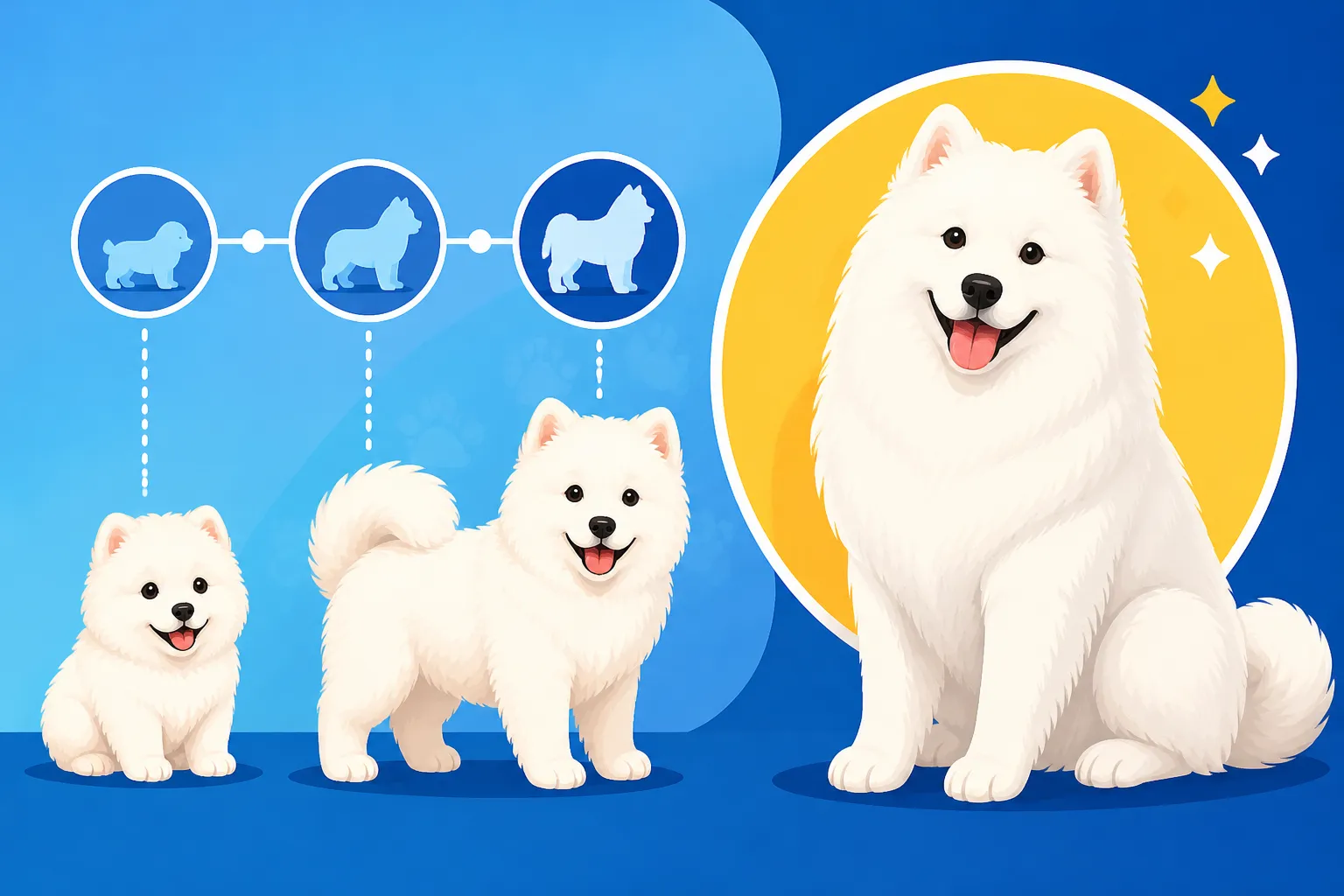
The Age a Samoyed Stops Growing
A Samoyed may look nearly adult before their first birthday, yet still be filling out for months afterward. That gap can make it hard to know whether your puppy is growing normally, needs a food change, or is simply developing at their own pace. This guide explains when Samoyeds usually reach adult height and weight, what affects their growth, and when to ask your veterinarian for help.
When a Samoyed Usually Stops Growing
Height often settles before the rest of the body
Many Samoyeds approach their adult height sometime around their first birthday, although individual dogs may grow for a little longer. That does not mean they are finished developing. A young dog can look tall and leggy while still having a narrow chest, light musculature, and an overall puppyish outline.
The breed’s adult height range is a useful reference, not a deadline. Genetics, sex, and the size of a dog’s parents all influence how large a Samoyed becomes. If you want a more specific comparison, How Much a Male Samoyed Weighs and How Much a Female Samoyed Weighs explain why healthy adult size varies between males and females.
It is also easy to misjudge a Samoyed’s build under all that coat. A fluffy ruff can make a puppy look broad, while long legs and a narrow frame can make them seem unusually tall. Try to assess growth through your veterinarian’s measurements and body-condition checks rather than by appearance alone.
Weight and muscle can continue changing into adulthood
After a Samoyed’s height has mostly stabilized, their body may continue to broaden and gain muscle. Many dogs keep filling out through the second year, and some mature more gradually. This later change is usually not the same as rapid puppy growth: it may show up as a deeper chest, stronger shoulders, or a more balanced adult outline.
A puppy who is still lean at a year old is not automatically underweight, just as a big-looking puppy is not automatically overweight. Healthy growth is about proportion and steady development, not reaching a particular number as quickly as possible. For more on that distinction, see Whether a Samoyed Fills Out After Two.
A practical expectation is that height tends to settle first, followed by slower changes in weight and body composition. There is no single age when every Samoyed is suddenly “done.” Your dog’s growth record, frame, appetite, and body condition give a more useful picture than a birthday-based rule.
What Affects a Samoyed’s Growth
Genetics, sex, and individual variation
A puppy’s parents provide clues about their likely adult size, but they do not make a precise prediction possible. Littermates can grow at different rates and end up with noticeably different builds. Sex can also affect adult size, though there is overlap between males and females.
Breeding lines matter as well. Some Samoyeds are more lightly built, while others have heavier bone or a broader frame. A puppy’s current size does not tell the whole story: a smaller puppy can have a normal growth pattern, and a larger puppy can still be developing appropriately.
If you are choosing a puppy, ask the breeder about the parents’ adult size and health, and ask to see relevant health information rather than relying on promises about a puppy’s future dimensions. The Health Tests Both Samoyed Parents Should Have offers useful context for those conversations. For an adult dog’s general size expectations, What a Samoyed Actually Weighs is another helpful reference.
Food and body condition matter more than “growing bigger”
It can be tempting to feed a puppy extra because they seem lanky or because you hope they will grow into a large, impressive adult. More food does not make a dog reach their genetically determined size in a healthier way. Overfeeding can instead encourage excess weight, which puts avoidable strain on growing joints.
Choose a complete puppy food appropriate for your dog’s life stage and follow the feeding guidance as a starting point. Then adjust with your veterinarian based on your Samoyed’s body condition, activity, and growth pattern. If you use a retailer such as Chewy to keep your puppy’s usual food on hand, check the exact product and life-stage label before reordering; formulas and packaging can vary.
A Samoyed’s coat makes visual checks tricky. Feel gently along the ribs rather than judging by the fluffy outline, and ask your vet to show you what a healthy body condition feels like. A regular weight log can reveal a steady pattern—or a sudden change—more clearly than memory can. For additional feeding context, see Whether a Samoyed Puppy Should Grow Slowly and Whether a Samoyed Needs Fewer Calories Than Expected.
| What you notice | What it may mean | A useful next step |
|---|---|---|
| Height changes slow down near the first birthday | Your puppy may be approaching adult height | Keep routine growth and body-condition checks |
| Chest and muscles continue developing after height stabilizes | Normal maturation may still be underway | Track weight and condition rather than expecting a fixed adult outline |
| Ribs are difficult to feel beneath the coat | Coat can hide excess body condition | Ask your vet to assess weight and show you how to check at home |
| Growth seems to stop early or weight drops | Illness, appetite changes, or other factors may be involved | Contact your veterinarian, especially if behavior or appetite also changes |
| A puppy seems to grow much faster than littermates | Individual variation is possible, but condition matters | Review the growth pattern with your vet instead of restricting food yourself |
How to Track Growth Without Guessing
Use a simple record, not a one-time weigh-in
A single weight does not tell you whether a Samoyed is growing normally. Weighing your puppy at regular intervals and recording the date gives you a trend to discuss with your veterinarian. Your clinic can also note height or body condition during appointments, giving you a more complete record than the scale alone.
At home, use the same scale when possible and weigh under similar conditions. If your puppy is too large to hold comfortably, ask your veterinary clinic whether they can weigh them during routine visits. Keep notes on appetite, activity, stool, and any food changes too; these details may help explain an unexpected change on the scale.
A basic log might include the date, weight, food amount, and a brief note such as “more active this month” or “recent food transition.” If you order food through Chewy or another retailer, keeping the bag label or product name in your notes can help you remember which formula your puppy was eating when the measurement was taken.
Look for patterns and discuss concerns early
Growth is rarely a perfectly straight line. A puppy may gain more during one period and less during another, and a brief plateau is not automatically a problem if the dog remains bright, active, and well. What matters is the broader pattern and whether your dog’s condition and behavior remain healthy.
Contact your veterinarian if your puppy loses weight, has a persistent poor appetite, seems unusually tired, develops ongoing digestive trouble, or appears painful or reluctant to move. Those signs are not simply part of “being a slow grower.” They deserve a proper assessment rather than a home adjustment to food or exercise.
Bring your growth notes to the appointment. Instead of saying only “he seems small,” you can share that his weight has changed in a particular way over several weeks, explain what he eats, and describe any changes you have noticed. That makes the conversation more useful and helps your vet decide whether observation, an examination, or testing is appropriate.
Supporting Healthy Growth Through the Puppy Years
Keep exercise age-appropriate
Samoyeds are energetic working dogs, but a growing puppy does not need to be pushed into strenuous activity to become fit. Let your puppy build strength through age-appropriate walks, play, and exploration, with breaks when they get tired. Avoid turning every outing into a long-distance challenge simply because your young dog seems eager to keep going.
Be especially thoughtful about repetitive high-impact activity while your puppy is developing. If you are interested in pulling sports, wait until your veterinarian says your Samoyed is ready and learn how to introduce the activity safely. Whether a Samoyed Puppy Should Pull a Sled covers why enthusiasm alone is not a good guide to readiness.
A growing dog can be lively and still need rest. Short, positive experiences are often more appropriate than forcing a puppy to keep up with an adult dog’s exercise routine. On warm days, take extra care: Samoyeds have dense coats, and heat can limit safe activity even when the puppy is eager to play.
Transition to adult care gradually
The move from puppy food to adult food should not be based on a rigid birthday or the moment your Samoyed reaches a certain size. Ask your veterinarian when a transition makes sense for your dog’s growth and body condition. When the time comes, a gradual change over several days can help reduce digestive upset, though your vet may recommend a different approach if your dog has specific needs.
Keep the feeding routine consistent while you monitor your puppy. If a preferred food is out of stock, check with your vet before making a sudden change, especially if your puppy has a sensitive stomach or a medical condition. Chewy can be one place owners look for familiar food and supplies, but the important part is confirming that the replacement is suitable, not just similar in name or packaging.
Finally, remember that “fully grown” can mean different things: a dog may have reached adult height but still be gaining muscle, or may look mature while continuing to settle into their adult body. There is no need to rush that process. A healthy Samoyed grows at an individual pace, and steady monitoring with your veterinarian is more useful than comparing your puppy with every dog at the park.
Disclaimer
This article is for general informational purposes only and does not constitute professional advice. Laws, prices and regulations vary by location and change over time. Consult a qualified professional for guidance on your specific situation.