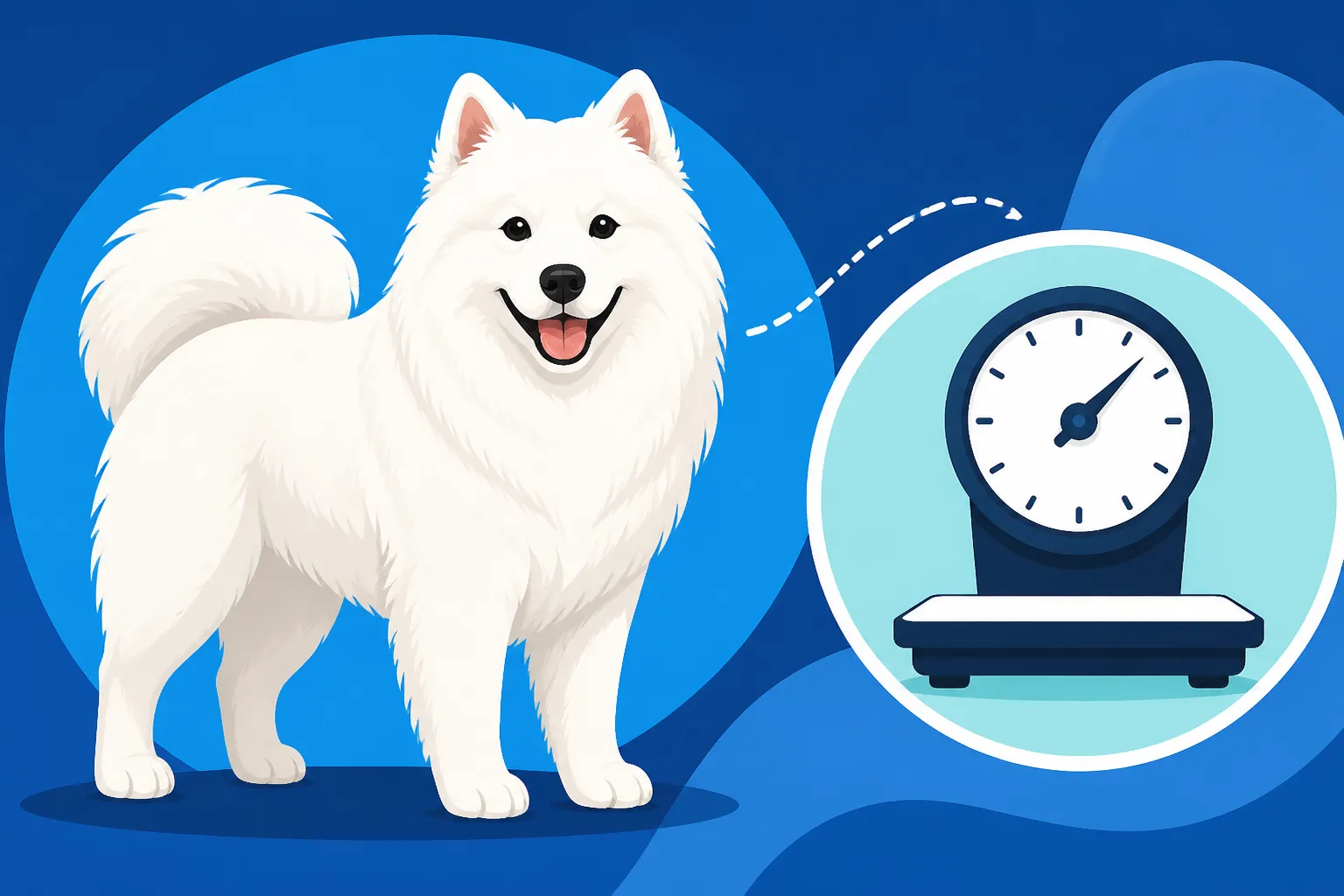
How Much a Male Samoyed Weighs
A male Samoyed can look heavier or lighter than he really is because his thick coat hides his shape, and the scale alone cannot tell you whether his weight is healthy. This guide explains the usual adult weight range, how to check body condition at home, what can affect a male Samoyed’s weight, and when a change deserves a call to your veterinarian.
Typical adult weight for a male Samoyed
The usual range is a guide, not a target
A healthy adult male Samoyed commonly weighs about 45 to 65 pounds. That span is broad on purpose: dogs vary in height, bone structure, muscle, and overall build. A tall, substantial male may be healthy near the upper end, while a smaller-framed Samoyed may be in excellent condition closer to the lower end.
Weight should be considered alongside height and body condition. The breed’s typical male height is another useful reference point, but it does not tell you exactly what one individual should weigh. For a closer look at that measurement, see How Tall a Samoyed Stands. The broader breed context is covered in What a Samoyed Actually Weighs.
The number on the scale is most useful as a trend. If your dog has stayed around the same weight while maintaining a visible waist and easy-to-feel ribs, that can be more reassuring than comparing him with a neighbor’s larger Samoyed. Two dogs of the same breed and sex can have different healthy weights.
Why two healthy males may look very different
A Samoyed’s coat can make his outline hard to read. A fluffy male may appear round even when his body condition is appropriate; another dog with a shorter or thinner coat can look leaner without actually weighing less. The coat changes what you see, not the underlying frame.
Build matters, too. Bone size and muscle mass can affect the scale without indicating excess fat. A fit, active male may weigh more than a less muscular dog of similar height. Working and show-line dogs can also have different builds, though a line or label alone does not determine an individual dog’s ideal weight. Whether a Working Samoyed Is Leaner Than a Show One explores that comparison.
That is why it is better to ask, “Does this weight suit this dog’s body?” rather than “Does he match a single number?” Your veterinarian can help establish a sensible target based on his frame, age, health, and body condition.
How to tell if your male Samoyed is at a healthy weight
Use your hands as well as your eyes
With a dense coat, feeling your dog’s body is often more useful than looking at it. Run your hands gently along his rib cage. You should be able to feel the ribs without pressing hard, but they should not be sharply prominent. If you have to push through a thick layer to find them, excess body fat may be present. If the ribs, spine, or hip bones feel unusually obvious, he may be too thin or have lost weight.
Look at his shape from above and from the side. From above, a healthy dog generally has a slight narrowing behind the ribs before the hips. From the side, the abdomen should rise somewhat toward the hind legs rather than continuing in a straight line beneath the body. These are useful clues, not a home diagnosis. For coat-specific guidance, see Feeling for Ribs Under a Samoyed's Coat.
Try checking in the same place each month, when your dog is calm and standing naturally. A quick note about how his ribs feel, how his waist looks, and what the scale says gives you a much clearer picture than a memory of last season’s shape.
Keep a simple weight record
Weighing your Samoyed regularly can help you catch a gradual change that is easy to miss under the coat. If he will stand calmly on a household scale, weigh yourself alone, then weigh yourself while holding him and subtract the first reading. For a larger dog or an unreliable reading, ask your veterinary clinic whether he can be weighed during a routine visit.
Write down the date, weight, and any relevant changes, such as a new food, altered activity, or recovery from illness. A short record is enough; there is no need to weigh him every day. Monthly checks are often practical for a healthy adult, while a veterinarian may suggest a different schedule if your dog has a medical concern or is working toward a weight goal.
A food diary can make the record more useful. Note meals, treats, chews, and table scraps, since small extras can add up without anyone noticing. If you are comparing foods on Chewy, check the calorie information on the specific package and use that information when discussing portions with your veterinarian. Food formulas and serving guidance can differ, so do not assume that one scoop means the same amount of calories across products.
What can change a male Samoyed’s weight
Age, activity, and daily food portions
Puppies gain weight as they grow, but growth does not follow one exact schedule for every Samoyed. A puppy’s weight makes more sense when considered with his age, height, body condition, and growth pattern over time. Avoid trying to make a young dog reach an adult weight quickly; your veterinarian can help you assess whether he is growing steadily.
Adult weight can shift when a dog’s routine changes. A Samoyed who gets fewer walks during a busy winter, for example, may use less energy while continuing to eat the same amount. On the other hand, a dog doing regular pulling, hiking, or other sustained activity may have different needs. Portions should reflect the dog in front of you, not only the suggested serving on a bag.
Measure meals consistently rather than relying on a casual scoop. A kitchen scale can help when portion accuracy matters, especially if you are adjusting food. If you buy his food through Chewy, keep the package information available so you can compare the food’s calorie content when discussing a change with your veterinarian. For more on portioning, see Whether a Samoyed Should Be Fed by Weight Rather Than Scoop and How Much a Samoyed Should Eat.
Neutering and other health changes
Some dogs need fewer calories after neutering, while others maintain their weight without a noticeable change. The practical approach is to monitor body condition and weight after the procedure rather than automatically making a large food reduction. Ask your veterinarian whether your dog’s portions or feeding routine should be adjusted.
Health problems can also affect weight. Gradual gain may follow reduced activity or overfeeding, but unexplained weight loss should not be dismissed as a harmless change in appetite or season. If your dog is losing weight despite eating normally, seems unusually tired, drinks or urinates more than usual, vomits, or has a sustained change in appetite, contact your veterinarian. A change in weight can be one clue among several, and a physical examination may be needed to understand what is happening.
Weight management can matter for mobility and general health, but it should not be used to diagnose or prevent a particular disease on its own. For example, the relationship between weight and diabetes is more nuanced than a simple cause-and-effect rule; Whether an Overweight Samoyed Is More Likely to Get Diabetes discusses that question in more detail.
Helping your Samoyed reach or maintain a healthy weight
Make small, trackable adjustments
If your veterinarian agrees that your male Samoyed should lose weight, avoid crash diets or sudden, drastic food cuts. Start by measuring everything he eats, including training treats and chews, then review the total with your vet. A practical first step might be replacing some high-calorie extras with smaller training rewards or setting aside part of his daily food for rewards.
Keep exercise steady and appropriate for his age and health. A regular walk, play, or a suitable activity can support fitness, but exercise should not be used to compensate for an unsuitable feeding plan. If your dog has joint pain, a heart condition, or another health issue, ask the veterinarian what forms of activity are appropriate before increasing his workload.
Recheck weight and body condition at planned intervals and share the record with the veterinary team. If the weight is not moving as expected, the answer may be to refine portions, check how treats are being counted, or look for a medical contributor—not simply to keep cutting food. For practical weight-loss considerations, see Getting Weight Off a Samoyed.
When to call your veterinarian
Arrange a veterinary check if your Samoyed’s weight changes noticeably without an obvious explanation, if he becomes difficult to keep at a healthy condition, or if you are unsure whether he is too lean or too heavy. A clinic can weigh him accurately and assess his body condition without being misled by the coat. The vet can also review his diet, activity, age, and medical history together.
Seek prompt advice for weight loss accompanied by other concerning changes, such as persistent vomiting, marked weakness, a poor appetite, or a sudden increase in thirst or urination. A swollen-looking abdomen is not a reliable way to judge body fat, either; if the belly seems newly enlarged or is paired with discomfort or distress, contact a veterinary professional rather than trying to manage it as a weight issue.
The most helpful goal is not to make every male Samoyed fit the same number. It is to know your dog’s normal, track changes, and use his body condition and veterinary guidance alongside the scale. That approach is more reliable than judging a fluffy silhouette or comparing him with another dog.
Disclaimer
This article is for general informational purposes only and does not constitute professional advice. Laws, prices and regulations vary by location and change over time. Consult a qualified professional for guidance on your specific situation.