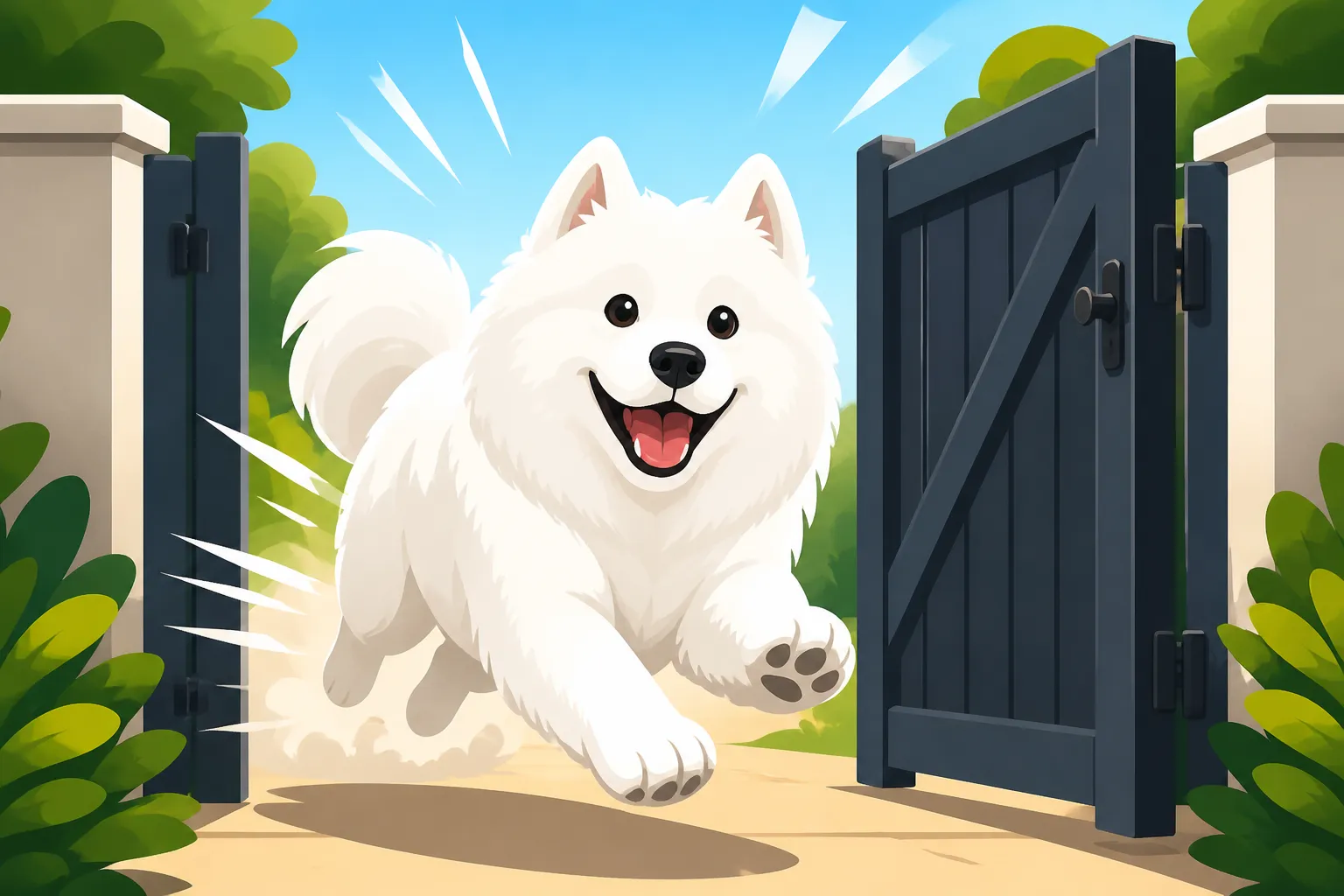
What a Samoyed Does the Moment a Gate Opens
Oh, the infamous "gate opening" scenario! If you've ever owned a Samoyed, you know the heart-stopping moment: that brief second of distraction, the gate clicks open, and suddenly, your fluffy white cloud of joy has vanished into the horizon. It's not just a minor inconvenience; it's a genuine fear for many Samoyed guardians, filled with anxiety about traffic, strange dogs, or simply losing sight of their beloved companion. This guide is here to unravel the mystery behind your Samoyed's sudden dash for freedom and offer realistic, empathetic strategies to prevent these escapes and keep your furry friend safe.
Understanding the Samoyed's Instinct to Roam
When that gate swings open, and your Samoyed takes off like a rocket, it's not usually a sign of defiance or a lack of love for you. It's often a deeply ingrained instinct, a whisper from their ancient past that calls them to explore, chase, and simply move. To truly address this behavior, we need to first understand the powerful forces driving it.
The Call of the Wild: Ancestral Roots
Samoyeds come from a lineage of working dogs, bred for centuries by the Nenets people of Siberia. These aren't your average couch potatoes; they were companions, hunters, herders of reindeer, and powerful sled dogs. Their very existence depended on their ability to travel vast distances, navigate diverse terrains, and make independent decisions. When you open a gate, you're not just opening a barrier in your yard; you're opening a doorway to what their ancestors perceived as their natural workspace. The urge to cover ground, to see what's beyond the immediate confines, is a hardwired trait. They were never meant to be confined to small spaces; their world was boundless tundra. This historical context helps us appreciate that their desire to roam isn't naughty, it's simply Samoyed.
Prey Drive: More Than Just a Squirrel
While exploring is one thing, the sudden burst of speed often comes from another primal urge: prey drive. Samoyeds, like many Nordic breeds, have a highly developed prey drive. That fluttering leaf, the squirrel darting across the street, a bird taking flight, or even a distant cat can instantly trigger an intense chase response. Once that switch is flipped, their ears might as well be painted on. The world narrows to the object of their pursuit, and everything else – your frantic calls, the open gate, the concept of boundaries – fades into the background. It's not malicious; it's instinct. They aren't trying to ignore you; they're biologically compelled to follow that instinct. You might find yourself shouting their name, but in that moment, the squirrel's movement is far more compelling than your voice.
The Thrill of the Chase and Exploration
Beyond ancient programming and prey drive, there's a simple, undeniable joy in the chase and in exploring new scents and sights. Imagine the excitement for a dog that primarily experiences the same backyard day in and day out. An open gate is a portal to an entirely new sensory experience. The thrill of the wind in their fur, the novel smells of the neighborhood, the feeling of freedom – these are powerful motivators. For a Samoyed, designed for endurance and enjoyment of work, the sudden burst of energy and the ability to run unfettered can be incredibly self-rewarding. Every escape, even if it ends with them being caught quickly, can reinforce this feeling of exhilaration, making the next attempt even more enticing. They're not being stubborn; they're simply following their bliss.
The Physics of Escape: How They Do It So Fast
It's one thing to understand why your Samoyed wants to escape, but it's another to witness the sheer speed and cunning with which they pull it off. They often seem to anticipate the moment a gate opens, transforming from a fluffy, placid presence into a white blur in a blink.
The Speed and Agility of a Samoyed
Don't let that luxurious coat fool you into thinking Samoyeds are slow or clumsy. Beneath all that fluff is a dog built for athleticism, endurance, and surprising bursts of speed. Their muscular build, strong legs, and agile bodies are designed to navigate challenging terrain and pull sleds over long distances. This means that when a gate opens, they can cover ground incredibly fast. A seemingly lazy Samoyed lounging in the sun can, in a split second, transform into a sprinter, often leaving their human companions stunned and struggling to catch up. They can dodge, weave, and accelerate with an efficiency that often catches owners off guard, especially if they haven't seen their Samoyed in full flight before. They were bred for this kind of movement, and they excel at it.
The "Nothing to See Here" Act
One of the most frustrating aspects of a Samoyed's escape artistry is their ability to lull you into a false sense of security. They might be standing right there, seemingly uninterested, maybe even looking the other way. You might think, "Okay, they're not paying attention, I can slip out for a second." But the moment that latch disengages, they seem to sense it. It's almost as if they're performing the "nothing to see here" act, waiting for the precise moment of opportunity. This silent, watchful awareness, combined with their incredible speed, means that by the time you realize what's happening, they're already several yards away, ears perked, tail wagging, and clearly reveling in their newfound freedom. It's a testament to their intelligence and opportunistic nature.
The Learned Behavior: Reinforcement of Freedom
Every successful escape, even a short one, acts as a powerful reinforcement for your Samoyed. They learn that an open gate equals freedom, exciting smells, and the thrill of the chase. This positive reinforcement makes them even more attentive to the sound of a latch or the sight of a gate moving. They're not just reacting; they're actively anticipating and strategizing. If they consistently manage to get out, even for a few minutes before being caught, they're learning that trying to escape is a worthwhile endeavor. This creates a cycle that can be incredibly difficult to break without consistent management and training. It's why Why a Samoyed's Recall Cannot Be Trusted is such a crucial read – once they're out, bringing them back is a whole different challenge.
The Dangers of a Loose Samoyed
While an escaping Samoyed might seem like just a mischievous antic, the reality is far more serious. A loose dog, particularly one with the size and speed of a Samoyed, faces numerous grave dangers, and poses risks to others as well. This isn't just about a lost afternoon; it can be a matter of life or death.
Traffic Hazards and Accidents
This is perhaps the most immediate and terrifying danger. Samoyeds, with their inherent desire to run and chase, often have little to no understanding of roads, traffic, or the speed of vehicles. A car is just another object in their path, or worse, something to chase. The thought of your beautiful, trusting Samoyed darting into the street is enough to make any owner sick with worry. Even if they're usually responsive to your calls in a safe, fenced area, that instinctual prey drive or the sheer joy of running can override all training when they're in a high-stimulus environment like a busy street. Accidents can happen in an instant, leading to severe injuries or fatalities for your dog, and potentially causing accidents for drivers.
Encounters with Other Animals and People
A loose Samoyed can also lead to unpredictable and potentially dangerous encounters. While Samoyeds are generally known for their friendly demeanor, a dog running freely can appear intimidating to some people, leading to fear or defensive reactions. More concerning are potential interactions with other dogs or animals. Your Samoyed might be friendly, but a sudden, unannounced approach from a large, fast-moving dog can trigger aggression in another leashed dog, leading to a fight. They might also harass local wildlife, like deer or rabbits, which can lead to them getting lost deeper in unfamiliar territory or even injured if they encounter a larger, more aggressive animal. The liability for damage or injury caused by your loose dog can also fall squarely on your shoulders, creating a legal and financial nightmare.
Getting Lost and Disoriented
Even if they avoid traffic and negative encounters, a Samoyed can easily become lost. Their natural inclination to roam means they can cover vast distances quickly. What might start as a fun exploration can quickly turn into disorientation. Without familiar landmarks or scents, they can lose their way, especially if they've been running with their nose to the ground, focused on a scent trail. The longer they're lost, the higher the risk of dehydration, injury, or falling into the wrong hands. It's why microchipping is non-negotiable for Samoyed owners; Whether a Samoyed Should Be Microchipped is a question with a very clear "yes!" The fear of not knowing where your dog is, or what dangers they might be facing, is a burden no Samoyed owner should have to bear.
Preventative Measures: Securing Your Perimeter
Given the Samoyed's natural inclinations and abilities, prevention is truly the best defense against escapes. It means thinking like a Samoyed, anticipating their moves, and creating a secure environment that leaves no room for error.
The Importance of High, Secure Fencing
This might seem obvious, but for a Samoyed, a standard 4-foot fence often isn't enough. Many Samoyeds are capable jumpers, and even if they don't clear it in a single bound, they can often find footholds or leverage to scale lower fences. A 6-foot fence is generally recommended as a minimum for most Samoyeds, but even then, vigilance is key. The material matters too; chain-link fences can offer tempting "ladders" for agile climbers. Smooth, solid fencing like wood or vinyl can be more effective.
Beyond height, security at the base is crucial. Samoyeds are notorious diggers, especially if they're bored or trying to create a cool spot in the summer. The Digging a Samoyed Does Because It Is Hot is a prime example of their motivation! Burying chicken wire or a concrete footer along the fence line, extending inward, can prevent them from tunneling their way out. Regularly inspect your fence for any weaknesses, loose boards, or areas where the ground has eroded, creating a potential escape route. Think of your yard as a fortress, and your Samoyed as a furry escape artist constantly looking for weak points.
Addressing Digging and Climbing Hazards
It's not just about the fence itself; it's about what's around it. Don't provide stepping stones for your clever Samoyed. Avoid placing anything near the fence that could be used as a launching pad – wood piles, storage bins, large planters, or even accumulated snow drifts. Yes, snow can become an escape ramp! Trim any low-hanging tree branches that could offer a path over the fence. For diggers, consider creating a designated "digging pit" within your yard, filled with sand, to give them a sanctioned outlet for this natural behavior, rather than having them dig under the fence. Make it more appealing than the fence line. Some owners even use "L-footers" (wire mesh laid horizontally under the fence line, extending inward) to deter digging.
Reinforcing Gates and Latches
The gate is often the weakest link in any fence. Standard gravity latches can be easily nudged open by a curious nose or a clever paw. Invest in heavy-duty, double-locking latches that require a human to operate both parts. Consider adding a padlock for extra security, especially if your gate leads to a public area. Always ensure the gate swings inward, if possible, making it harder for a dog leaning against it to push it open. Never, ever rely on a simple hook-and-eye latch. It takes just one strong push or a sudden lunge from your Samoyed to defeat it. If you have children or frequent visitors, make sure everyone understands the importance of securing the gate every single time they enter or exit. The momentary lapse is all it takes for your Samoyed to be gone. Also, consider installing a self-closing spring hinge to ensure the gate always shuts itself, even if someone forgets to physically close it.
Training for Gate Protocol and Recall
While physical barriers are paramount, training plays a crucial role in managing a Samoyed's desire to bolt. It’s about building a solid foundation of obedience, even if it feels like an uphill battle with a breed known for its independent streak.
The "Wait" Cue at the Gate
One of the most valuable commands for gate safety is a reliable "wait." This means your Samoyed should stand or sit calmly, several feet away from the gate, and not attempt to pass through until explicitly released. Start practicing this far away from the actual gate, perhaps at an interior doorway, before moving to the outdoor gate. Use high-value treats and praise for even a second of waiting. Gradually increase the duration and the excitement level. The goal is for the gate to open, and your Samoyed remains put, looking at you for permission. This takes consistent, patient repetition.
When you're ready to practice at the actual gate, always have your Samoyed on a leash initially. Open the gate slightly, then immediately close it if they try to lunge. Only open it wider when they hold their "wait" command. This teaches them that rushing the gate doesn't get them what they want – calm waiting does. Over time, you can transition to practicing off-leash in a secure area, but never truly trust an off-leash Samoyed at an open gate, no matter how well-trained. Remember, their instincts are incredibly strong.
Building an Iron-Clad Recall (or as close as you can get!)
A truly reliable recall is the holy grail for any dog owner, but for a Samoyed, it’s often more like a myth. Their independent nature and strong prey drive mean that "come" often comes with an asterisk. However, you can work towards the best possible recall. This means making coming back to you the most rewarding thing in their world. Always use a happy, excited voice. When they do come, even if it's slow, reward them lavishly with their absolute favorite treats (think boiled chicken or cheese) and enthusiastic praise. Never punish them if they take a long time to come; otherwise, they'll associate coming to you with negative consequences.
Practice recall in low-distraction environments first, gradually increasing the distractions. Use a long line (a 30-50 foot leash) to practice in open, safe spaces. This allows them the feeling of freedom while you still maintain control. When you call them, reel them in gently while praising and rewarding. Programs like BAXTER & Bella offer excellent online resources and step-by-step guidance for building strong foundation behaviors, including recall, which can be invaluable for a challenging breed like the Samoyed. Remember, a Samoyed's "recall" should be thought of as a strong suggestion, not an absolute command, especially when faced with high-value distractions.
Emergency Recall Training
Beyond your everyday "come," it's wise to have an emergency recall word that you only use for life-or-death situations. This word should be unique, perhaps something like "NOW" or "FREEZE!" and should be associated with the highest-value rewards imaginable (e.g., a special toy they only get for this, or an entire can of sardines). The idea is that this word is so rare and so highly rewarded that it cuts through any distraction.
Practice your emergency recall only a few times a year, in various controlled but distracting environments, using your special reward. The less you use it, the more powerful it remains. If your Samoyed ever slips out and is heading towards danger, this emergency recall is your last resort. It's a tool you hope you never have to use, but having it in your training arsenal provides an extra layer of peace of mind. Consistent positive reinforcement, making yourself more interesting than the world outside the gate, is the core of any successful Samoyed training.
Technology and Tools to Aid Containment and Recovery
Even with the best training and physical barriers, a Samoyed can sometimes surprise you. That's where technology and supplementary tools can step in to provide extra layers of security and help in recovery.
GPS Trackers for Peace of Mind
If your Samoyed does manage to make a break for it, a GPS tracker can be an absolute lifesaver. These small, lightweight devices attach securely to your dog's collar and allow you to track their location in real-time via a smartphone app. Many brands offer features like geofencing, where you receive an alert if your dog leaves a pre-defined safe zone (like your yard). This immediate notification can give you crucial minutes to respond before your Samoyed travels too far.
While there is usually a subscription fee for the tracking service, the peace of mind they offer is often considered priceless by Samoyed owners. Imagine the anxiety of a loose Samoyed versus being able to pinpoint their exact location on your phone. You can find various models and price points for these trackers on platforms like Amazon, but always check reviews for accuracy, battery life, and durability, especially for an active breed like a Samoyed. What a GPS Collar for a Samoyed Costs is an investment worth considering for every owner.
Smart Gate Sensors and Alarms
Beyond just the latch, you can add smart technology to your gates. Gate sensors can be installed that send an alert to your phone whenever the gate is opened or if it's left ajar for too long. These can be particularly useful if you have multiple family members who might occasionally forget to fully secure the gate or if you're concerned about someone accidentally leaving it open.
These sensors act as an extra warning system, alerting you to a potential breach the moment it happens, rather than discovering your Samoyed missing later. While they don't prevent the escape, they give you the earliest possible warning, which is invaluable when dealing with a fast-moving Samoyed. This immediate notification can allow you to react quickly, potentially catching your Samoyed before they get too far or encounter any dangers.
Professional Training Resources and Online Programs
Sometimes, despite your best efforts, you might feel overwhelmed by your Samoyed's independent spirit or their clever escape tactics. Don't be afraid to seek professional help. A certified professional dog trainer, particularly one experienced with Nordic breeds, can provide tailored strategies and hands-on guidance. They can assess your specific situation, identify weak points in your current setup or training, and help you develop a more effective plan.
Online training platforms, like those offered by BAXTER & Bella, can also be a fantastic resource. They provide structured courses, video tutorials, and often access to trainers who can answer your questions remotely. These programs can help you refine your recall, teach advanced gate manners, and address any other behavioral challenges that contribute to your Samoyed's escape attempts. Investing in professional guidance is an investment in your Samoyed's safety and your peace of mind.
| Containment/Recovery Method | Primary Function | Pros | Cons | Best Use Case |
|---|---|---|---|---|
| Physical Fencing | Barrier against escape | High security, constant presence | Can be jumped/dug under, requires maintenance | Primary containment for most yards |
| "Wait" Training | Behavior at open gate | Builds impulse control, reinforces manners | Requires consistent training, not 100% foolproof | Before exiting/entering gates or doors |
| Strong Recall Training | Bringing dog back to you | Critical for safety, can prevent danger | Very challenging for Samoyeds, not 100% reliable outside | Emergency situations, off-leash in safe, controlled areas |
| GPS Tracker | Real-time location tracking | Aids in recovery, geofencing alerts | Requires battery charging, subscription fee, can fall off | Supplement for all other methods, especially for escape artists |
| Smart Gate Sensor | Alerts to gate opening/status | Immediate notification of potential breach | Doesn't prevent escape, relies on human response | Added security for forgetful family members, unattended gates |
| Professional Trainer | Expert guidance and customized plan | Tailored solutions, behavioral modification | Can be costly, requires owner commitment | Addressing persistent escape issues, advanced training needs |
Disclaimer
This article is for general informational purposes only and does not constitute professional advice. Laws, prices and regulations vary by location and change over time. Consult a qualified professional for guidance on your specific situation.