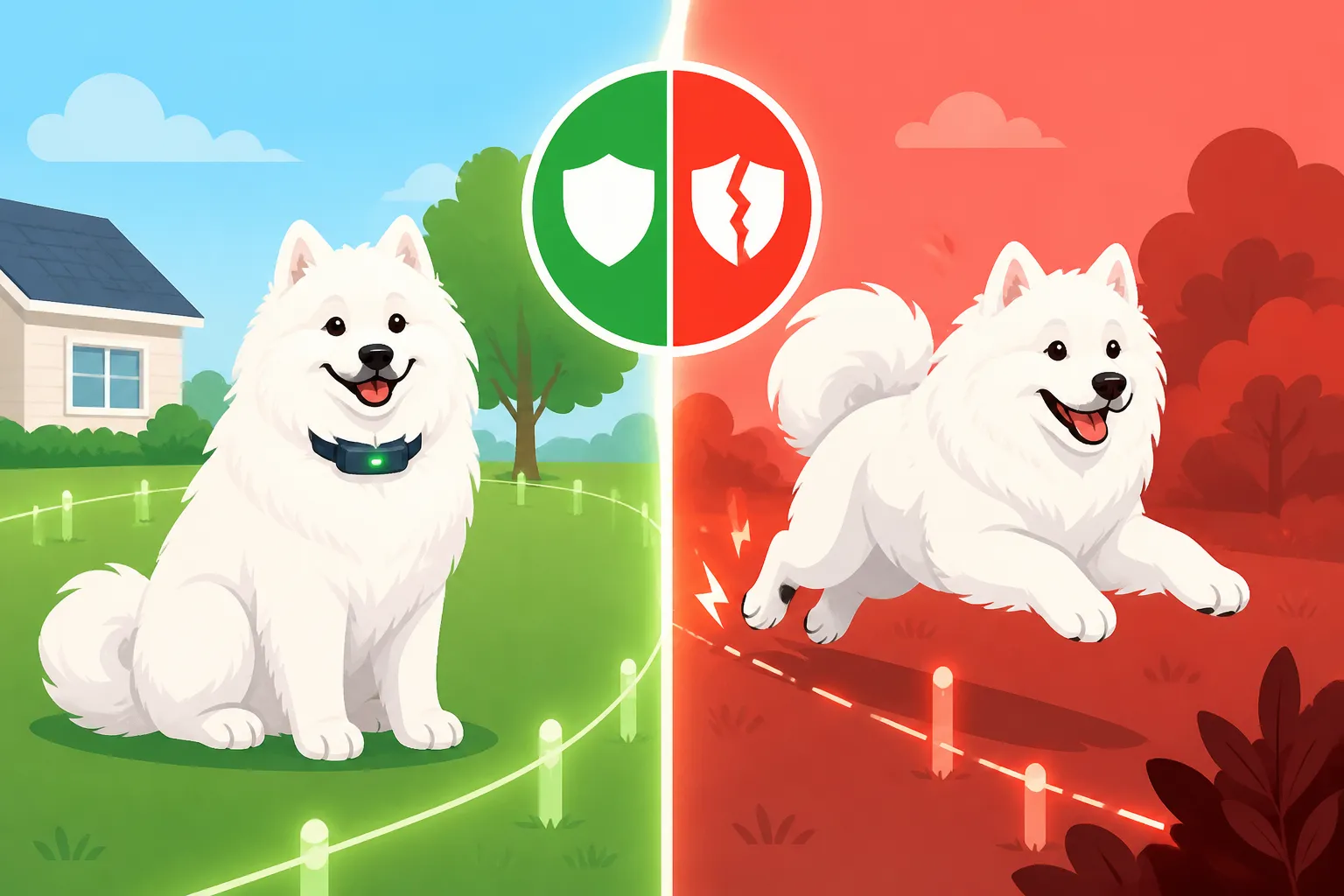
Whether an Invisible Fence Holds a Samoyed
The dream of letting your Samoyed roam freely in the yard, enjoying the sunshine and sniffing every interesting blade of grass, is a beautiful one. But for many Samoyed owners, the thought of trusting their independent, intelligent, and often mischievous fluffball to an invisible fence system brings a tidal wave of anxiety. This guide will dive deep into why these popular containment solutions often fall short for our beloved Samoyeds, exploring their inherent traits and offering more reliable alternatives to keep them safe and sound.
Understanding the Samoyed's Nature: Why Containment Is Tricky
Before we even get into the mechanics of invisible fences, we have to talk about the Samoyed themselves. These aren't just pretty faces; they're ancient working dogs bred for specific tasks, and those instincts run incredibly deep. When you understand what makes a Samoyed tick, you quickly realize why some modern containment methods just don't stand a chance.
The Instinct to Roam and Explore
Samoyeds were literally bred to travel. Their ancestors covered vast distances with nomadic tribes, herding reindeer and pulling sleds. This isn't a breed content to stay in a small, static perimeter just because you ask them to. They possess an innate drive to explore, to see what's over that hill, around that bend, or on the other side of that property line. For them, a boundary isn't a hard limit; it's often more of a suggestion, especially if something exciting is on the other side. This exploratory nature means they're constantly evaluating their surroundings, looking for new scents, new sounds, and new adventures. An invisible barrier, by its very nature, doesn't register as a physical impediment to this deep-seated need to move and discover. They might learn to avoid the shock, but that doesn't necessarily mean they've internalized the concept of the boundary in the same way a physical fence communicates it.
High Prey Drive and Distraction
Ah, the squirrel. Or the rabbit. Or the leaf blowing just so. Samoyeds, despite their fluffy appearance, retain a strong prey drive, a remnant of their working past where they might have needed to chase down a stray reindeer or even smaller game. This instinct can override almost any training or perceived discomfort from an invisible fence. Imagine your Samoyed, happily sniffing in the yard, when a rabbit darts across the street. That primal urge to chase is incredibly powerful. The momentary static correction from a collar might register as an annoyance, but it's often not enough to halt a determined Samoyed in full pursuit. Many owners have shared heartbreaking stories of their Samoyeds blowing right through the invisible fence boundary, completely ignoring the shock, all in the thrill of the chase. Once they've made that dash, retrieving them can be a nightmare, particularly since Why a Samoyed's Recall Cannot Be Trusted when something more interesting is happening.
The Samoyed's High Pain Threshold
It might sound tough, but Samoyeds are incredibly resilient dogs. They were bred to endure harsh Siberian winters and demanding work, and their tolerance for discomfort can be surprisingly high. What might be a significant deterrent for a more sensitive breed can sometimes be shrugged off by a Samoyed. A static correction from an invisible fence collar is designed to be unpleasant, not truly painful, but even then, a determined Samoyed might decide the brief sting is worth the reward of chasing that squirrel or greeting that passing stranger. They can learn to "take the hit" if the motivation to cross the boundary is strong enough. This isn't to say they enjoy it, but rather that their threshold for enduring it for a perceived benefit is higher than many other breeds. This resilience, while admirable in many contexts, works against the efficacy of an invisible fence.
How Invisible Fences Work (and Where They Fall Short for Samoyeds)
Let's dive into the nuts and bolts of how these systems typically operate and why those mechanics often don't align with the unique characteristics of our Samoyed companions. It's not just about the fence; it's about the dog on the other side of it.
The Shock Collar Mechanism
Most invisible fence systems, whether they use a buried wire or a wireless signal, rely on a collar that delivers a static correction (often referred to as a "shock") when the dog approaches a defined boundary. The idea is that the dog first hears a warning beep, then, if they continue, receives the static correction, associating the unpleasant sensation with crossing the line. Over time, the hope is that the dog learns to avoid the boundary altogether. However, this mechanism has several inherent flaws when applied to a Samoyed. The static correction is a negative reinforcement tool, and while it can teach avoidance, it doesn't teach understanding. A Samoyed might learn to avoid the buzzing zone, but they don't understand why. This lack of comprehension can lead to anxiety or confusion, especially if the correction is inconsistent or triggered by something unforeseen, like a low battery. Moreover, the correction is instantaneous and localized, not a broad psychological deterrent that explains "stay within these unseen lines always."
The "Correction" vs. the Samoyed Mindset
Samoyeds are intelligent, but they are also notoriously independent thinkers. They weigh consequences, often in their own favor. A momentary "correction" might not be enough to override a strong instinct or desire. Think of it like this: for many breeds, a small unpleasantness is enough to say, "Okay, not worth it." For a Samoyed, it's often more like, "Hmm, that was annoying, but that rabbit is STILL over there!" Their inherent stubbornness, coupled with their high motivation for certain activities (like exploring or chasing), means they can often rationalize or simply ignore the static pulse if the reward for crossing is high enough. It's a fundamental mismatch between the intended psychological impact of the correction and the Samoyed's unique blend of independence and drive. Trying to enforce a boundary through negative reinforcement alone often conflicts with What Actually Motivates a Samoyed to learn and obey.
Psychological Impact on a Samoyed
Beyond just the effectiveness, we need to consider the potential psychological toll an invisible fence can take on a Samoyed. These are sensitive, social dogs who thrive on positive interactions and clear communication. Relying on a static correction can create anxiety, fear, or confusion. A dog might associate the unpleasant sensation not just with the boundary, but with anything nearby – a child playing, another dog walking by, or even the mailman. This can lead to unexpected behavioral issues, such as fear aggression, barrier frustration, or general skittishness around their own yard. Instead of a safe haven, their home environment becomes a place where unpredictable, uncomfortable sensations can occur. This is particularly concerning because a Samoyed's naturally cheerful disposition can mask underlying stress, making it harder for owners to recognize when their dog is struggling. How a Samoyed Hides Illness Behind a Smile also applies to emotional distress, making it crucial to observe their subtle cues.
Common Scenarios and Why Invisible Fences Fail Samoyeds
Real-world experience paints a very clear picture: invisible fences are frequently an inadequate solution for Samoyeds. Let's look at some classic scenarios where these systems simply don't stand up to the challenge of a determined, fluffy escape artist.
The Allure of the Chase
This is perhaps the most common failure point. Your Samoyed is in the yard, ostensibly contained. Then, a deer ambles by at the edge of the property, a cat saunters across the street, or a new dog owner walks their energetic puppy past your house. The Samoyed's prey drive, or simply their friendly desire to say hello to another canine, kicks in. The warning beep sounds. The static correction zaps. But the lure of the chase or the joy of a potential greeting is so much stronger than the temporary discomfort. They hit the boundary, yelp, but their momentum and instinct carry them right through. Once they're out, they're free. And the collar, designed to keep them in, offers no deterrent to coming back in. Many a Samoyed has learned that it's a one-time sting to get out, and then pure freedom until the owner can catch them. This leads to dangerous situations where your dog is loose, potentially in traffic or bothering neighbors, and you're left frantically calling their name while they're enjoying their temporary liberty.
Bolting Through the Boundary
It's not always about a high-value chase item. Sometimes, it's sheer exuberance or a sudden scare. A loud noise, a visitor arriving, or just a burst of "zoomies" can send a Samoyed sprinting across the yard. If they hit the invisible fence boundary at full speed, their momentum can easily carry them right through the static correction. It's like trying to stop a freight train with a feather. The brief jolt isn't enough to halt their powerful stride. For a breed known for its energy, especially younger Samoyeds, these spontaneous bursts are common. Owners often express frustration, thinking their dog should understand, but the reality is that an invisible shock is a poor substitute for a solid physical barrier when dealing with a dog built for power and speed. Furthermore, the lack of a visual cue means a Samoyed may not even register the exact point of correction until it's too late, contributing to the "bolting through" phenomenon.
The Danger of "One-Way" Containment
One of the most critical and often overlooked dangers of invisible fences for Samoyeds is their "one-way" nature. While the system is designed to keep your dog in, it does absolutely nothing to keep other animals or people out. Imagine your Samoyed, happily playing in their supposedly safe yard. A stray dog wanders onto your property, perhaps aggressive. Your Samoyed, with their friendly but sometimes reactive nature, might want to investigate or even defend themselves. But they are trapped. They can't escape the intruder by crossing the invisible boundary without receiving a correction, and the intruder faces no such barrier. Similarly, children, wild animals, or even determined dog thieves can easily enter your yard, leaving your Samoyed vulnerable. This inherent flaw turns a supposed containment system into a potential trap, leaving your beloved companion unprotected in their own space. It underscores the critical difference between true security and a simple boundary-enforcement tool.
| Feature | Invisible Fence System | Physical Fence (e.g., Wood, Chain Link, Vinyl) |
|---|---|---|
| Physical Barrier | None | Yes, a tangible wall/barrier |
| Keeps Dogs In | Relies on static correction; often unreliable for Samoyeds due to drive/pain threshold. Can lead to "bolting." | Effective if adequately tall and secure (e.g., How High a Samoyed Can Jump a Fence). |
| Keeps Others Out | No protection from intruders (animals or people). | Yes, provides a barrier against external threats. |
| Visual Cue | None for the dog (beyond flags during training); invisible. | Clear visual boundary for both dog and owner. |
| Training Method | Aversion/negative reinforcement (static correction). | Teaches physical limits; can be combined with positive training. |
| Psychological Impact | Can cause anxiety, confusion, fear-based behaviors. | Clear, consistent boundaries; generally less stress for the dog. |
| Cost (Initial) | Varies greatly, can be significant for professional installation. | Can be a substantial investment, especially for quality materials and installation. |
| Maintenance | Battery changes, wire breaks, signal interference. | Repairs for damage, gate maintenance, painting/staining. |
| Aesthetics | Unobtrusive, maintains open yard appearance. | Changes landscape, may require HOA approval. |
| Samoyed Suitability | Generally not recommended due to breed traits. | Highly Recommended for safety and peace of mind. |
Training with Invisible Fences: A Samoyed's Perspective
You might think, "Well, if I just train them really well, it'll work!" And while training is always paramount with a Samoyed, the inherent limitations of invisible fences, particularly when combined with Samoyed psychology, make even the best training regimens struggle. It's a battle against nature, and nature usually wins.
The Importance of Consistent, Positive Training
Any successful dog containment or behavior modification relies heavily on consistent, positive reinforcement. Samoyeds thrive on praise, treats, and clear, calm guidance. This is why resources like those offered by BAXTER & Bella, which focus on positive, reward-based approaches, resonate so well with Samoyed owners. When a system relies primarily on an aversion-based method like static correction, it inherently clashes with a positive training philosophy. While flags are used initially to mark the boundary, the ultimate deterrent is the shock, not the dog's intrinsic understanding or desire to please. For a Samoyed, who can be quite sensitive despite their tough exterior, a negative interaction can quickly sour their willingness to learn or participate. They respond much better to being shown what to do rather than being punished for what not to do. The ambiguity of an invisible boundary, coupled with unpredictable corrections, makes building a strong, trust-based understanding of "staying in" incredibly difficult.
When the Shock Isn't a Deterrent
We touched on the Samoyed's pain threshold, but it's worth reiterating how this impacts training. Even with a well-calibrated system and careful introduction, a Samoyed might simply decide the momentary discomfort isn't a strong enough reason to curb their impulses. Think of it from their perspective: they receive a brief, unpleasant sensation, but the rabbit is still there, or the person walking by seems friendly. The reward of interaction or pursuit often outweighs the cost of the correction. This isn't a failing of the Samoyed; it's a failing of the system to provide a strong enough deterrent against deeply ingrained breed instincts. Once a Samoyed "tests" the boundary and finds they can push through, the system loses its effectiveness entirely. They might learn to avoid the correction when bored, but when highly motivated, it becomes irrelevant. This can lead to a false sense of security for owners, only to discover too late that their Samoyed views the fence more as a suggestion than a hard limit.
Alternatives to Invisible Fence Training
If an invisible fence isn't the answer, what is? The focus should always be on clear communication, positive motivation, and physical security. Instead of teaching avoidance with a shock, teach engagement and recall within a secure space. This means utilizing long lines for supervised outdoor time in unenclosed areas, working on a solid Whether a Samoyed Can Ever Be Off Leash and "stay" commands in various environments. Training platforms (even those found readily on Amazon for various topics) can provide structured lessons, but the key is always a physical barrier for unsupervised time. For a Samoyed, safety is paramount, and a trained recall, while incredibly important, is never 100% reliable when the stakes are high, like an open gate. Therefore, training should complement, not replace, physical security measures. When it comes to effective training, resources that emphasize understanding canine behavior and using reward-based methods are far more beneficial than systems relying on electronic corrections.
Safer and More Effective Containment Solutions for Samoyeds
So, if invisible fences are a gamble with a Samoyed, what are the reliable alternatives? The good news is that there are tried-and-true methods that genuinely keep your fluffy friend safe and give you peace of mind. It primarily comes down to physical barriers and vigilant supervision.
Physical Fencing: The Gold Standard
For a Samoyed, a robust physical fence is truly the gold standard for outdoor containment. We're talking about a fence that is tall enough (often six feet or more, considering How High a Samoyed Can Jump a Fence), sturdy, and, crucially, extends beneath the ground. Samoyeds are notorious diggers, especially when they want to escape, or if they're simply trying to The Digging a Samoyed Does Because It Is Hot. A physical fence, whether made of wood, vinyl, or chain link, provides a clear, undeniable boundary that your dog can see and respect. It prevents accidental escapes due to a strong instinct and, equally important, keeps other animals and people out of your yard, protecting your Samoyed from potential threats. Yes, the initial What a Six Foot Fence Costs a Samoyed Owner can be higher than an invisible system, but it's an investment in your dog's safety and your peace of mind. Ensure all gates are secure with latches that a clever Samoyed can't easily manipulate. Remember, if there's a will, a Samoyed often finds a way through or under, so prevention is key.
Supervision and Long Lines
Even with a fantastic physical fence, supervision remains incredibly important. When outside the fenced area, a Samoyed should almost always be on a leash or a long line. Their wanderlust and prey drive are simply too strong to trust them off-leash in an unfenced space. A long line, which you can easily find on Amazon, allows your Samoyed to explore a larger area while still giving you control. It's a great tool for practicing recall in a safe environment, gradually building their responsiveness without the risk of them bolting. Dedicated time spent actively supervising your Samoyed in the yard, engaging them in play, or simply sitting with them while they sniff around, not only ensures their safety but also strengthens your bond. It's about being present and actively managing their environment, rather than relying on an electronic device to do the job for you. This dedicated outdoor time is vital for How Much Exercise a Samoyed Needs and mental stimulation.
Creating an Enriched, Secure Environment
Beyond just physical barriers, creating an enriched and stimulating environment within your secure yard can significantly reduce the desire to escape. A bored Samoyed is an inventive Samoyed, and that often translates to digging or attempting to get out. Provide plenty of toys, rotate them regularly, and consider interactive puzzle toys. If your Samoyed loves to dig, give them a designated digging pit filled with sand or loose soil, hiding toys for them to find. Ensure they have ample shade and fresh water, especially in warmer weather, to prevent them from seeking cooler spots outside the yard. For a dog that loves to talk, ensuring their vocalizations don't lead to boredom might also involve providing enough mental stimulation; after all, The Samoyed Scream and Why It Is Not Barking often comes from a place of excitement or even frustration. The more content and engaged your Samoyed is within their own space, the less likely they are to feel the irresistible pull of the great beyond. And for peace of mind in case they do manage to become How Far a Loose Samoyed Travels, ensuring your Samoyed is microchipped and wears a Whether a GPS Collar Is Worth It for a Samoyed can be life-saving.
Disclaimer
This article is for general informational purposes only and does not constitute professional advice. Laws, prices and regulations vary by location and change over time. Consult a qualified professional for guidance on your specific situation.