Whether the Smile Is in the Samoyed Standard
A Samoyed’s upturned mouth is more than a photogenic quirk: the breed standard describes the characteristic expression as the “Samoyed smile.” That does not mean every dog must hold a grin, show its teeth, or look cheerful in every photograph. This guide explains what the standard says, what judges look for, and how to tell a normal expression from a possible health concern.
What the Samoyed standard says about the smile
The smile is part of the described expression
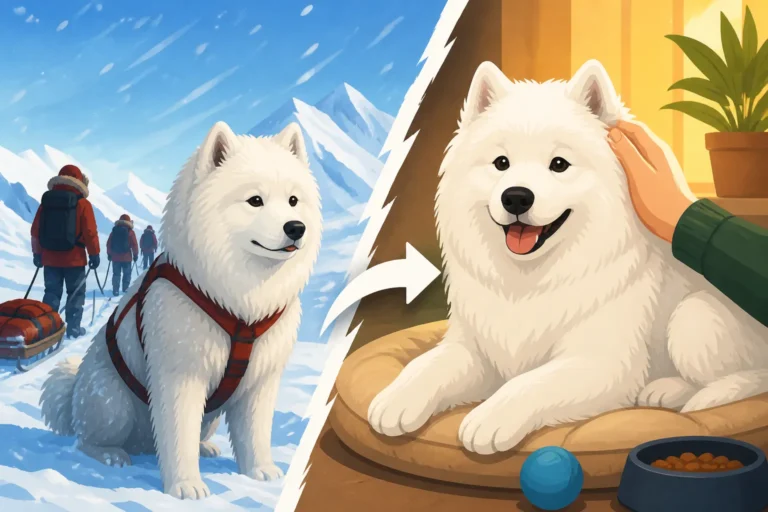
The Samoyed standard describes the breed’s expression as the “Samoyed smile,” with the lips curving upward at the corners. So, yes: the smile is in the standard. It is not simply a nickname added by owners or a trick Samoyeds learn for the camera.
That wording refers to the overall expression created by the shape and position of the mouth, together with the eyes and other features of the head. It does not mean a Samoyed should bare its teeth or maintain a human-like grin. The typical look is a relaxed, closed mouth with the corners gently turned upward.
The standard’s description is one reason the Samoyed’s face is so recognizable. But it is only one part of a larger picture that includes the dog’s proportions, coat, movement, and temperament. For more background on how the expression became a defining breed feature, see Why the Samoyed Smiles.
What “curving upward at the corners” means
Imagine looking at a Samoyed with its mouth closed. The lips meet naturally, and the corners appear to angle slightly upward rather than droop. The effect can make the dog look bright, friendly, or amused, even when it is simply resting.
The curve is usually subtle. It may be more noticeable in one dog than another, and it can look different depending on the dog’s head shape, age, posture, and expression at that moment. A still photograph can exaggerate it, while a moving dog may show the feature less clearly.
The “smile” is also not a reliable measure of mood. A dog may have the characteristic mouth shape while feeling tired or uncertain, and a happy Samoyed may not look especially smiley in a particular photo. The feature is part of the breed’s anatomy and expression, not proof that the dog is cheerful every second.
The mouth is one feature, not the whole standard
A show judge considers the Samoyed as a whole. A lovely smile cannot compensate for unrelated structural or movement faults, just as a dog with an understated expression is not automatically a poor-quality dog. The standard offers a guide to the breed’s overall type rather than a checklist of isolated features.
That distinction can be reassuring if you are comparing puppies or looking at photographs online. Lighting, camera angle, a wet muzzle, or an open mouth after play can all change how the lips appear. It is better to assess a dog in person, at rest and in motion, than to decide what its expression is like from one carefully posed image.
The smile’s role in the standard is also separate from its possible practical function. The upward corners are often discussed in relation to the breed’s cold-weather origins, but the standard describes the appearance; it does not require a dog to demonstrate a particular function. The history and mechanics are explored in Why a Samoyed's Mouth Curls Upward and Whether the Samoyed Smile Is Functional.
What judges and owners should look for
A natural, relaxed expression
A typical Samoyed expression should look natural rather than strained. The lips are not pulled back tightly, and the dog is not baring its teeth in a threatening or nervous display. The mouth’s corners may curve upward while the face remains relaxed.
For a judge, the expression is considered alongside other features of the head. The Samoyed standard also describes the eyes and ears, and these contribute to the alert, friendly impression associated with the breed. An attentive Samoyed may look especially animated when watching its handler, but expression can change from one moment to the next.
At home, owners may notice the smile most clearly when their dog is calm, looking toward them, or standing in good light. It may be less visible after a drink, during panting, or when the dog is focused on a scent. Those variations are ordinary; a breed-standard expression is not a permanent facial pose.
A smile does not mean an open mouth or visible teeth
Samoyeds often pant after exercise or in warm conditions, and their mouths may naturally open during play. That is different from the closed-mouth expression described as the Samoyed smile. Teeth showing in a photograph do not necessarily indicate a problem, but they are not what the standard means by an upturned-lip expression.
Likewise, a dog that curls its lips during a greeting, handling, or a tense interaction may be communicating discomfort rather than displaying its characteristic smile. Look at the whole body: stiffness, turning away, pinned ears, a tucked tail, or repeated lip licking can provide important context. Avoid assuming that every raised lip is a friendly grin.
If you are unsure what you are seeing, take a short video of the dog at rest and during ordinary interaction, then ask your veterinarian or a knowledgeable breed professional. A brief clip can show whether the mouth is relaxed and symmetrical or whether the movement appears unusual.
The eyes and lips contribute to the overall look
The Samoyed’s characteristic expression is not created by the mouth alone. Eye shape, eye placement, and the way the dog holds its head help shape the overall impression. Dark, almond-shaped eyes are commonly associated with the breed’s standard appearance; eye color and expression are discussed further in Whether a Samoyed's Eyes Should Be Dark and Whether a Samoyed Can Have Blue Eyes.
Lip pigmentation is another feature people often notice, especially against a white coat. The standard describes the mouth’s shape, while pigment is a related but distinct subject. A naturally dark lip outline can make the curved corners easier to see, but the presence of the smile should not be judged from color alone. For that separate detail, see Whether a Samoyed's Lips Must Be Black.
| What you notice | What it usually means | What to check |
|---|---|---|
| Closed mouth with gently raised corners | Typical Samoyed expression | Whether the face and body look relaxed |
| Open mouth after play or in warm weather | Panting, not the standard smile itself | Whether the dog cools down comfortably |
| Teeth visible during a tense interaction | Could be a warning or discomfort signal | Body posture, trigger, and whether the dog can move away |
| New, uneven lip position or facial droop | Not simply a breed-standard variation | Contact a veterinarian, especially if it appeared suddenly |
| Redness, sores, odor, or difficulty eating | Possible mouth or dental problem | Arrange a veterinary examination |
When a Samoyed’s expression may need attention
Normal variation versus a sudden change
Not every Samoyed has an equally pronounced smile. Some dogs have a more obvious upward curve, while others have a subtler expression. Age, facial proportions, coat around the muzzle, and the dog’s mood can affect what you see. A less noticeable smile, by itself, does not prove that something is wrong.
A sudden change is different. If one side of the mouth begins to droop, the dog cannot close its mouth normally, or the face looks noticeably uneven, do not dismiss it as a variation in breed type. A change that appears quickly deserves veterinary advice, particularly if it comes with trouble swallowing, unusual drooling, weakness, or altered behavior.
It can help to compare with older photographs or videos, but do not delay care if the change is sudden or severe. A familiar expression is useful as a baseline; it is not a diagnosis.
Mouth discomfort can alter the expression
Dental disease, an injury, an object caught in the mouth, or irritation around the lips can make a dog hold its mouth differently. Watch for signs such as chewing on one side, dropping food, reluctance to eat, pawing at the face, bleeding, or a strong change in breath odor. These symptoms are not part of the Samoyed smile and merit a professional check.
Routine mouth care is useful for every dog, not just Samoyeds. If you are comparing toothbrushes or dental products, retailers such as Chewy can be one place to review the available options, but ask your veterinarian which products suit your dog. A product listing is not a substitute for an examination when your Samoyed seems sore or has trouble eating.
Do not force your dog’s mouth open to inspect it if the dog is painful, frightened, or resisting. That can make the experience harder for both of you and may risk a bite. A calm, gradual handling routine can help with ordinary checks, while a veterinarian can examine a painful mouth safely.
The smile should not be used to judge emotional wellbeing
Because the Samoyed’s expression looks cheerful, people sometimes assume that a smiling dog must be content. That can lead owners to miss subtler signs of stress or discomfort. A dog’s facial shape is only one part of communication; posture, movement, appetite, sleep, and response to familiar people matter too.
If your dog’s face looks as usual but its behavior has changed, pay attention to the behavior rather than relying on the smile. A Samoyed that withdraws, avoids normal activities, or reacts differently to touch may need a closer look, even if its mouth still appears to curve upward. The broader topic of how dogs can mask discomfort is covered in How a Samoyed Hides Illness Behind a Smile.
Chewy’s dental-care listings may help you compare routine supplies, but they cannot tell you whether a particular change in facial expression is medical. If there is pain, swelling, bleeding, sudden asymmetry, or difficulty eating, contact your veterinarian instead of trying to solve the problem with a chew or brush. Chewy can be a shopping option for ordinary supplies; it should not replace clinical advice.
How to interpret the smile when choosing or showing a Samoyed
Do not choose a puppy from one photograph
Puppy faces change as they grow, and a single image may not show the mouth clearly. A puppy might be panting, yawning, chewing, or reacting to a sound when the photograph is taken. Those momentary expressions are not a dependable way to assess how the adult dog’s smile will look.
When visiting a litter, watch puppies interacting naturally and ask the breeder about the parents’ health, temperament, and conformation. Look at the dog’s overall condition and behavior rather than focusing on whether its lips make a particularly dramatic curve. A responsible breeder should be able to discuss the breed standard without promising that every puppy will have an exaggerated, camera-ready grin.
If you are considering showing a Samoyed, discuss the dog’s overall qualities with an experienced breeder or handler. The smile is part of the standard expression, but it does not replace sound structure, appropriate movement, and a balanced presentation. A less pronounced smile in a photograph should not be treated as a verdict on show potential.
Do not mistake coat color or lighting for a different expression
The Samoyed’s pale coat can make shadows around the lips and muzzle more noticeable in some lighting. A wet muzzle may darken the hair around the mouth, while bright light can wash out details. These visual changes can make the smile seem stronger, weaker, or uneven from one picture to another.
Coat color and markings are separate from the mouth’s shape. If you are curious about permissible coat shades or biscuit coloring, see Whether a Samoyed Can Be Any Color but White and What Biscuit Means on a Samoyed. Those details may affect the way a dog appears, but they do not change what the standard means by the Samoyed smile.
In practical terms, assess the expression in good light, with the dog relaxed and its mouth closed. Then consider the rest of the dog. A natural upward curve is a hallmark of the breed, but a healthy, well-cared-for Samoyed is much more than a smile.
Disclaimer
This article is for general informational purposes only and does not constitute professional advice. Laws, prices and regulations vary by location and change over time. Consult a qualified professional for guidance on your specific situation.