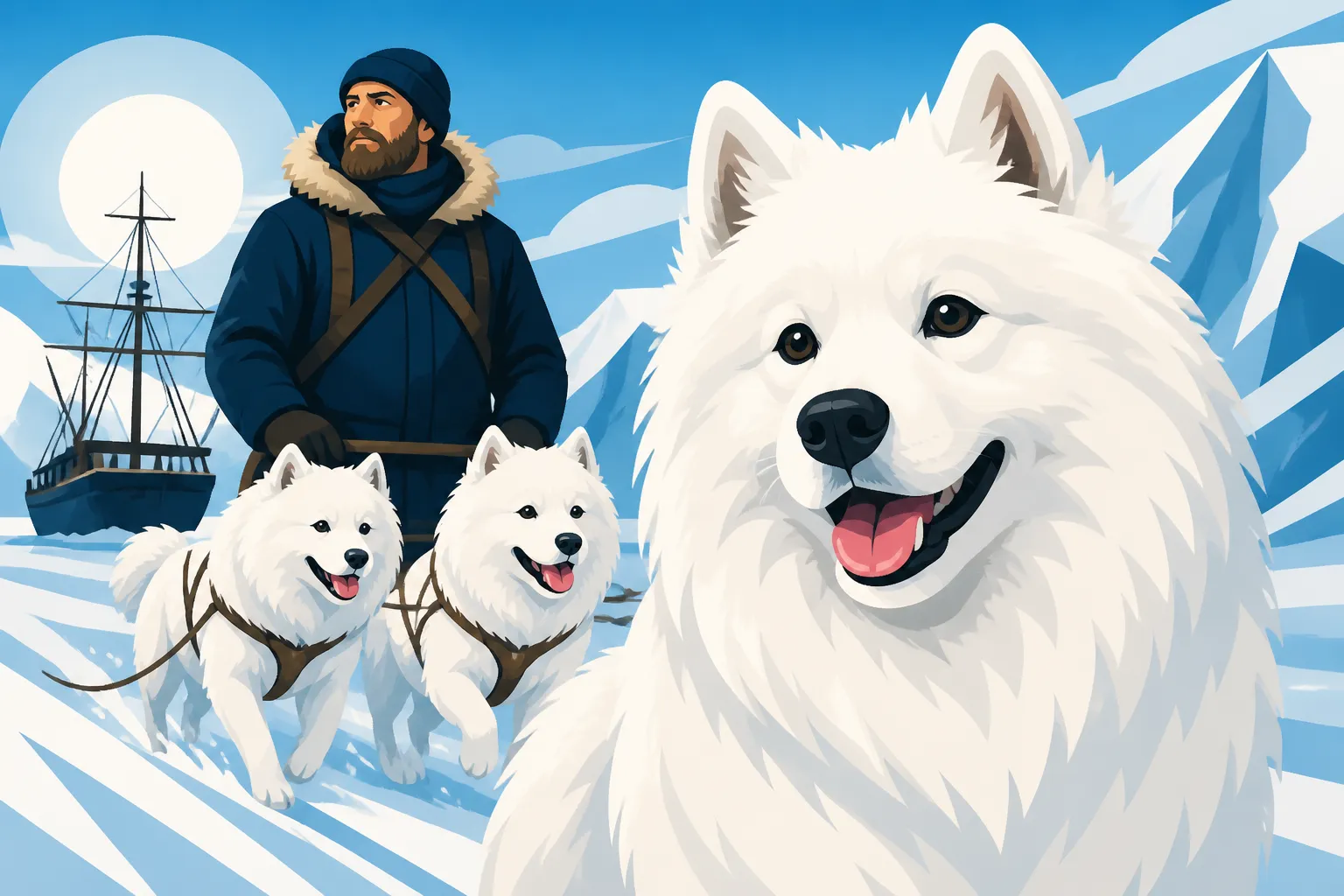
Shackleton’s Samoyeds
Shackleton’s Antarctic story is often told through the men, ponies, and record-breaking journey toward the South Pole, leaving the dogs in the background. This guide explains what is known about the dogs on his Nimrod expedition, what work they did, and why calling them modern Samoyeds can be misleading.
Shackleton’s dogs on the Nimrod expedition
Which expedition brought the dogs south
Ernest Shackleton’s best-known Antarctic journey with dogs took place during the British Antarctic Expedition of 1907–1909, usually called the Nimrod expedition after its ship. It sailed from New Zealand and established its main base at Cape Royds on Ross Island. The expedition brought dogs as part of a larger transport plan that also included ponies and motorized equipment.
The dogs were not a side detail in a neatly organized modern support system. Antarctic travel meant moving people, food, fuel, scientific gear, and shelter across a remote landscape where a delay could become dangerous. A dog team could help haul supplies over snow and ice, but it also required food, handling, and careful decisions about where and when it could work.
Shackleton’s expedition is sometimes described as having taken “Samoyeds” to Antarctica. That label needs a little care. Early polar accounts did not always use breed names consistently, and expedition dogs were often described by broad terms such as “Siberian” or “Samoyed.” Those labels do not necessarily establish that every dog had the documented pedigree of a modern Samoyed.
The history of expedition dogs is easier to understand when placed alongside the longer story of how polar explorers acquired dogs from northern regions. How Polar Explorers Took Samoyeds Out of Siberia explores that wider context, while Which Polar Expeditions Used Samoyeds looks at the role of northern dogs across different Antarctic journeys.
Why Shackleton did not rely on dogs alone
Shackleton’s team experimented with several methods of transport. The expedition’s ponies became a prominent part of the push toward the South Pole, while dogs contributed to the broader work of moving supplies and supporting travel. The expedition’s transport choices reflected practical conditions as much as preference: snow, terrain, temperatures, loads, animal stamina, and available food all affected what could be used.
It is tempting to imagine an Antarctic expedition as one long, uninterrupted dog-sled journey. In reality, transport arrangements changed as explorers learned what worked. A dog team that was useful on one route or for one task might not be the best option for another. The dogs also needed to be managed as living animals, not treated as equipment that could be left behind without consequence.
Shackleton’s most famous southern journey ended when he and his companions turned back before reaching the Pole. They reached a record southern latitude but faced the basic calculation that shaped polar travel: continuing farther could make it impossible to return safely. The dogs were part of the expedition’s wider logistics, but they were not the team that carried Shackleton to the farthest point of that journey.
What work did Shackleton’s dogs do
Hauling and supporting expedition logistics
Sled dogs could move loads across snow without the same kind of wheeled track required by a vehicle. That made them valuable for hauling supplies and assisting with sledging work. On a polar expedition, even a short supply movement could matter: food, fuel, tents, scientific instruments, and emergency equipment all had to reach the places where people needed them.
Dog teams were also a practical test of expedition planning. The men had to decide how much weight to assign, how to distribute it, how to feed the dogs, and how to manage the team over changing snow conditions. A sledge that seemed manageable at the start might become exhausting when the surface softened, the route became rough, or weather reduced visibility.
A useful comparison is to think of the dogs as one part of a transport system, rather than the whole system. Shackleton’s expedition brought different animals and equipment because no single method solved every problem. This was not a sign that dogs were useless. It was evidence that Antarctic travel demanded flexibility and that every method had limits.
| Expedition element | What it contributed | Why it mattered |
|---|---|---|
| Dogs | Sledging and movement of supplies | Could haul loads over snow and support travel |
| Ponies | Transport for loads on parts of the southern journey | Offered another hauling option, though conditions could be difficult |
| Motorized equipment | An experimental transport approach | Tested whether machines could help in polar conditions |
| Human teams | Navigation, camp work, and hauling when needed | People had to adapt when animals or equipment could not proceed |
This mix of methods is part of the reason Shackleton’s expedition is such an interesting chapter in polar history. It was not simply a contest between dogs and ponies. It was a real-world trial of how to move people and provisions through an environment that punished weak planning.
The difficult conditions behind the romantic image
Stories about sled dogs can make polar travel sound stirring and straightforward: a team surges across a white landscape, the sledge glides behind them, and the explorer presses onward. The reality was less tidy. Dogs needed care, food, rest, and protection from injury. Their usefulness depended on the route and the condition of the snow, and the people handling them had to balance the expedition’s objectives with the animals’ welfare.
The same conditions affected every transport option. A team might be slowed by rough ice or heavy loads. A route could change under weather. Supplies had to be rationed, and a long journey had to be planned around the return trip, not just the exciting outward push. In that setting, stopping or changing plans could be the responsible choice.
That practical side also helps explain why historical accounts do not always give the dogs the same detail as the men. Expedition narratives often focus on leadership decisions, scientific goals, and geographic milestones. Dogs may appear mainly when discussing transport, leaving readers with less information about individual animals than they might expect.
Were Shackleton’s dogs actually Samoyeds
Historical breed names were not always precise
The modern Samoyed is a recognized northern breed with a defined type and a documented breed history. In older expedition writing, however, names such as “Siberian dog,” “Samoyed,” and “Eskimo dog” could be used loosely or inconsistently. An account using the word “Samoyed” does not automatically prove that a dog would meet today’s breed standard or have a traceable pedigree.
That distinction matters because the word can refer to different things depending on the context. It may describe a dog believed to come from a particular northern region, a general type of sled dog, or a dog associated with the Samoyedic peoples. It may also be a popular shorthand added later when people retell an expedition story.
The breed’s roots are tied to northern communities and working life, not to Antarctic exploration alone. The Nenets of the Yamal Peninsula Bred the Samoyed and What the Nenets Bred the Samoyed to Do provide background on the people and work behind the breed’s history. That context helps separate the Samoyed’s earlier working origins from the later use of northern dogs by explorers.
How to read claims about “Shackleton’s Samoyeds”
When you see a claim that Shackleton took Samoyeds south, check what the wording actually establishes. Does it cite a contemporary expedition record, or is it a later retelling? Does it call the dogs Samoyeds while describing their origin, or does it make a definite claim about modern breed identity? Those are not quite the same thing.
It is fair to say that Shackleton’s expedition used northern sled dogs and that historical accounts may call them Samoyeds. It is less secure to assume that every dog was a purebred Samoyed by modern standards. The documentation and terminology of the period do not always support that level of certainty.
This is a common issue in polar history, not a problem unique to Shackleton. Dogs from different northern populations and working backgrounds were used by several expeditions, and later accounts sometimes simplify the terminology. For a comparison, Amundsen's Samoyeds and The Samoyeds on Scott's Expedition show how dog stories can differ between expeditions. What Happened to Expedition Samoyeds on the Ice also examines the difficult outcomes that could follow when animals were taken into extreme conditions.
Shackleton’s legacy and the dogs’ place in it
Why the dogs matter even without a starring role
Shackleton’s dogs are less famous than the explorer himself, and they do not dominate the story of the 1907–1909 expedition. Yet their presence reveals how much planning went into Antarctic travel. The expedition tested several ways of hauling supplies, and the dogs were part of that attempt to solve a problem that had no easy answer.
The dogs also remind us that polar exploration depended on animals as well as human courage. Sledging animals had to work in conditions that were physically demanding and unfamiliar, while explorers made decisions about routes, loads, food, and survival. When a historical account reduces them to a line in a transport inventory, it can hide the amount of care and risk involved.
For readers interested in the wider story, Which Expedition Samoyeds Came Home adds another perspective on what happened to dogs after polar journeys. The Century the Samoyed Appeared offers a broader breed-history timeline, useful for understanding how the modern Samoyed’s identity developed alongside these early expedition accounts.
What modern Samoyed owners can take from the story
The most useful lesson is not that a modern Samoyed should be treated like an Antarctic sled dog. Today’s Samoyeds are companion animals as well as working dogs, and their needs should be met in the conditions where they actually live. Their historical ability to work in cold regions does not make them immune to heat, fatigue, injury, or poor planning.
The history does offer a reminder that Samoyeds were bred for activity and cooperation with people. A dog with that heritage may enjoy purposeful exercise and training, but its workload should be suited to its age, health, fitness, and the weather. Modern pulling sports require appropriate equipment, gradual conditioning, and attention to the dog’s comfort; they are not a reenactment of polar exploration.
If you are reading Shackleton’s story because you love the breed, it is worth keeping both truths in view: northern working dogs helped explorers attempt extraordinary journeys, and the Samoyed’s present-day welfare depends on thoughtful care at home. The history is compelling precisely because it involves real animals, not just symbols of endurance.
Disclaimer
This article is for general informational purposes only and does not constitute professional advice. Laws, prices and regulations vary by location and change over time. Consult a qualified professional for guidance on your specific situation.