Why an American Eskimo Dog Is Not a Small Samoyed
A white, fluffy dog with pointed ears can look like a miniature Samoyed at first glance, especially in a puppy photo. But the American Eskimo Dog is a separate breed with a different history, size range, and breed standard. This guide explains what the two dogs share, where they differ, and how to tell which kind of companion may suit your home.
Why the American Eskimo Dog and Samoyed Look Alike
They share a spitz-type appearance
Both breeds have the familiar spitz silhouette: erect ears, a curled or carried-over-the-back tail, a wedge-shaped face, and a thick double coat. Their expressions can look especially similar in photos, where a white coat and dark eyes make it easy to assume one dog is simply a smaller version of the other.
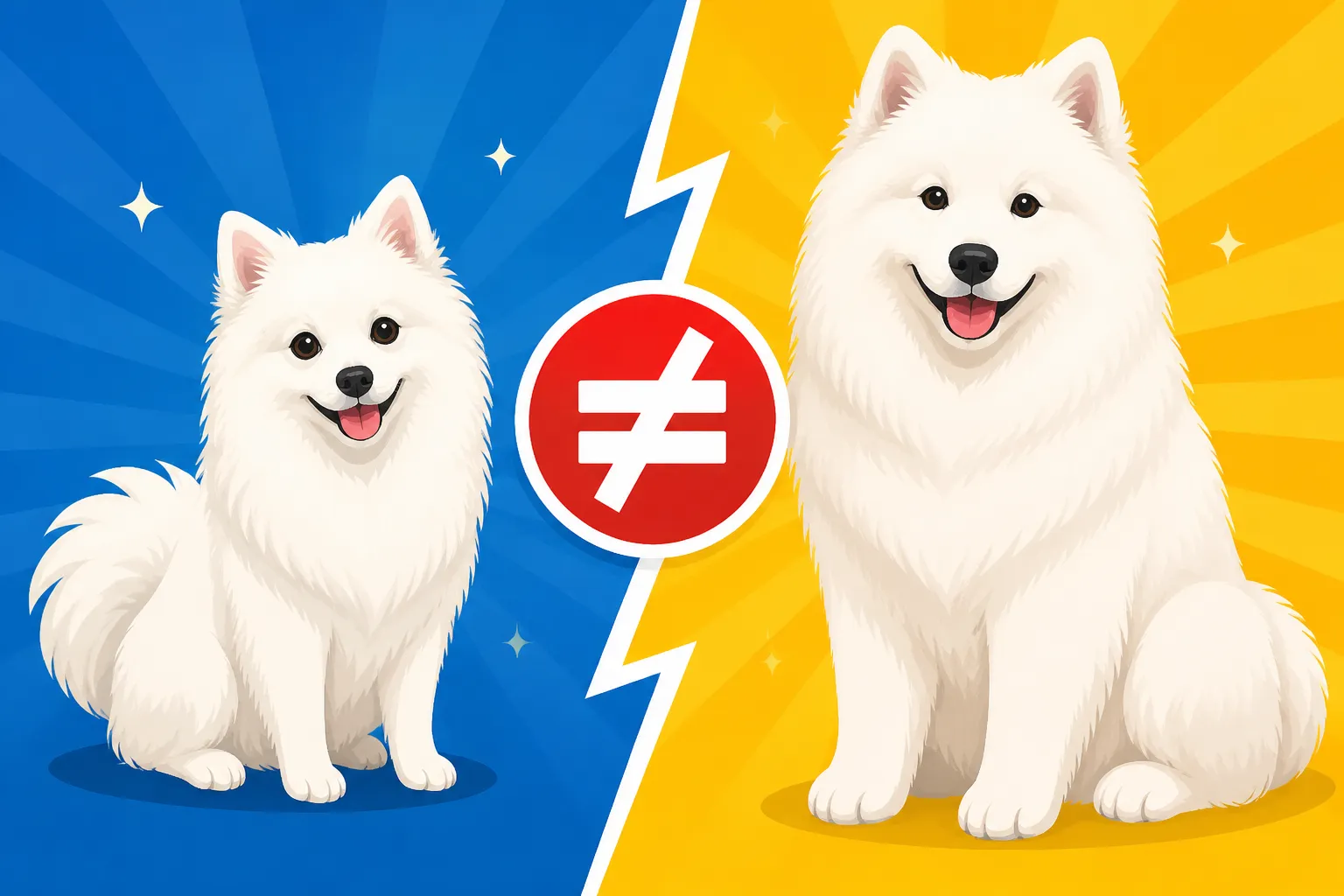
That resemblance reflects shared broad ancestry among northern and European spitz-type dogs, not a simple parent-and-miniature relationship. “Spitz” describes a general family of dogs with recognizable physical traits; it does not mean every spitz breed is a size variety of another. A Samoyed is not an American Eskimo Dog that grew larger, and an American Eskimo Dog is not a Samoyed bred down.
Their white coats also contribute to the mix-up. The American Eskimo Dog is generally known for its white coat, sometimes with cream or biscuit shading, while the Samoyed standard allows white and certain pale biscuit or cream tones. Coat color alone is not enough to identify either dog. For a closer look at Samoyed coat shades, see The Colors a Samoyed Comes In.
The breeds have different histories
The American Eskimo Dog developed in the United States from European spitz-type dogs, with German Spitz ancestry central to its history. German immigrants brought spitz dogs to North America, where they became popular as companions and performers. The breed was once known as the American Spitz; its name changed during a period of anti-German feeling around the First World War.
The Samoyed, by contrast, comes from northern Siberia and is associated with the Nenets people. Samoyed dogs worked alongside people in demanding Arctic conditions, helping with reindeer herding and sled pulling and living close to their families. Their background is not simply “a large white spitz.” It is a distinct working history shaped by a particular region and way of life. What the Nenets Bred the Samoyed to Do explores that heritage in more detail.
So, while the breeds can look alike, their roots tell different stories: one developed from European spitz-type dogs in America, and the other from an Arctic working breed with a long association with the Nenets.
The Main Differences in Size, Coat, and Build
A Samoyed is not just the largest American Eskimo Dog variety
One source of confusion is that American Eskimo Dogs come in three size varieties: toy, miniature, and standard. Even the standard variety is not a Samoyed. It remains an American Eskimo Dog with its own proportions and breed standard, not an undersized representative of the Samoyed breed.
Samoyeds are medium-to-large dogs with a strong, substantial build. Their size and structure reflect a history of working outdoors and pulling loads, rather than simply having more fluff. If you are trying to judge a dog from a photo, look beyond its apparent height: dense coat can make both breeds look broader than they are. A side view of the body, the dog’s proportions, and reliable breed records are more useful clues than a single face shot. What a Samoyed Actually Weighs and How Tall a Samoyed Stands offer more detail on Samoyed size.
| Feature | American Eskimo Dog | Samoyed |
|---|---|---|
| Breed identity | A distinct American breed with European spitz ancestry | A distinct Arctic breed associated with Siberia |
| Size | Toy, miniature, and standard varieties | Medium-to-large working breed |
| Typical coat impression | Plush, stand-off coat with a pronounced ruff | Dense double coat with a full ruff and heavy furnishings |
| Historical roles | Companion and performer, among other roles | Reindeer herding, sled pulling, and close family companionship |
| Common point of confusion | White coat, erect ears, curled tail | White coat, erect ears, curled tail |
The table is a quick guide, not a way to identify every individual dog. Breed standards and accepted descriptions can vary by registry, and mixed-breed dogs may combine traits in unexpected ways. If a dog’s background matters for health planning, adoption paperwork, or registration, ask for records rather than relying on appearance.
Similar-looking coats have different practical demands
Both dogs have a double coat: a longer outer layer and a softer insulating undercoat. Both can shed significantly, and neither should be treated as a low-maintenance, “white dog that stays clean” simply because its coat sometimes releases dirt as it dries. Loose undercoat can collect around the house, especially during seasonal shedding.
A Samoyed’s coat is particularly dense and developed for insulation in cold conditions. That does not mean its coat should be shaved in warm weather; removing it can interfere with the coat’s protective function and expose skin to sun. The American Eskimo Dog also needs regular coat care, but coat density and grooming needs vary by the individual. For more about the Samoyed’s coat, see How a Samoyed's Coat Insulates Against Heat as Well as Cold and How Often a Samoyed Needs Brushing.
Make grooming decisions based on the dog in front of you. Work through tangles gently, paying attention to areas where friction can create mats, such as behind the ears and around the legs. If you are assembling brushes, combs, and coat-care supplies, you might compare options at a local pet shop or through a retailer such as Chewy. The important part is choosing tools suited to the dog’s coat and learning how to use them without pulling painfully at the skin.
Differences in Temperament, Training, and Daily Life
Both are bright, but that does not make them interchangeable
American Eskimo Dogs and Samoyeds are often described as intelligent, alert, and people-oriented. Those traits can make training enjoyable, but they do not guarantee effortless obedience. A clever dog may learn a cue quickly and still decide that something more interesting is happening across the room.
An American Eskimo Dog may be quick to notice activity around the home and can be vocal when excited or alert. Samoyeds are also known for being expressive and noisy, with plenty of opinions to share. In either breed, early practice with calm greetings, settling, and appropriate ways to respond to sounds can help prevent everyday excitement from becoming a household habit.
Training works best when it is consistent and rewarding. Keep practice sessions short enough that the dog stays engaged, use rewards it values, and rehearse in different places rather than assuming a cue learned in the kitchen will automatically work in the park. For a Samoyed, that playful, social personality can mean training needs patience as well as good timing. Whether a Samoyed Suits a First Time Owner offers more context on the demands of living with one.
Their working backgrounds shape their exercise needs
A Samoyed was developed for substantial outdoor work, including pulling and herding. A pet Samoyed does not need to live on a sled team, but it still benefits from regular physical activity and opportunities to use its mind. A walk alone may not meet every dog’s needs; games, training, scent activities, and suitable pulling sports can add variety.
An American Eskimo Dog also needs daily exercise and mental stimulation, but its needs should be considered according to its individual size, age, health, and temperament. A toy variety and a standard variety are not identical in practical handling, even though both are American Eskimo Dogs. Likewise, two Samoyeds can differ in energy, confidence, and stamina.
Before choosing either breed, picture a normal weekday rather than an ideal weekend. Could you offer activity before work, time with the dog after work, and training or enrichment that fits into ordinary routines? If the answer depends on having a large yard, remember that a yard does not replace interaction, supervision, and exercise. For Samoyed-specific exercise and working questions, The Household a Samoyed Was Built For and Pulling: What a Samoyed Was Actually Bred to Do provide helpful background.
How to Tell Which Breed You Are Looking At
Use several clues, not just a photograph
A white coat and curled tail are not enough to confirm breed. Compare the dog’s overall size and build, face, coat, and proportions, then check the documentation. American Eskimo Dogs have toy, miniature, and standard varieties; a Samoyed has a separate breed standard and a distinctly larger, sturdier working-dog appearance.
The “Samoyed smile” is a familiar feature, created by the shape and placement of the lips and mouth. It may help explain why people associate a Samoyed’s face with a friendly, smiling expression, but it is not a dependable test on its own. Lighting, grooming, age, and individual facial structure can make a dog look quite different from a typical breed photograph. Why the Samoyed Smiles explains this characteristic in more depth.
For a puppy, adult appearance can be even harder to interpret. Coat changes, growth, and awkward adolescent proportions can make breed guesses unreliable. If you are buying from a breeder, ask which registry the parents are recorded with and request pedigree and health information. If you are adopting, ask the rescue or shelter what is known about the dog’s history, while keeping in mind that appearance does not always establish ancestry with certainty.
Choose for the life you can provide
Neither breed is automatically the better choice. The right fit depends on your expectations for size, grooming, exercise, noise, training, and time together. A smaller American Eskimo Dog may be easier to lift or accommodate in a compact home, but its smaller size does not eliminate shedding, training, or activity needs. A Samoyed’s larger frame and heavy coat may require more space and careful planning, but those traits do not make every individual difficult to live with.
Make a practical list before bringing a dog home. Think about how much coat care you can keep up with, how your neighbors might respond to vocal behavior, whether you have a safe way to exercise the dog, and who will handle care when you travel. If you need a slicker brush, comb, nail clippers, or other routine supplies, a pet retailer such as Chewy can be one place to compare what is available; a groomer or veterinarian can help you decide what is appropriate for the particular dog.
For a Samoyed, plan around a large, sociable, working-breed dog rather than an oversized lap dog. For an American Eskimo Dog, look at the specific size variety and the individual dog’s personality instead of assuming it will behave like a miniature Samoyed. When you are choosing food or everyday care items, Chewy may be one option alongside local stores, but your veterinarian’s advice should guide choices tied to health or a special diet. And if the decision is between a Samoyed and a similar-looking dog, a comparison article such as The Samoyed Against an American Eskimo Dog can help you weigh the differences without mistaking resemblance for sameness.
The simplest answer is that the two breeds share a spitz-like look but have separate identities, histories, and standards. Once you look past the white coat, the distinction becomes much clearer: the American Eskimo Dog is not a small Samoyed, and the Samoyed is not merely a larger version of an American Eskimo Dog.
Disclaimer
This article is for general informational purposes only and does not constitute professional advice. Laws, prices and regulations vary by location and change over time. Consult a qualified professional for guidance on your specific situation.