Amundsen’s Samoyeds
Amundsen’s Antarctic sled dogs are often described online as Samoyeds, which makes the story confusing for anyone trying to separate breed history from expedition history. The key distinction is simple: Roald Amundsen’s South Pole team is generally identified as Greenland dogs, not Samoyeds. Here’s what the dogs did, why the mix-up persists, and how their story fits into the wider history of northern breeds.
Were Amundsen’s dogs Samoyeds
The short answer is no
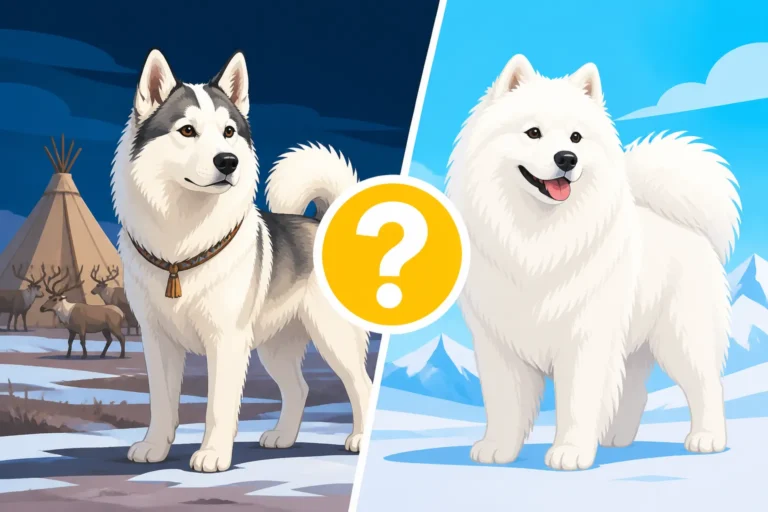
Roald Amundsen’s dogs on his South Pole expedition were Greenland dogs, also described in historical accounts with broader terms such as “Eskimo dogs.” They were not Samoyeds in the modern breed sense. Both are northern working dogs with thick coats and a history of pulling sleds, but sharing a cold-weather job does not make two breeds interchangeable.
The confusion is understandable. Early accounts did not always use dog names consistently, and popular retellings sometimes lump different Arctic and sub-Arctic sled dogs together. A reader may see “polar dog,” “sled dog,” or an old general label and assume the animal was a Samoyed. But those broad descriptions do not establish a breed identity.
Amundsen’s dogs came from Greenland, while the Samoyed’s history is associated with the Nenets people of northern Siberia. Those working traditions overlapped in some ways, but they developed in different places and involved different communities. For more on that background, see Who the Nenets Who Bred the Samoyed Are and What the Nenets Bred the Samoyed to Do.
Why the names get mixed up
The Samoyed is one of several northern spitz-type breeds that became known beyond its original homeland through exploration, trade, and later organized breeding. When people hear that a white, thick-coated dog helped an explorer travel across snow, it can be tempting to attach the story to the Samoyed, especially because the breed is visually memorable.
There is also a broader historical tangle: polar expeditions used dogs from different regions, and those animals were not always recorded using the kind of precise breed labels familiar to dog owners today. A historical writer might focus on a dog’s role or place of origin rather than a standardized breed name. It’s worth checking which expedition and which dogs an account actually describes before repeating the label.
This distinction matters because the history of the Samoyed is interesting in its own right. The breed’s traditional work included herding reindeer as well as pulling sleds, and its relationship with people was not limited to travel across ice. For a closer look at Samoyeds in exploration history, compare Which Polar Expeditions Used Samoyeds with How Polar Explorers Took Samoyeds Out of Siberia.
What Amundsen’s dogs did on the South Pole expedition
The dogs made transport possible
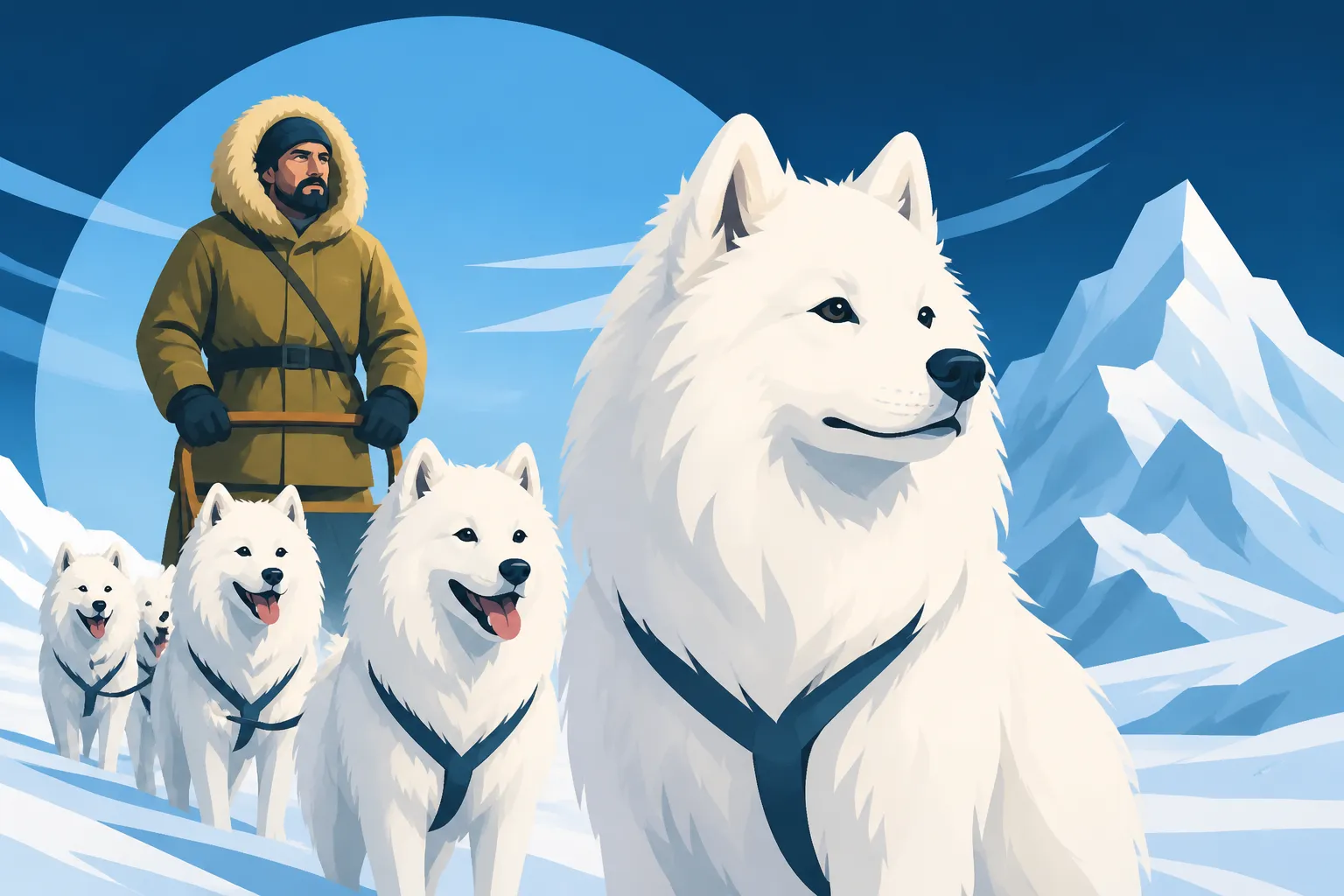
Amundsen’s expedition set out for the South Pole in 1910 aboard the ship Fram. The dog teams were central to the plan: they could move people, tents, food, and scientific equipment across a vast, frozen landscape where ordinary transport was impractical. In a setting with severe cold, difficult terrain, and no dependable roads, a team’s ability to travel under load could make the difference between reaching a supply point and being stranded short of it.
The dogs were not simply companions along for the journey. They were working animals, trained and organized into teams, with people responsible for driving them, feeding them, and managing the loads. Expedition logistics depended on planning how much food to carry, how far a team could travel, and where supplies would be stored for later use. Even small miscalculations could become serious when the nearest help was far away.
Amundsen’s success is often discussed in terms of preparation and route choice, but the dogs were part of that preparation, not a side note. The expedition’s plan relied on them to haul supplies and establish depots along the route. To understand how differently other explorers used dogs, it helps to read Shackleton's Samoyeds and The Samoyeds on Scott's Expedition alongside accounts of Amundsen’s Greenland dogs.
The team’s journey involved hard choices
A sled-dog expedition in Antarctica demanded a level of hardship that can be uncomfortable to read about today. The dogs faced cold, exhausting travel, and limited resources. When teams could no longer carry every animal and all the provisions needed for the return, expedition members made decisions based on survival and the practical limits of transport.
Historical accounts describe dogs being killed along the route, with some meat used to feed the remaining dogs and expedition members. This was part of the expedition’s logistics and survival strategy, not a sign that the animals were treated as modern household pets. It is possible to recognize the dogs’ enormous contribution while also being honest about the harsh conditions and the choices made during the journey.
Numbers vary in retellings, partly because accounts may refer to different stages of the expedition: dogs brought south, dogs that began a particular journey, dogs that reached the Pole, or those that returned. A useful way to read the figures is to ask what point in the journey they describe instead of treating every number as a contradiction. The story of working dogs on polar journeys more generally is explored in What Happened to Expedition Samoyeds on the Ice.
Reaching the Pole was a team achievement
Amundsen and four other men reached the South Pole in December 1911. The dogs helped transport the party and its supplies, making the journey possible in a way that would have been difficult to replicate with human power alone. But describing the event as a triumph of dogs alone would leave out the planning, navigation, equipment, food management, and teamwork behind the expedition.
The animals’ work also helps explain why their story is sometimes attached to different breeds. People remember the striking image of sled dogs hauling a team over the ice, then connect that image to whichever northern breed they know. The image is powerful, but it can blur the historical details. Amundsen’s dogs were Greenland dogs; that does not make their achievement any less significant, and it does not make them Samoyeds.
For context on the breed-specific question, Whether Samoyeds Reached the South Pole is a more precise question than asking whether “Samoyeds” were involved in every famous polar expedition. The answer depends on the expedition and on how carefully the historical record identifies the dogs.
| Question | Best-supported distinction |
|---|---|
| Which dogs did Amundsen use? | Greenland dogs, also described with broader historical labels |
| Were they Samoyeds? | No, not in the modern breed sense |
| Where is the Samoyed’s historical homeland? | Northern Siberia, in connection with Nenets communities |
| What work did Amundsen’s dogs do? | Hauled people and supplies across Antarctic terrain |
| Why does the confusion persist? | Old terminology, similar working roles, and simplified retellings |
What the story means for Samoyed breed history
Similar work does not mean the same breed
Samoyeds and Greenland dogs share traits that make northern dogs effective in cold environments: substantial coats, stamina, and a history of working alongside people. That resemblance can make it easy to assume they are the same dog under different names. In reality, breed histories are shaped by geography, people, and the tasks dogs performed in their home regions.
Samoyeds are associated with the Nenets and the reindeer-herding cultures of northern Siberia. Their traditional work included helping with herds and pulling sleds, while also living closely with families. The combination of practical work and close human contact is part of what makes the breed’s history distinctive. The history of How a Samoyed Herded Reindeer offers a useful counterpoint to the Antarctic transport work associated with Amundsen’s team.
This is a helpful reminder when reading breed histories: a dog can be built for cold weather without belonging to the same breed as every other cold-weather working dog. Similar coats, curled tails, or sledding ability are clues to a shared environment and function, not proof of identical ancestry.
Exploration stories can obscure the dogs’ origins
Polar exploration narratives often put the explorer at the center. The dogs may be mentioned as equipment, transport, or numbers in a team, while their origins and working histories receive less attention. That can leave modern readers with a simplified picture in which all “polar dogs” become one type.
A more careful account separates the expedition’s dogs from the breed histories later associated with polar travel. Amundsen’s team belonged to the Greenland dog tradition. Other expeditions and accounts may involve different dogs, including Samoyeds. Reading about Who Etah the Samoyed Was is one way to see how an individual Samoyed’s story differs from the better-known accounts of Amundsen’s team.
It is also useful to distinguish a dog’s historical role from modern breed standards. Today’s Samoyed is a recognizable breed with an established appearance and documented breed identity. The working dogs used by explorers lived in a different context, and historic terms may not map neatly onto present-day categories. That is why a careful answer is better than a quick claim that a famous expedition “used Samoyeds” simply because it used sled dogs.
What modern owners can take from the history
For a modern Samoyed owner, Amundsen’s expedition is best understood as a story about working-dog capability, preparation, and the demands placed on animals in extreme environments—not as a guide to recreating Antarctic conditions. A Samoyed may enjoy pulling activities, but safe recreational work depends on appropriate training, suitable equipment, conditioning, and weather. A dog’s enthusiasm does not mean it should be asked to work through heat, exhaustion, or pain.
If you are shopping for a well-fitted harness or other everyday dog supplies, a retailer such as Chewy may help you compare available options, but product listings cannot tell you whether a particular setup fits your dog’s body or activity. Check fit carefully and ask a qualified trainer or veterinarian if you are unsure. Historic expedition gear was designed for a very different purpose and should not be treated as a modern equipment template.
Nutrition is another place where history and present-day care should stay separate. Amundsen’s expedition had to manage food under severe constraints; that does not offer a sensible feeding plan for a pet Samoyed. For current food choices, Chewy can be one place to browse products, while your veterinarian can help you choose based on your dog’s age, health, and activity. If you use Chewy or another retailer, focus on your individual dog’s needs rather than assuming that a working breed automatically requires a high-performance diet.
The most useful lesson is not that every Samoyed should pull a sled. It is that breed history makes more sense when we pay attention to where dogs came from, who worked with them, and what job they were expected to do. Amundsen’s Greenland dogs deserve recognition for their role in the expedition, and the Samoyed deserves to be understood through its own history.
Disclaimer
This article is for general informational purposes only and does not constitute professional advice. Laws, prices and regulations vary by location and change over time. Consult a qualified professional for guidance on your specific situation.