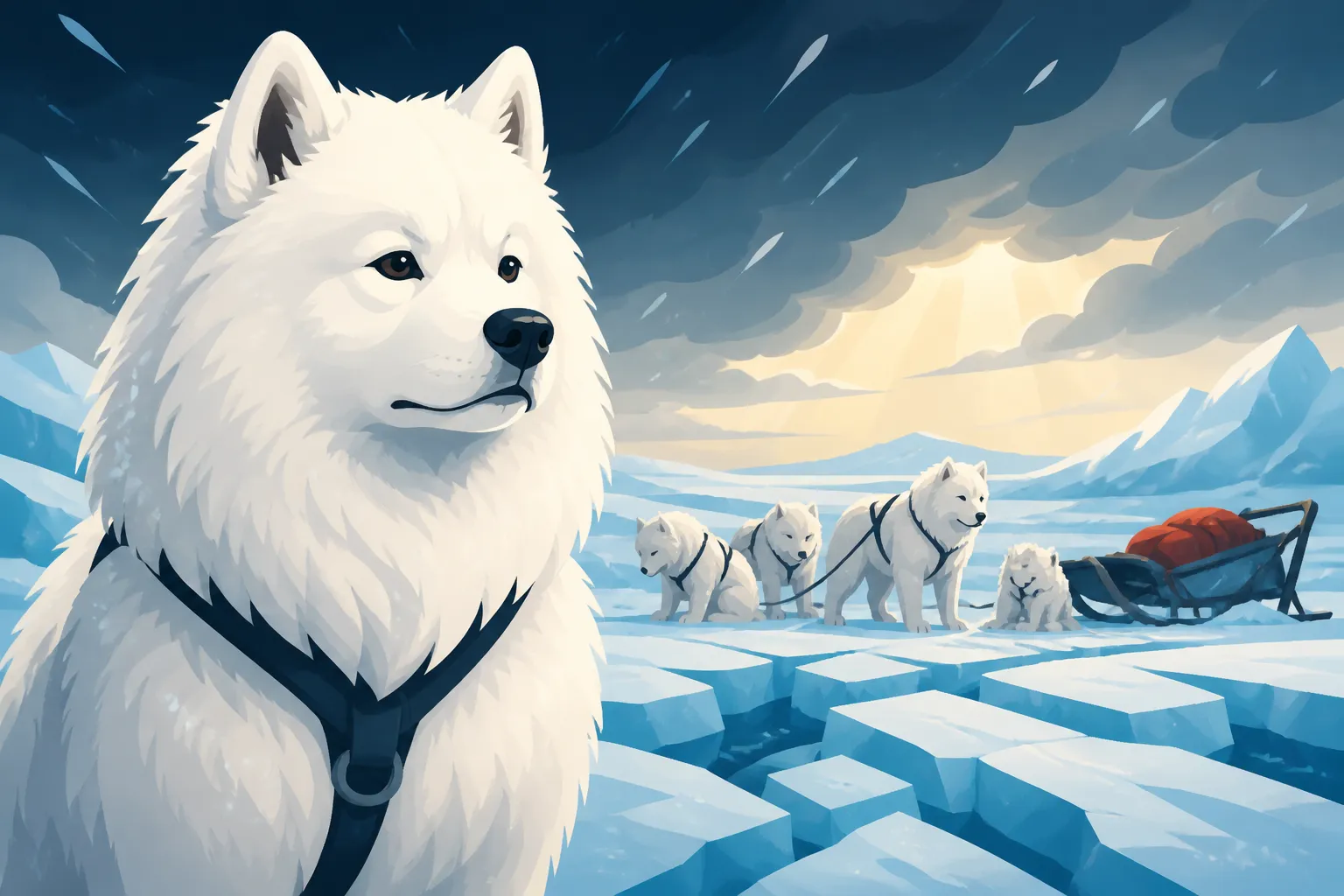
What Happened to Expedition Samoyeds on the Ice
A polar expedition’s dogs faced far more than cold: they hauled food and equipment across crevassed ice, lived on limited rations, and could be lost when a ship was trapped or a journey went wrong. The story is also more complicated than the word “Samoyed” suggests. This guide explains what happened to expedition dogs and why the breed label is sometimes used loosely.
Were the Antarctic expedition dogs really Samoyeds
A breed name can hide a mixed history
Today, Samoyed means a recognizable northern breed. On early polar expeditions, though, the dogs described as Samoyeds or Siberian dogs were not always documented with the precision a modern breed registry would expect. Dogs were selected for practical work, and expedition records could use broad labels for northern, thick-coated sled dogs.
So when a historical account mentions “Samoyeds,” it may refer to dogs of Samoyed type, dogs brought from Siberia, or a team whose ancestry was mixed. That does not make the label meaningless, but it does mean we should be careful about treating every expedition dog as a purebred Samoyed in the modern sense.
This distinction matters when asking what happened to expedition Samoyeds on the ice. A dog’s fate depended on the expedition, its route, the work assigned to its team, and the decisions leaders made as supplies ran short. There was no single outcome shared by every dog that travelled south.
For more on how these working dogs reached polar exploration, see How Polar Explorers Took Samoyeds Out of Siberia. The broader story includes changing names, shifting ideas about breed identity, and teams assembled for survival rather than show-ring pedigree.
Different expeditions used different kinds of dogs
The famous Antarctic journeys are often blended together in popular retellings. Amundsen, Scott, and Shackleton all became associated with dogs, but their expeditions did not use identical teams or follow the same plan. Even within one expedition, dogs could have different jobs: hauling supplies, establishing depots, carrying people, or supporting a party that later continued on foot.
Amundsen’s 1911 journey to the South Pole depended heavily on dog teams. His expedition brought dogs from the north and used them to transport supplies across the Antarctic plateau. Scott’s Terra Nova expedition also had dogs, but its route and logistical choices differed. Shackleton’s expeditions used dogs as well, alongside other transport methods, including ponies on the Nimrod expedition.
The names of the men involved can make it tempting to assume that any dog associated with an Antarctic story was part of the same team. They were not. Amundsen's Samoyeds, The Samoyeds on Scott's Expedition, and Shackleton's Samoyeds each belong to a distinct expedition history, and the dogs’ experiences should be considered separately.
The journey itself could be more dangerous than the cold
Antarctic cold was an obvious hazard, but it was not the only one. Dogs and people crossed uneven sea ice, glaciers, and snow-covered terrain where crevasses could be hidden under a deceptively smooth surface. Weather could obscure landmarks and make travel difficult. A team might also face food shortages, injuries, exhaustion, or the loss of a route back to camp.
The dogs’ thick coats helped them tolerate cold, but a coat could not solve every problem. A dog still needed enough food, rest, and protection from injury. Sled work was physically demanding, and a team’s condition could deteriorate quickly if the expedition could not maintain its supplies.
The expedition record is therefore not simply a tale of dogs thriving in their natural element. Dogs could be remarkably capable in polar conditions, but their survival relied on people’s planning and on circumstances that might change with little warning.
What happened to the dogs on major Antarctic journeys
Amundsen’s dogs hauled supplies toward the South Pole
Amundsen’s expedition used dog teams as a central part of its plan. The dogs hauled provisions and equipment over long distances, allowing the expedition to move more efficiently than a party relying entirely on people to pull sledges. Their work helped Amundsen’s team reach the South Pole in December 1911.
The story is also a stark one. Amundsen’s plan included killing some dogs during the journey and using their meat to feed surviving dogs and expedition members. That decision was part of the expedition’s logistics, not an accidental consequence of a single disaster. It is difficult to read about by modern standards, but understanding it is essential to an honest account of what happened to the dogs.
Not every dog on the expedition had the same fate. Some were killed along the route, while others survived and returned with the expedition. Historical accounts focus heavily on the achievement of reaching the Pole, so individual dogs’ later lives are not always described in equal detail. Whether Samoyeds Reached the South Pole explores the distinction between dogs that reached the Pole and dogs that supported the expedition elsewhere.
Amundsen’s dog Etah is especially prominent in accounts of the journey. The dog’s story is often told as part of the wider history of northern breeds in exploration, but it should not obscure the many other dogs whose labour made the expedition possible. Etah, the Samoyed That Reached the South Pole First looks more closely at that famous individual.
Scott’s dogs were part of a different transport plan
Scott’s Terra Nova expedition took dogs south, but the expedition’s transport plan was not the same as Amundsen’s. Dogs were used for support work, including hauling supplies, but Scott’s final party travelled to the Pole on foot. The last stage of that journey became a man-hauling effort rather than a dog-sled journey.
That difference can be surprising. People often picture a dog team accompanying Scott all the way to the Pole because sled dogs are so closely linked with Antarctic exploration. In fact, the dogs’ role was tied to the expedition’s support system, and the polar party’s route and decisions did not mirror Amundsen’s approach.
Scott and several members of his polar party died on the return journey. Their deaths are sometimes mistakenly treated as the fate of every dog on the expedition, too. The dogs were not all with the polar party when it perished. The wider expedition had other members, camps, and support teams, and the animals’ outcomes varied.
Individual records are not equally complete for every dog, which is one reason broad claims about “what happened to Scott’s Samoyeds” can be misleading. Some dogs were involved in support and depot work; the expedition’s animals did not all share one final scene on the ice. Which Expedition Samoyeds Came Home examines the question of survival and return more directly.
Shackleton’s dogs faced the collapse of the Endurance expedition
Shackleton’s Antarctic history includes more than one expedition, and the dogs’ experiences differed across them. The Nimrod expedition used dogs as part of a mixed transport plan. Later, the Endurance expedition became a different kind of ordeal when the ship was trapped in Antarctic ice and eventually crushed.
When a ship is lost and people are forced to camp on drifting ice, the practical conditions change dramatically. There is no longer a reliable base from which to carry out the planned journey. Food, shelter, and the safety of the entire party become urgent concerns. The Endurance dogs were kept with the expedition for a time, but the team ultimately faced the painful decision to kill the dogs as the situation worsened.
That outcome was not the same as Amundsen’s planned use of dogs along a route, but both histories show how expedition leaders treated dogs as working animals within a survival system. The animals could be valued, cared for, and depended upon—and still be sacrificed when the people in charge believed the group could not survive otherwise.
The Shackleton story is especially hard because the dogs’ deaths were connected to a prolonged emergency rather than a successful return from the planned journey. For a closer look at the separate expedition histories, Shackleton's Samoyeds is a useful companion piece.
| Expedition | Role of dogs | What shaped their fate |
|---|---|---|
| Amundsen’s South Pole expedition | Hauling supplies and supporting travel toward the Pole | Some dogs were killed for food; others survived and returned |
| Scott’s Terra Nova expedition | Support work and supply transport | The polar party’s final journey was made on foot; dogs were not all with that party |
| Shackleton’s Nimrod expedition | Part of a transport system that also used ponies | Their work and survival depended on the expedition’s route and logistics |
| Shackleton’s Endurance expedition | Working animals kept with the expedition after the ship became trapped | The worsening ice emergency and food concerns led to the dogs being killed |
Why some dogs survived and others did not
Food was a major part of the decision-making
A sled dog’s work consumed energy, and expedition planners had to bring enough food for both people and animals. The weight of food itself created a challenge: every additional supply had to be transported across difficult terrain. When food ran low, leaders had to decide how to ration what remained.
In some expeditions, dogs were killed so their meat could feed people or other dogs. This can sound like a simple calculation when described in a sentence, but it was a consequential decision made under dangerous conditions. It involved the lives of animals that had been doing essential work and, in many cases, had been living closely alongside expedition members.
The calculations differed by expedition. A planned journey with a defined route and supply strategy is not identical to an emergency in which a ship has been lost or a camp is stranded. In either case, food availability could determine whether a dog returned alive.
When reading a historical account, look for details about depots, supplies, and the expedition’s transport plan. Those details help explain why the dogs’ fates were different from one journey to another.
Sled work demanded endurance, not just cold tolerance
Dogs that pulled sledges had to cope with sustained exertion. They worked over snow and ice while hauling equipment and food, often under conditions where rest and nourishment were limited by the expedition’s schedule. A dog that could withstand low temperatures still needed to be fit enough to do the work.
Injuries or exhaustion could affect the whole team. A weaker dog might be unable to keep pace, while a team with fewer dogs had less capacity to move a loaded sledge. The animals’ strength and stamina mattered, but so did the way they were managed and the choices made by their handlers.
This is one reason it is misleading to romanticize the dogs as if their thick coats made them naturally invulnerable. Their adaptations were useful, but they did not eliminate the risks of hauling, poor nutrition, accidents, or prolonged exposure to extreme conditions.
“Returned” can mean different things in expedition records
When people ask whether expedition dogs came home, the answer may depend on what they mean by “home.” Did a dog return from an inland journey to the expedition’s base? Was it transported away from Antarctica aboard a ship? Did it survive the expedition but later disappear from the written record? Those are different outcomes.
Expedition narratives often preserve the names of famous dogs and the broad decisions made about teams, but they do not always provide a complete account of every animal’s later life. The record can be detailed about a dramatic event and sparse about what happened after a ship sailed north.
That gap can leave readers with an understandable sense of frustration. It is natural to want to know whether a dog that helped haul supplies was eventually safe, adopted, or returned to its original home. Sometimes the evidence supports a clear answer; sometimes it does not. What Happened to the Samoyed Etah After the Expedition follows one dog’s story beyond the ice, while Who Owned the Samoyed Etah After the Ice focuses on what came next.
What the expedition stories mean for Samoyed owners today
The modern breed is not living an expedition life
Samoyeds retain a northern history, but a modern companion dog is not automatically suited to Antarctic travel simply because its ancestors or breed relatives worked in cold places. Today’s Samoyed needs appropriate exercise, grooming, veterinary care, and protection from hazards in its own environment.
A dog’s coat can help insulate it, but owners still need to pay attention to conditions. Cold, wind, wetness, ice, and time outdoors affect individual dogs differently. Age, health, body condition, acclimation, and activity level all matter. Historical endurance is not a substitute for observing the dog in front of you.
If you are preparing for ordinary winter outings, think in practical terms: a secure harness, access to water, a plan for rest, and a way to check paws for ice or irritation. For basic travel supplies, some owners browse Chewy for items such as portable bowls or reflective walking gear. Chewy is one possible place to look, but fit and suitability matter more than the retailer; ask your veterinarian about your dog’s specific needs.
Cold-weather care is different from expedition survival
A family walk in winter is not comparable to a polar expedition. Modern owners have the option to shorten an outing, return indoors, warm the dog, and contact a veterinarian if something seems wrong. That flexibility is exactly what expedition members often lacked.
For a day trip, carry water and take breaks before your dog is exhausted. Check the ground for ice, sharp debris, or substances that may irritate paws. If your Samoyed is reluctant to continue, unusually tired, or behaving differently from normal, do not assume it is simply being stubborn or “built for snow.” End the outing and assess what is happening.
For longer travel, owners may use Chewy to look for routine items like travel bowls or a dog blanket, while checking that any equipment fits properly and does not interfere with movement. A purchase can help organize a trip, but it cannot replace planning around weather, safe transport, and your dog’s health.
A respectful history includes both achievement and cost
Polar exploration stories often celebrate human courage and technical ingenuity. The dogs deserve to be part of that history, too—not only as symbols of endurance, but as animals that worked under human direction and bore the consequences of expedition decisions.
Some dogs helped teams travel farther and carry more. Some survived the journey and returned. Others were killed for food or lost amid circumstances that left little room for safer choices. Remembering those outcomes gives a fuller account than treating the dogs as background equipment or assuming every one of them came home.
That perspective can also shape how we care for dogs now. If you enjoy taking a Samoyed on snowy trails or winter trips, the goal is not to recreate an expedition. It is to make the outing safe, suited to the dog, and easy to end when conditions change. Chewy may be useful for finding everyday gear, but careful observation and good veterinary guidance remain central to responsible care.
Disclaimer
This article is for general informational purposes only and does not constitute professional advice. Laws, prices and regulations vary by location and change over time. Consult a qualified professional for guidance on your specific situation.