Which Expedition Samoyeds Came Home
A white sled dog in an old polar photograph may be called a Samoyed, but expedition records often used breed names loosely. That makes it surprisingly hard to tell which dogs actually survived the ice and returned home. This guide explains what “came home” means, which expeditions brought dogs back, and why the famous Samoyed Etah needs a little historical context.
What it means for an expedition Samoyed to come home
Returning from Antarctica was not the same as returning to a family
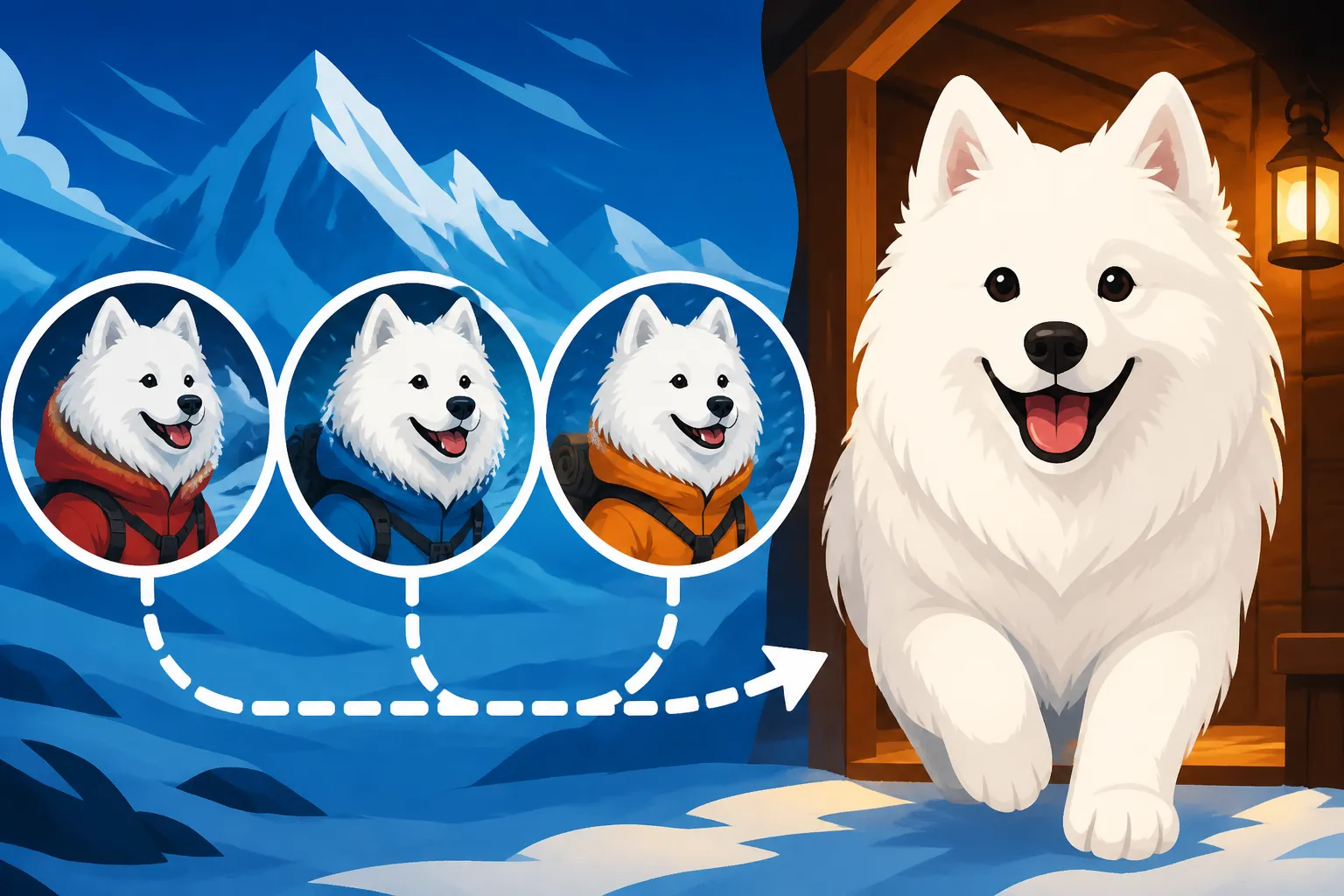
For an expedition dog, “came home” can mean several different things: surviving the journey, leaving Antarctica aboard a ship, reaching the expedition’s home country, or eventually living with a new owner. A dog might accomplish the first two without returning to the person who bred or originally owned it.
This distinction matters because sled dogs were working expedition animals, not always household pets travelling with a family. They could be reassigned, sold, given away, or kept by a handler after the voyage. Some were also killed during expeditions, either because they were injured or because explorers used dog meat to feed people and surviving dogs. A dog that left Antarctica alive might therefore still have had a difficult journey afterward.
There is another complication: historical writers sometimes used “Samoyed” broadly for northern, pale-coated sled dogs. The Samoyed breed has connections to dogs from northern Siberia, but explorers also used Greenland dogs and dogs described as Siberian, Eskimo, or husky. Those names do not always tell us exactly what a dog’s ancestry was. For the wider background, see How Polar Explorers Took Samoyeds Out of Siberia and Which Polar Expeditions Used Samoyeds.
Expedition rosters did not always record each dog’s fate
Ships’ logs, expedition diaries, and later accounts were usually written to document the journey, not to provide a complete life story for every dog. A record might say how many dogs were taken on a voyage, how many were at a camp, or how many returned on a ship, without naming all of them.
The count could also change along the way. Dogs might be lost to illness, injury, exhaustion, accidents, or the brutal conditions of travel. They could be redistributed between teams, and some expeditions deliberately reduced their number of dogs as supplies ran low. This is why a surviving dog’s name can be better documented than the fate of the rest of the team.
When trying to identify which expedition Samoyeds came home, it helps to ask three separate questions: Were the dogs genuinely Samoyeds, did they survive the work in Antarctica, and did they travel back from the continent? Those questions often produce different answers.
A useful guide to the best-known cases
The table below offers a cautious overview. It distinguishes famous individual dogs from larger teams, because the available accounts do not always provide a reliable name-by-name record.
| Expedition or dog | What is commonly reported | What “came home” means in this case |
|---|---|---|
| Roald Amundsen’s South Pole expedition | The dogs were largely Greenland-type sled dogs, though Etah is widely described as a Samoyed | Etah is remembered as a surviving dog who returned from the expedition; many other dogs did not survive the journey |
| Robert Falcon Scott’s Discovery expedition | The sled dogs were often described as Siberian dogs, with breed labels varying in later accounts | Dogs were taken away from Antarctica at the end of the expedition, but individual fates are not always easy to trace |
| Scott’s Terra Nova expedition | Dogs were brought for sled work, but the team suffered serious losses | Some dogs survived to leave Antarctica, while others died during the expedition |
| Ernest Shackleton’s Nimrod expedition | Dogs were part of the expedition’s transport plans | Dogs that survived could be returned by ship, but records are not consistent enough to treat every dog as a Samoyed |
Etah and the Amundsen expedition
Why Etah is the name most often connected with the South Pole
Etah is the best-known dog associated with the question of expedition Samoyeds coming home. She is often identified as a Samoyed and is remembered for reaching the South Pole with Roald Amundsen’s party. Her story is unusual because it connects the breed’s public history with one of the most famous polar journeys.
Still, Etah’s breed identity should be handled with care. Amundsen’s expedition relied heavily on Greenland sled dogs, and not every dog in a polar team can be confidently assigned a modern breed label. Historical terms did not always match today’s pedigree definitions. The basic story of Etah is widely told, but the broad label “Samoyed” does not mean that every dog on Amundsen’s team was one.
If you are reading accounts of the expedition, it helps to separate Etah’s individual story from the makeup of the entire team. Who Etah the Samoyed Was explores her identity, while Amundsen's Samoyeds gives more context about the dogs connected with the expedition.
Did Etah survive and return?
Etah is commonly described as having survived the expedition and returned from Antarctica. That makes her a clear example of a famous polar dog who came back from the ice, although “came back” does not necessarily mean that she returned to an ordinary home or to her original owner. After an expedition, a dog could travel onward with the explorers or be transferred to someone else.
The distinction between surviving the southern journey and having a documented later life is important. Expedition accounts tend to preserve a dog’s role in the adventure more clearly than the details of its life afterward. Etah’s continued public fame has generated several versions of what happened after the expedition, so it is wise to avoid treating every later detail as equally certain. For that next part of her story, see What Happened to the Samoyed Etah After the Expedition.
A polar dog’s survival also should not make the expedition sound comfortable or safe. The journey involved severe cold, demanding sled work, and the loss of many dogs. Etah’s survival is remarkable precisely because survival was not guaranteed for the animals or the people.
Why “the first dog at the pole” needs context
Etah is frequently described as the first dog to reach the South Pole, reflecting her connection to Amundsen’s successful expedition. That phrase refers to the expedition’s arrival at the geographic South Pole, not to a solo feat by one dog. She was part of a team of people and sled dogs whose work made the journey possible.
The phrase can also lead readers to assume that every dog in the team was a Samoyed. That is not a safe conclusion. Amundsen’s sled dogs were generally associated with Greenland, and historic descriptions of northern dogs can overlap or vary. Etah’s story is worth celebrating without turning the whole team into a single breed.
This is a familiar challenge in breed history: one famous animal can become the face of an event even when the full story involves many dogs with different backgrounds and fates. Etah, the Samoyed That Reached the South Pole First looks more closely at the way her name became tied to the polar achievement.
Scott and Shackleton’s dogs
The dogs on Scott’s expeditions
Scott’s expeditions are often discussed alongside Amundsen’s because both relied on dogs for travel in Antarctica. But “Scott’s dogs” can refer to more than one expedition, and the animals’ origins and fates varied. The Discovery expedition and the later Terra Nova expedition should not be collapsed into one story.
The dogs used on these journeys are often described as Siberian or husky-type sled dogs. Later summaries may call some northern dogs Samoyeds, but that label is not always supported by detailed records. When a source names a particular dog, it may be possible to follow that animal more confidently than to identify every member of a team by breed.
Some dogs were removed from Antarctica when an expedition ended or when relief ships came to the region. Others died before a return voyage. So the answer to “Did Scott’s Samoyeds come home?” depends on which expedition, which dog, and how strictly the term Samoyed is being used. The Samoyeds on Scott's Expedition discusses the dogs associated with Scott’s journeys, while What Happened to Expedition Samoyeds on the Ice focuses on the difficult question of survival and loss.
What can be said about Shackleton’s dogs
Shackleton’s Nimrod expedition is another part of the story, but it is easy for later retellings to blend the dogs from different polar journeys. Shackleton’s expedition used animals and equipment for Antarctic travel, and dogs were among the working animals associated with the journey. As with Scott’s teams, the record does not always provide a neat, complete roster of named dogs and their eventual homes.
If a dog survived and was taken aboard a returning vessel, that is evidence it came back from Antarctica. It does not automatically prove that the dog was a purebred Samoyed or that it was reunited with a specific owner. For a more focused account of the dogs linked to this expedition, see Shackleton's Samoyeds.
The broader lesson is that expedition survival stories are rarely as tidy as a list of dogs who lived and dogs who died. The dogs moved through a chain of handlers, camps, and ships, and the surviving paperwork often records practical details rather than personal ones.
Why the breed label can be uncertain
The Samoyed is historically connected to northern Siberian dogs, while polar expeditions also used dogs from Greenland and other northern regions. To a modern reader, a white, thick-coated sled dog in an old photograph may look unmistakably like a Samoyed. Appearance alone, however, cannot establish pedigree.
There are several reasons for the uncertainty. Expeditions obtained dogs through different suppliers and communities. Names such as “Siberian dog,” “Eskimo dog,” or “husky” could describe working type or origin rather than a documented breed. Later writers also sometimes applied familiar breed names retrospectively to dogs whose ancestry was never formally recorded.
That does not make the dogs’ stories less meaningful. It simply means that a careful account should distinguish “described as a Samoyed,” “believed to have been a Samoyed,” and “a dog from a team that included northern sled dogs.” Who Brought Samoyeds Out of Siberia gives useful background on how dogs connected to the breed reached Europe and became part of the polar-exploration story.
How to read claims about expedition dogs
Look for a named dog and a specific expedition
A reliable account should say which expedition it means. “Scott’s expedition” could refer to different journeys, and a dog’s fate might differ depending on the year and the ship that carried the team. A named dog also gives you a better chance of separating a documented individual from a later generalization.
When a claim says a Samoyed “came home,” check what home means in that telling. Did the dog merely leave Antarctica? Was it transported to England, New Zealand, or Norway? Is there evidence of its later owner or life? These are not picky distinctions; they prevent a dramatic expedition tale from being mistaken for a full biography.
Be especially cautious with claims that every dog returned, that all dogs on a team were Samoyeds, or that one animal’s experience represents the fate of the entire team. Polar expeditions were long and dangerous, and a dog’s circumstances could change substantially during the journey.
Separate survival from breed history
A dog may be well documented as surviving an expedition even when its breed is uncertain. Conversely, a group may be described as Samoyeds in a later retelling without enough detail to establish which individual dogs were genuinely of that breed. Keeping those two questions separate makes the history clearer.
For example, Etah’s survival and connection to Amundsen’s South Pole journey are central to her story. That does not make the broader dog team a Samoyed team. Similarly, the fact that Scott or Shackleton used northern sled dogs does not establish that every dog was a Samoyed or that every survivor returned to its original home.
A good account can hold both ideas at once: Samoyeds are part of the wider history of polar exploration, and the precise identity and fate of individual dogs can be difficult to verify from expedition-era records.
The most careful answer to the question
The clearest famous example is Etah, commonly described as a Samoyed who reached the South Pole with Amundsen’s expedition and survived to return from Antarctica. Dogs associated with Scott’s and Shackleton’s expeditions also survived and were taken away from the continent, but the breed labels and individual return stories are less straightforward.
So the short answer is not that a clearly documented group of purebred Samoyeds all came home. Rather, some polar dogs survived and returned by ship; Etah is the best-known Samoyed identified with that outcome; and the histories of other expedition dogs depend on which journey and which records are being discussed. That careful wording respects both the dogs’ real work and the gaps in the historical record.
Disclaimer
This article is for general informational purposes only and does not constitute professional advice. Laws, prices and regulations vary by location and change over time. Consult a qualified professional for guidance on your specific situation.