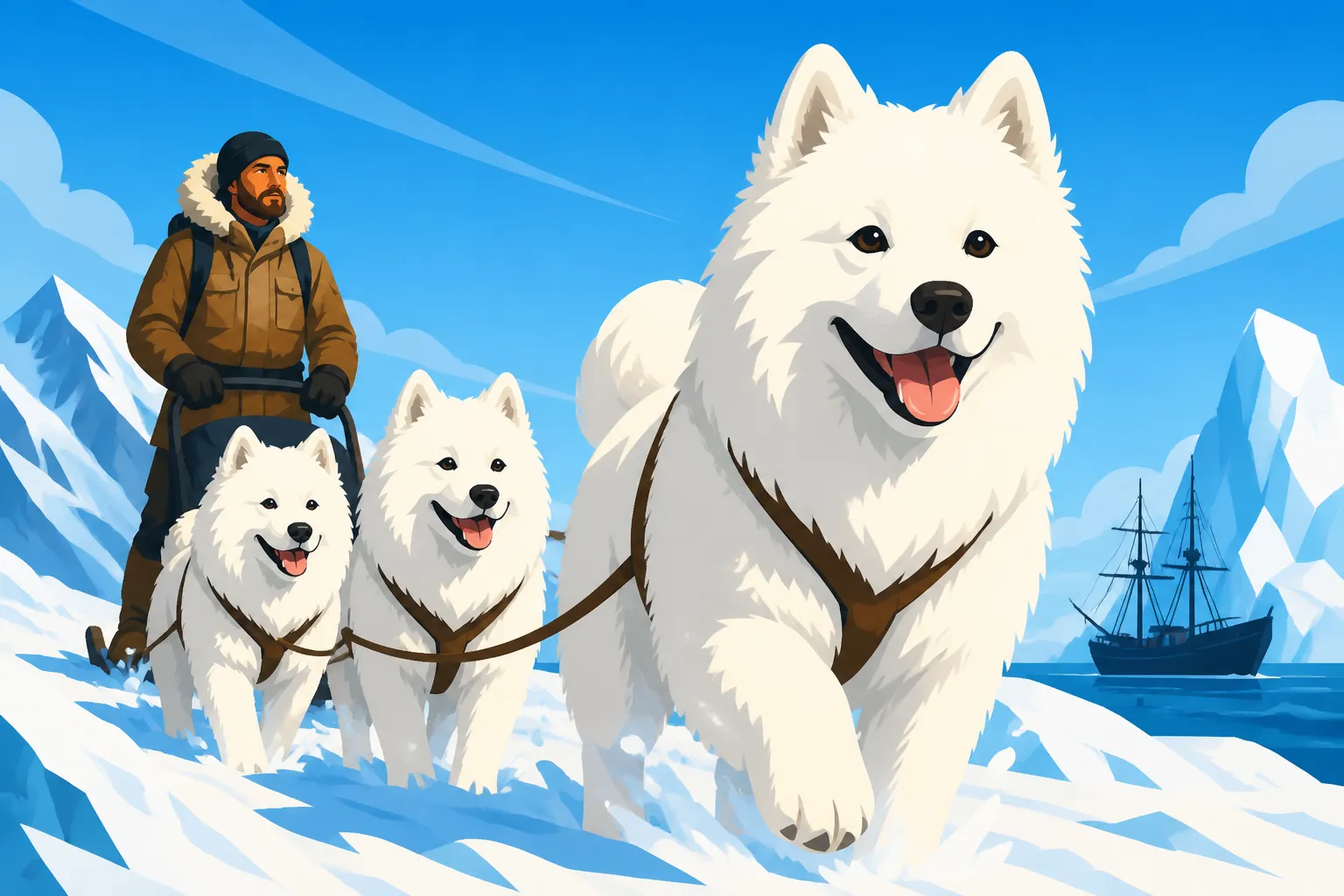
The Samoyeds on Scott’s Expedition
Scott’s Antarctic expedition is often remembered for the men who reached the South Pole and the tragedy of their return, but dog teams also played an important part in the journey. The dogs helped move supplies across the ice, yet they did not accompany Scott’s final party to the Pole. Here’s what they did—and why calling them Samoyeds needs some care.
Who were the dogs on Scott’s expedition
A team assembled for an Antarctic journey
Robert Falcon Scott’s Terra Nova expedition set out for Antarctica in 1910. It carried dogs as part of a larger transport plan that also included ponies and motor sledges. The dogs were meant to haul food and equipment over snow and ice, helping expedition members establish supply depots and travel across the Ross Ice Shelf.
Cecil Meares was responsible for acquiring and managing the dogs, with Dmitri Geroff among the expedition’s dog drivers. The animals were not companions brought along for a leisure trip; they were working dogs expected to pull loads in severe conditions. Their daily lives involved harnesses, sledges, feeding, and long stretches of travel over difficult terrain.
The word “Samoyed” can be confusing in accounts of early polar exploration. Historical writers sometimes used breed names loosely, and the dogs bought for an expedition were not always described with the precision expected from a modern pedigree record. Scott’s dogs are generally discussed as Siberian sled dogs. It is safer not to assume that every dog on his team was a Samoyed in today’s breed-specific sense.
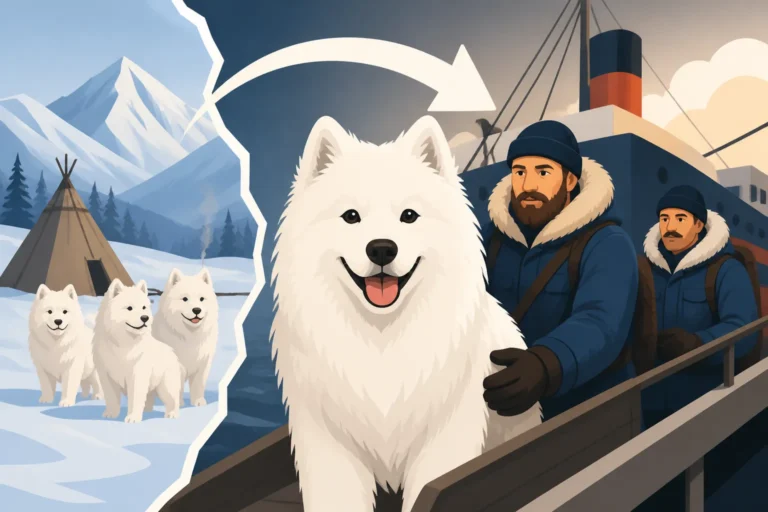
That distinction matters because expedition dogs were often grouped by where they came from, what they looked like, or the work they did. The broader history of the dogs taken south is explored in How Polar Explorers Took Samoyeds Out of Siberia, while The Samoyed Against the Husky and the Malamute explains why these northern breeds can be mistaken for one another.
Why the breed label is not always clear
A modern Samoyed is a recognizable breed with established standards and records. Early twentieth-century expedition teams, by contrast, were assembled for practical work. Dogs might be purchased in remote regions, shipped across continents, and described by people who were not focused on formal breed classification. That makes it difficult to apply today’s labels with complete confidence.
There is also a difference between saying “Samoyed-type” and identifying a dog as a purebred Samoyed. A dog with a pale coat, a thick double coat, and a northern origin might be called a Samoyed in a popular account, yet those features alone do not prove its ancestry. Sled dogs from Siberia and other northern regions could share traits while belonging to different types or mixed lines.
So when someone asks whether Samoyeds were on Scott’s expedition, the most careful answer is that Scott’s expedition had Siberian sled dogs, and some historical references may use Samoyed terminology broadly. The available descriptions do not justify treating the whole team as a group of modern, registered Samoyeds. This is a small wording difference with a big effect on how accurately the expedition’s history is told.
What the dogs did in Antarctica
Hauling supplies and supporting the depot system
The dogs’ most important contribution was practical: they helped move supplies. Antarctic travel depended on carefully placed depots, where food and fuel could be stored ahead of time. A party travelling south could then collect provisions along its route instead of carrying everything from the coast in one enormous load.
Moving supplies over the ice was punishing work. Sledges had to cross uneven surfaces, soft snow, and pressure ridges, while the dogs pulled in harnesses and the people travelling with them managed the loads and route. A successful depot journey was not simply a matter of going from one point to another. The team had to reach the right location, leave supplies securely, and make the return journey with enough provisions to survive.
This logistics work is easy to overlook because it happened before the expedition’s most famous moment. The South Pole party’s progress depended in part on a wider network of journeys, people, animals, and stored food. Scott’s expedition did not rely on the dogs alone, but their hauling helped move equipment and provisions through the Antarctic landscape.
The role of animals in polar exploration varied between expeditions. Why Antarctic Explorers Chose Samoyeds looks at the qualities explorers sought in northern dogs, while Shackleton's Samoyeds offers a useful comparison with another British Antarctic expedition.
The dogs were not part of Scott’s final push to the Pole
Scott’s journey to the South Pole was not a single party travelling south from the ship with every member and animal. It involved stages, support teams, and decisions about who would continue. Dogs were used during supply work, but Scott’s final group travelled the last part of the route without them.
That choice reflected the expedition’s transportation plan and the way the journey was organized. Scott’s polar party ultimately man-hauled its sledges. The men pulled heavy loads themselves across the ice, a physically exhausting method that has become closely associated with the expedition. The dogs’ absence from the final push does not mean they were unimportant; it means their main work was connected to support and transport rather than the last stage of the race.
The distinction also helps clear up a common misunderstanding. The dogs did not accompany Scott and his four companions all the way to the Pole and then perish with them on the return journey. Scott’s party died on its way back, but the dogs belonged to the expedition’s wider transport system and were handled separately from the final polar party.
For a broader account of the animals and their difficult journeys, see What Happened to Expedition Samoyeds on the Ice. The role of dogs on a competing Norwegian expedition is covered in Amundsen's Samoyeds, where the transport strategy differed significantly.
The dogs’ journey and the expedition’s outcome
A journey shaped by weather, distance, and limits
Antarctic travel placed enormous demands on dogs and people alike. The cold was only one challenge. Deep snow could make pulling slow and exhausting, while rough ice made sledges difficult to control. The amount of food carried mattered, too: a team needed provisions for the dogs as well as for the people, and every additional load affected how far the party could travel.
A dog team could be valuable when conditions and planning aligned, but it was not a simple solution to every problem. The expedition had to decide when to use the dogs, what loads they could haul, and when their journeys should end. On long trips, choices about animal welfare, food, and return routes were part of the same practical calculations as fuel and human rations.
The dogs’ work belongs in the story of Scott’s expedition, but it should not be romanticized. They were working animals in a high-risk environment, and the expedition’s planning choices shaped their experience. At the same time, they were not incidental baggage: without transport support and depot work, the movement of supplies across the ice would have been harder.
Scott’s death does not tell the dogs’ whole story
Scott and the members of his polar party died during the return from the South Pole in 1912. Their fate is the central tragedy of the expedition, but it is separate from the dogs’ outcome. The dogs were not with the men in the tent where Scott and his companions died, and their story should not be folded into the final events as if they all shared one journey.
The expedition’s transport parties had different responsibilities and different timelines. Some dogs were part of earlier supply journeys; others were managed as the expedition changed plans and moved through its Antarctic season. As a result, accounts of the dogs need to be read with attention to which party, journey, and period they describe. “Scott’s dogs” can refer to the team associated with the expedition as a whole, not one group that followed Scott continuously.
That is one reason the wider history of expedition dogs is worth exploring. Different teams served different purposes, and the same broad label may conceal very different origins and experiences. Which Expedition Samoyeds Came Home examines what happened to dogs associated with polar journeys, while The Year the First Samoyed Reached England provides context for how northern dogs became better known outside their homelands.
How to understand the Samoyed connection
What can be said with confidence
Scott’s Terra Nova expedition used sled dogs to support Antarctic travel and supply work. The animals helped haul loads and played a role in the broader logistics of the expedition. Scott’s final party did not take dogs all the way to the Pole; its members man-hauled their sledges during the final stage.
It is also reasonable to say that historical accounts may use breed terms differently from modern sources. The dogs were commonly described as Siberian sled dogs, and the word “Samoyed” may appear in discussions of early polar dogs. But a broad historical label does not establish that each animal was a purebred Samoyed as the breed is understood today.
This careful phrasing avoids two opposite mistakes: erasing the dogs’ contribution, or claiming more certainty about their breed than the records support. Acknowledging uncertainty about exact breed identity does not diminish their work. It simply keeps the distinction clear between a dog’s historical role and a modern breed classification.
Why their story still matters to Samoyed owners
For Samoyed owners, Scott’s expedition can prompt a familiar question: how much of a dog’s behavior comes from its working history? The breed’s northern heritage is associated with endurance, companionship, and cooperation with people, but an individual Samoyed is not a polar expedition dog living in a modern home. Historical work provides context, not a ready-made training manual.
It is still useful to remember that northern dogs were valued for more than their appearance. Their thick coats, stamina, and willingness to work were part of the reason explorers sought dogs from cold regions. Today, those same traits can show up in ordinary ways: a Samoyed may thrive on outdoor activity, need regular engagement, and be happiest when included in family life. That does not mean every dog should pull a sled, but it does help explain why a short walk around the block may not satisfy every individual.
Scott’s dogs also remind us that the history of a breed is not always a neat line from past to present. Expedition records, informal labels, mixed ancestry, and changing terminology all complicate the picture. The safest takeaway is that dogs were an important part of Scott’s Antarctic transport system, while the precise Samoyed identity of the team should not be overstated.
| Question | Most careful answer |
|---|---|
| Did Scott’s expedition use dogs? | Yes. Sled dogs supported transport and supply work. |
| Did the dogs reach the South Pole with Scott’s final party? | No. Scott’s final party man-hauled its sledges. |
| Were all the dogs modern Samoyeds? | That is not established; the dogs are generally described as Siberian sled dogs. |
| Did the dogs die with Scott’s polar party? | No. They were part of separate transport work and were not in the party’s final camp. |
| Why do accounts use different breed names? | Early expedition descriptions and breed labels were not always consistent with modern classifications. |
Disclaimer
This article is for general informational purposes only and does not constitute professional advice. Laws, prices and regulations vary by location and change over time. Consult a qualified professional for guidance on your specific situation.