Whether a Samoyed Is Related to the Chow Chow
A Samoyed and a Chow Chow can look like distant cousins: both are sturdy, thick-coated dogs with upright ears and a curled tail. But resemblance does not prove that one breed descended from the other. This guide explains what they share, where their histories differ, what DNA can and cannot tell you, and how to assess a dog who may be a Samoyed-Chow mix.
Are Samoyeds and Chow Chows related
In a broad sense, yes: both belong to the ancient spitz family of dogs, a varied group often recognized by prick ears, dense coats, and tails carried over the back. But that does not establish that Samoyeds came from Chow Chows, that Chow Chows came from Samoyeds, or that the breeds are close relatives in the way that two recently developed breeds might be.
A useful comparison is two languages that share old roots but developed in different places. Their features can hint at common ancestry without showing a direct line from one modern breed to the other. The Samoyed and Chow Chow both carry traits associated with northern and Asian spitz-type dogs, yet their breed histories and traditional roles are distinct.
Shared spitz features do not prove direct descent
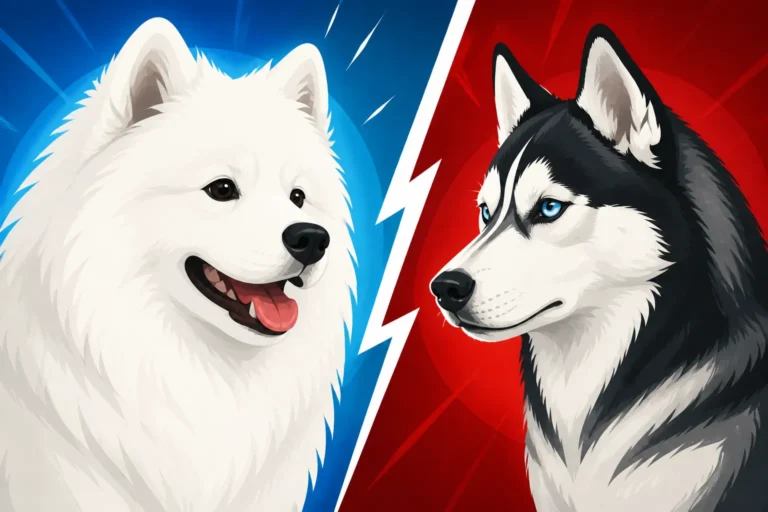
The resemblance is easy to notice. Both breeds can have a thick double coat, a compact and substantial build, pointed ears, and a tail that curves over the back. Those traits are common across numerous spitz breeds, however, and can reflect shared ancestry far back in canine history rather than a close, recent connection between these two breeds.
Their coats also create a visual shortcut that can be misleading. A fluffy Samoyed may look broadly “Chow-like” to someone who is thinking mainly about coat and silhouette. But coat color, coat length, head shape, and expression vary considerably among spitz breeds. Similar features are clues to investigate, not proof of a particular family tree.
For more context on the Samoyed’s own background, see The Nenets of the Yamal Peninsula Bred the Samoyed. That history centers on the Nenets people and the dogs they relied on in the Arctic. It is different from the history commonly associated with the Chow Chow, which is connected to China.
Their histories and traditional work are different
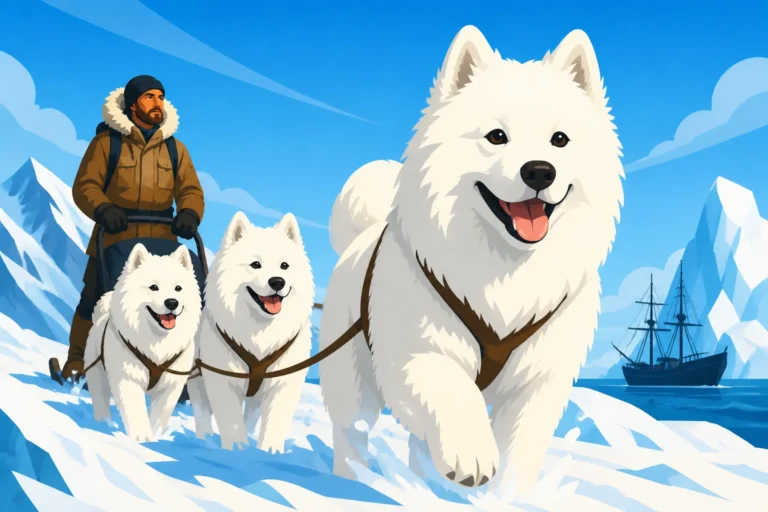
The Samoyed was shaped by life with the Nenets in the far north of what is now Russia. Samoyed-type dogs helped with tasks such as herding reindeer and pulling sleds, and they lived close to the families who depended on them. Their work called for stamina, a weather-resistant coat, and a cooperative relationship with people.
The Chow Chow’s history developed in a different part of Asia. The breed is commonly associated with China, where dogs of this type were kept for varied roles over a long period. The details of ancient breed histories are not always as tidy as a modern pedigree chart, but there is no well-established account that makes the Chow Chow the direct ancestor of the Samoyed.
A Samoyed’s working background is explored in What the Nenets Bred the Samoyed to Do. Meanwhile, The Samoyed Against an American Eskimo Dog offers another useful reminder: dogs can share broad spitz traits while remaining distinct breeds with different histories, sizes, and temperaments.
What similarities and differences should you look for
If you are comparing the breeds in person, look beyond a fluffy coat. Head shape, expression, movement, coat texture, and behavior can all help you understand what you are seeing, but individual dogs vary. A purebred dog may not match every familiar visual stereotype, and a mixed-breed dog may inherit an unexpected combination of features.
Neither appearance nor a single personality trait can confirm ancestry. A calm Chow Chow is not necessarily mixed with a Samoyed, and a vocal, friendly Samoyed is not necessarily carrying Chow Chow ancestry. Breed tendencies can be useful background, but they are not a dependable substitute for knowing the individual dog.
A side-by-side look at the breeds
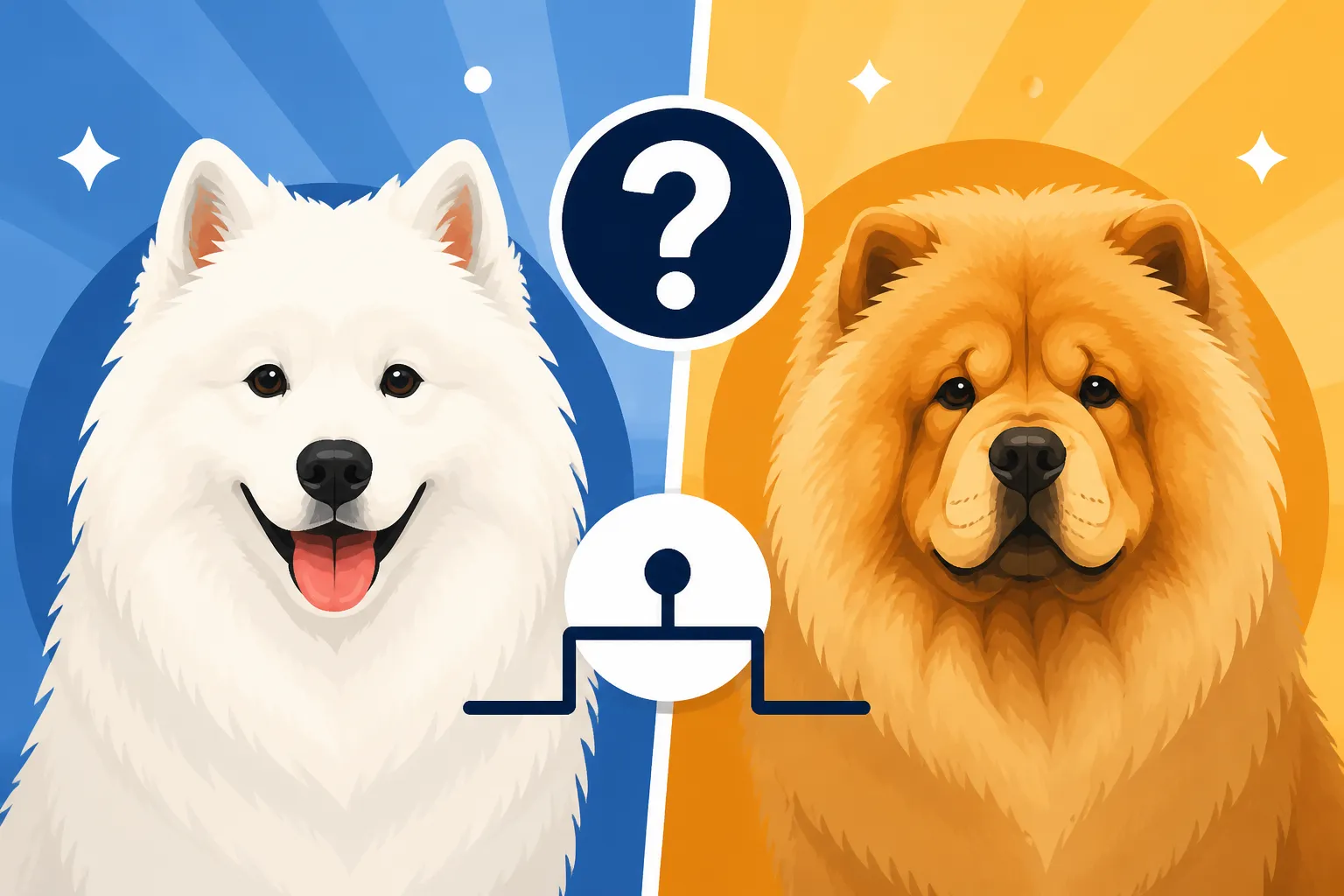
| Feature | Samoyed | Chow Chow |
|---|---|---|
| Broad type | Spitz-type working breed | Spitz-type breed |
| Historical association | Nenets communities in northern Russia | China |
| Traditional roles | Reindeer herding, sled pulling, close family companionship | Varied roles across its long history |
| Typical coat impression | Abundant, stand-off double coat; usually white or shades of biscuit | Dense coat that may be rough or smooth; commonly seen in several colors |
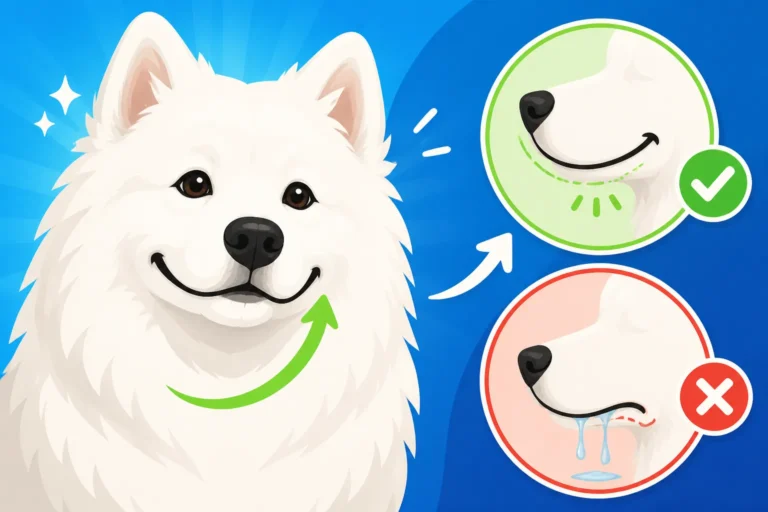
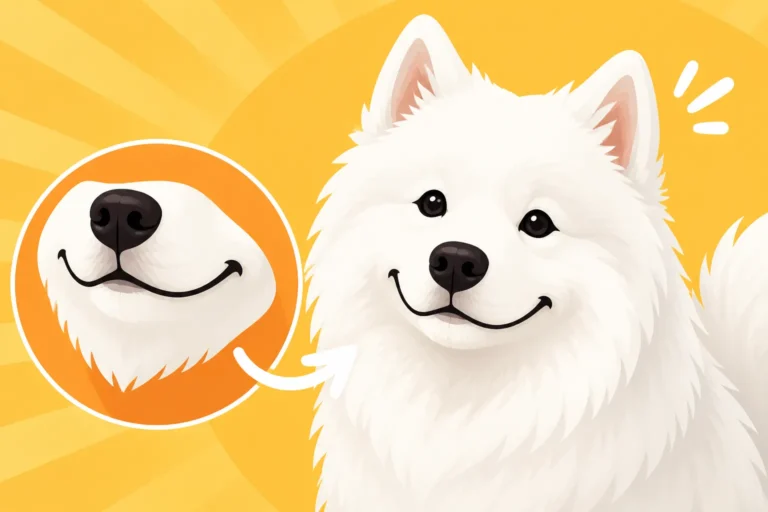
| Common expression | Upturned mouth that creates the familiar “Sammy smile” | Broad head and distinctive frowning expression |
| Tongue | Usually pink, though dark spots may occur | Characteristically blue-black in adult dogs |
| Temperament in broad terms | Often social, energetic, and people-oriented | Often more reserved and independent |
| What appearance can prove | Nothing conclusive about another breed’s ancestry | Nothing conclusive about another breed’s ancestry |
The table describes common breed features, not rules that every dog follows. For a deeper look at the Samoyed’s appearance, Why the Samoyed Smiles explains the distinctive expression, while The Colors a Samoyed Comes In covers the range of recognized coat colors and markings.
One especially noticeable difference is the Chow Chow’s blue-black tongue. Samoyeds do not typically have the same solid blue-black tongue; some can have dark spots on the tongue, which is not the same feature. Tongue color alone still cannot diagnose a dog’s ancestry. If a dog has an unusual change in mouth color or another sudden physical change, a veterinarian is the right person to ask.
Similar coat does not mean similar grooming needs
Both breeds have substantial coats, but coat care depends on the individual dog, its coat type, and how much undercoat it has. A Samoyed’s coat can shed heavily, especially during seasonal coat changes, and mats can form where friction and moisture collect. Chow Chows also need consistent grooming, with needs varying between rough-coated and smooth-coated dogs.
For a possible mix, plan for the coat in front of you rather than assuming it will be exactly like either parent breed. Check behind the ears, under the collar, around the legs, and at the tail base. These areas can tangle before the rest of the coat looks messy, so a regular hands-on check is more useful than waiting until knots are visible from across the room.
If you are assembling basic coat-care supplies, you might compare brush and comb options at retailers such as Chewy, then ask a groomer which tools suit your dog’s coat texture. A grooming tool that works well on a dense Samoyed undercoat may not be the best choice for every Chow coat or cross. For a Samoyed-specific routine, see How Often a Samoyed Needs Brushing.
Can a DNA test tell you whether a dog is related
A dog DNA test may estimate breed ancestry and can help investigate whether a mixed-breed dog has Samoyed or Chow Chow in its background. It cannot reconstruct every ancestor with certainty, and its result should be treated as an estimate based on the company’s reference data and testing method.
That distinction matters when a dog has an unusual appearance. A DNA result is not the same as a pedigree, and a pedigree is not the same as proof of health. If you are considering buying a puppy described as a purebred Samoyed or Chow Chow, ask for the relevant registration and health information rather than relying on a visual guess or an ancestry result alone.
What an ancestry test can and cannot show
Most consumer ancestry tests compare a dog’s genetic markers with reference samples assigned to breeds. The report may estimate the proportion of a dog’s ancestry associated with particular breeds, but the precision can vary. A result listing one breed does not necessarily mean that a known purebred dog from that breed appears in the recent family tree. Likewise, a small percentage should not be treated as a complete historical explanation.
Mixed ancestry can also be difficult to interpret when breeds share older genetic relationships or when a dog’s family background is unknown. Two dogs with similar looks may receive different results, and a test may not identify every breed contribution equally well. Results can be informative, but they are not a perfect family record.
If you want to understand what a Samoyed-specific health screen is designed to find, The DNA Test That Finds the Samoyed Kidney Gene is a separate topic. A breed-ancestry test and a health test answer different questions: one estimates breed background, while the other looks for particular genetic variants associated with health risks.
When a possible mix needs more than a visual guess
If you adopted an adult dog with no reliable background, ancestry testing may satisfy curiosity, but it is usually more helpful to start with the dog’s needs. Ask a veterinarian about a health assessment, keep a record of weight and appetite, and pay attention to energy level, breathing, skin, ears, and movement. These details matter regardless of whether the dog is part Samoyed, part Chow Chow, or neither.
For a puppy from a breeder, ask what health screening was done on the parents and whether the breeder can explain the results. A responsible breeder should be willing to discuss the purpose and limits of testing, not just show a breed label. The Health Tests Both Samoyed Parents Should Have is a useful starting point for understanding what health information to ask about when a Samoyed is involved.
If you are choosing a DNA kit, read the provider’s description carefully and make sure it answers the question you actually have. Some tests focus on ancestry, some focus on health variants, and some combine different types of results. Do not assume one test covers every condition or can certify that a dog is free from all inherited disease.
What to expect from a Samoyed-Chow mix
A Samoyed-Chow mix can inherit traits from either parent in combinations that are hard to predict. The dog might have a thick coat, a curled tail, a more reserved manner, a highly social temperament, or some blend that does not neatly match either breed. Even puppies from the same litter can differ in coat, size, and behavior.
For that reason, it is safer to prepare for the practical demands that both breeds can bring rather than expecting a mix to be an “average” version of the two. Plan for ongoing grooming, thoughtful training, and individual socialization. A dog’s behavior is shaped by genetics, early experiences, health, and the environment it lives in.
Temperament can vary widely between individual dogs
Samoyeds are often described as people-oriented and active, while Chow Chows are often described as more independent or reserved. These are broad tendencies, not guarantees. A particular Samoyed may be quieter than expected, and a Chow Chow may be more outgoing than the stereotype suggests. A mix could lean toward either pattern or show a combination of traits.
Meet the dog, if possible, and look at how it responds to ordinary situations: a new person approaching, a change in surroundings, handling, other dogs, and brief periods of separation. With a puppy, ask the breeder or rescue what the puppy has experienced so far. With an adult, allow time to settle in before deciding that a behavior is permanent. A dog that seems withdrawn during the first week in a new home may simply be adjusting.
Training should be calm, consistent, and adapted to the individual. Rewarding behaviors you want to see, using short practice sessions, and giving the dog a predictable routine can help build trust. If the dog shows fear, guarding, or difficulty coping around people or animals, seek guidance from a qualified trainer or veterinary behavior professional rather than assuming the behavior comes from one breed.
Prepare for coat care and day-to-day needs
A dense coat can hide tangles and make a dog look larger than it is. Set aside time for brushing and check the skin as you go, especially in warm weather or after outdoor activities. If the coat is badly matted, painful, or difficult to manage, ask a professional groomer or veterinarian for help instead of pulling at knots or attempting a drastic haircut at home.
Retailers such as Chewy can be one place to compare basic grooming supplies, but the best choice depends on the dog’s coat and tolerance for grooming. Introduce tools gradually, pair handling with rewards, and stop before the dog becomes distressed. For food, choose a complete diet appropriate to the dog’s age and health, and make changes gradually with veterinary guidance; Chewy may be convenient for comparing food labels, but a retailer’s product listing is not a substitute for tailored nutrition advice.
The Samoyed’s relationship with cold weather also does not mean every thick-coated dog is comfortable in heat. Provide shade, water, and a cool resting space, and watch for heavy panting, weakness, or unusual behavior during warm conditions. A mixed dog’s coat may not behave exactly like either parent’s, so use the dog’s comfort and your veterinarian’s advice rather than relying on breed assumptions.
Make decisions from the dog in front of you
The clearest answer is that Samoyeds and Chow Chows share broad spitz-type characteristics and may have distant shared ancestry, but the Samoyed is not generally understood to descend directly from the Chow Chow. Their histories developed in different places and around different human communities and roles.
If you are looking at a particular dog, appearance can suggest possibilities but cannot settle the question. A reliable background, careful health information, and—if useful—an ancestry test can give you more context. Above all, make care decisions around the dog’s actual coat, health, behavior, and daily needs, not a guess based on its resemblance to a breed.
Disclaimer
This article is for general informational purposes only and does not constitute professional advice. Laws, prices and regulations vary by location and change over time. Consult a qualified professional for guidance on your specific situation.