Whether the Samoyed Etah Was Named for a Greenland Village
Etah’s name is often connected to Etah, a place in northwestern Greenland, but a familiar story is not automatically a documented fact. The uncertainty is understandable: accounts of the famous polar dog mix breed labels, expedition history, and later retellings. This guide explains what the place-name theory says, what it does not prove, and how to assess the story carefully.
Was Etah named after the Greenland settlement?
The connection between the dog and the place
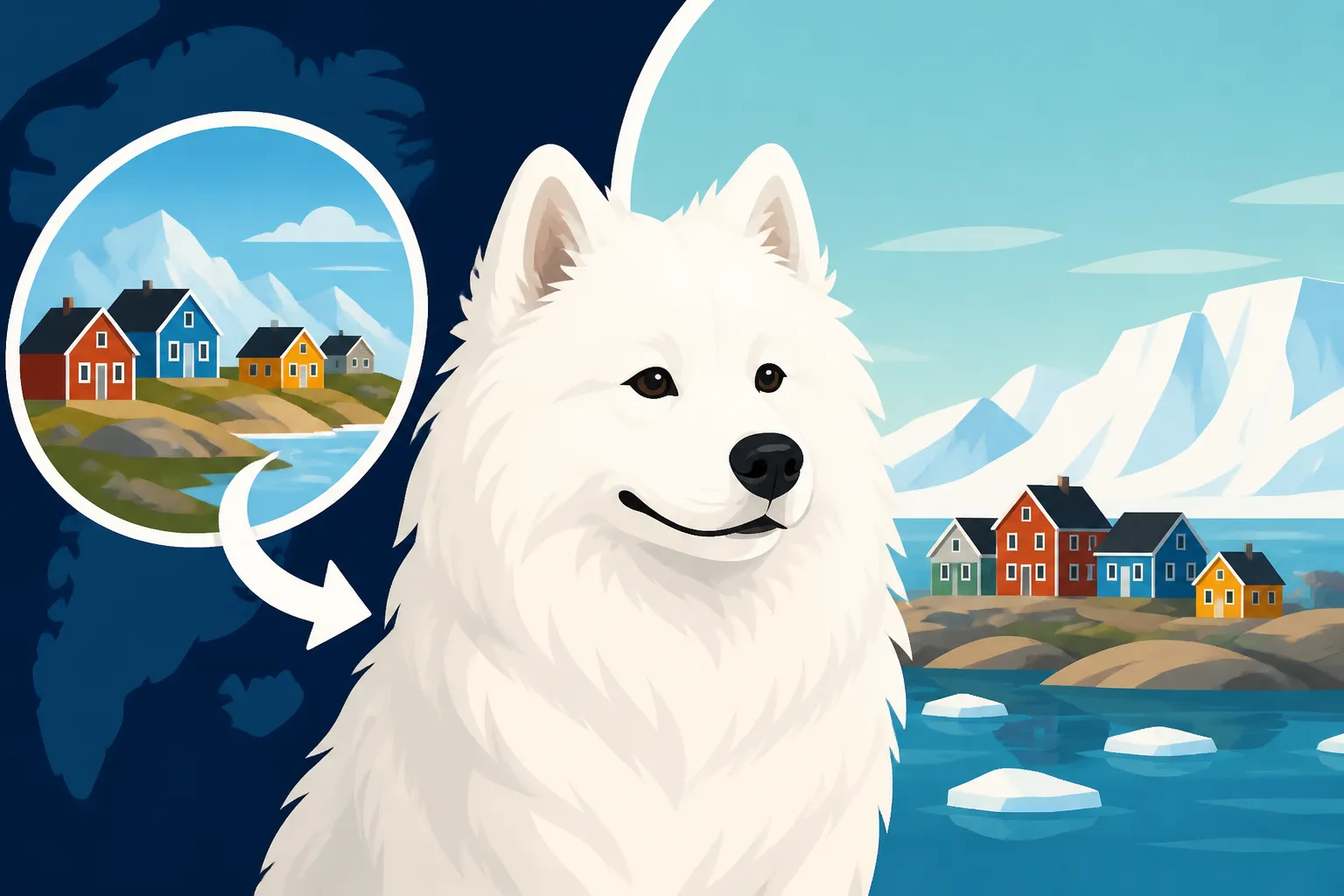
Etah is the name of a settlement in northwestern Greenland, near Smith Sound and the broader region explorers associated with Arctic travel. The dog Etah is remembered in accounts of polar exploration, particularly for her association with Roald Amundsen’s expedition to the South Pole. Because the names match, it is natural to ask whether the dog was named after the Greenland settlement.
That explanation is commonly repeated: the dog’s name was inspired by Etah in Greenland. It is plausible in the context of polar exploration, where people, dogs, and place-names moved through overlapping Arctic histories. But a plausible explanation is not the same as a securely documented one. The matching name alone cannot prove who chose it or why.
It also helps to distinguish the place from the dog’s birthplace. Even if Etah the dog was named for the Greenland settlement, that would not establish that she was born there, lived there, or belonged to a particular community there. A place-name can be commemorative, practical, personal, or simply chosen because it sounded appropriate.
For a broader account of the dog herself, see Who Etah the Samoyed Was. The story of her name is one piece of a much larger history, and it should not be treated as a complete record of her origins.
What makes the Greenland theory plausible
The setting makes the theory appealing. Etah the dog became known through a story of travel across extreme northern and southern landscapes, while Etah the settlement is associated with Greenland’s Arctic geography. Explorers often gave dogs names that reflected people, places, or experiences from their travels. Against that backdrop, naming a dog after a northern settlement would make sense.
There is another reason the explanation has endured: it gives the name a neat origin story. A short, distinctive name tied to an Arctic place feels like it belongs in an account of polar exploration. That satisfying fit can help a detail survive in retellings even when the original naming moment is not recorded in a source readers can readily check.
Still, the theory should be described as a reported or commonly repeated explanation rather than an established certainty. Unless a reliable contemporary account clearly says who named the dog and what the name referred to, the safest wording is that Etah may have been named for the Greenland settlement. That preserves the likely connection without presenting an inference as a proven fact.
What the name does and does not tell us
A place-name is not proof of breed or ancestry
The story of Etah’s name sometimes gets tangled with another question: what kind of dog was she? Some later accounts call her a Samoyed, while discussions of polar expeditions also involve Greenland dogs and other northern sled dogs. Historical breed labels can be inconsistent, especially when modern breed categories are applied to dogs recorded in older expedition accounts.
A name connected to Greenland would not settle that question. Dogs can be named after places far from where they were born, and a dog’s name does not establish its pedigree. To assess breed identity, readers need information about the animal’s documented ancestry and the terminology used by people close to the expedition—not just an appealing explanation for the name.
That distinction matters because a memorable story can make several uncertain details seem certain at once. Someone may read that Etah was named after a Greenland place and then assume she was born there, was a Greenland dog, or belonged to a modern Samoyed lineage. Those conclusions do not follow from the name by itself. The broader history of the breed is explored in How Polar Explorers Took Samoyeds Out of Siberia and The Nenets of the Yamal Peninsula Bred the Samoyed.
Why historical breed labels can be confusing
Modern breed names are often used as shorthand in popular histories. They help readers picture a dog, but they may not match the way an expedition’s records described that individual. A dog could be called a “Samoyed” in a later account even if the original documentation used a broader or different label.
The challenge is especially clear with sled dogs. Their work depended on practical qualities such as stamina, cold tolerance, and cooperation in a team. Dogs from different northern regions could look or work similarly, and expedition writers did not always use breed terms with the precision expected in modern pedigree records.
So when a source identifies Etah as a Samoyed, it is worth asking what kind of source it is and when it was written. Is it a contemporary expedition record, a later biography, a breed history, or a modern summary? Each can be useful, but they do not carry the same weight for establishing a dog’s identity. Whether Samoyeds Reached the South Pole provides further context for the breed’s place in polar-exploration stories.
How to assess claims about Etah’s name
Separate documented facts from repeated explanations
When checking an origin story, start by separating the parts of the claim. One claim is that a dog named Etah was associated with an Antarctic expedition. Another is that the dog was called a Samoyed. A third is that her name came from the Greenland settlement. Those claims may have different levels of evidence, even when they appear together in a single paragraph online.
Look for the wording used by the source. Phrases such as “was named after” imply a firm answer. Phrases such as “is believed to have been named after” or “may have been named for” signal that the author is reporting a possibility. If later articles repeat the same sentence without showing where it came from, repetition should not be mistaken for independent confirmation.
A useful habit is to ask whether a source explains the naming event. Does it identify the person who chose the name? Does it refer to a diary, letter, expedition account, or another contemporary record? If not, the place-name connection may still be credible, but the evidence is thinner than a definitive statement suggests.
Keep modern commercial labels in their proper place
Today, owners often encounter breed names through product descriptions, shopping filters, and general pet-care pages. Chewy can be useful when someone needs to find ordinary supplies for a Samoyed, but a retailer’s breed category is not historical evidence about an expedition dog. A Chewy listing cannot verify Etah’s ancestry or explain how she received her name.
That distinction is helpful well beyond this one story. A modern product label may use a familiar breed name because it helps shoppers find a brush, harness, or food bowl. It is not designed to document a dog’s lineage from a century ago. Even a Chewy page that correctly categorizes products for today’s Samoyed owners would not establish whether Etah was named after a Greenland settlement.
When the question is historical identity, prioritize expedition records and carefully researched histories. Use contemporary shopping and care resources for present-day ownership questions, not as substitutes for historical documentation. The name “Etah” can prompt a fascinating search, but the explanation for it should stand on historical evidence rather than on how the name is categorized today.
Etah in the wider story of polar exploration
A dog’s name can become part of a larger legend
Etah is remembered not only as an individual dog but as part of the larger story of dogs used in polar travel. In those accounts, dogs were working animals: they pulled loads, helped teams cross difficult terrain, and depended on attentive handling for food, rest, and care. The human retelling often centers on an expedition’s destination, while the dogs’ individual histories can be harder to recover.
That imbalance is one reason a name-origin story becomes so attractive. A detail such as “named after a Greenland settlement” gives the reader a link between a particular dog and a place on the map. It helps turn an expedition animal into a character with a traceable connection to the Arctic. But the appeal of that connection is not proof that every part of the story is documented.
For more on how Etah fits into later accounts, read What Happened to the Samoyed Etah After the Expedition and Which Expedition Samoyeds Came Home. These histories can help separate what is known about the dog’s life from what later stories add around it.
A careful answer to the question
So, was Etah the dog named for the Greenland settlement? Possibly, and that is the explanation often given, but the connection should be presented with care unless it is supported by a clear contemporary record. The shared name makes the theory plausible; it does not, by itself, establish the naming story.
The distinction may feel fussy when the explanation seems harmless, but it makes historical writing more trustworthy. Readers can still enjoy the Greenland connection while understanding that it is a reported theory rather than an unquestionable fact. And keeping the name separate from questions of birthplace and breed avoids turning one appealing detail into several unsupported conclusions.
A careful version of the story is therefore simple: Etah, the polar dog, is often said to have been named after Etah in Greenland, but the precise origin of the name is not certain. That answer respects the tradition without claiming more than the evidence can show.
Disclaimer
This article is for general informational purposes only and does not constitute professional advice. Laws, prices and regulations vary by location and change over time. Consult a qualified professional for guidance on your specific situation.