Whether an Intact Male Samoyed Roams
It’s a tale as old as time for many Samoyed owners: one moment your fluffy white companion is happily romping in the yard, and the next, he's a white streak disappearing down the road, nose to the ground, off on an adventure. This common, heart-stopping scenario often plagues owners of intact male Samoyeds, leaving us frantic and wondering why our otherwise devoted dogs suddenly develop a severe case of wanderlust. This guide will dive deep into the instinctual reasons behind an intact male Samoyed's desire to roam and equip you with robust strategies to keep your beloved four-legged family member safe and sound at home.
The Irresistible Call of the Wild: Why Intact Samoyed Males Roam
Understanding why an intact male Samoyed feels such an overwhelming urge to roam isn't about blaming them; it's about acknowledging their biological programming. These aren't inherently "bad" dogs, but rather creatures driven by powerful, ancient instincts that can override even the best training and the strongest bonds. Their world is dictated by scent, and the presence of a female in heat is an almost irresistible siren song.
The Scent That Drives Them Home (and Away From Yours)
Imagine a smell so potent, so utterly compelling, that it eclipses every other thought in your mind. For an intact male Samoyed, the scent of a female in estrus (in heat) is precisely that powerful. These pheromones are airborne chemical signals that can travel for miles, carried on the wind, lingering in the grass, and permeating the very air we breathe. What might be an undetectable nuance to our human noses is a blaring, neon sign for a Samoyed's incredibly sensitive olfactory system, calling him to his primal purpose.
This isn't about your dog being disobedient or not loving his home. It's an instinct woven deeply into the fabric of canine existence: the imperative to reproduce. When that scent hits, it triggers a cascade of hormonal responses that override learned behaviors, comfort, and even fear. His focus narrows entirely on locating that potential mate, and every fiber of his being compels him to follow the trail, no matter where it leads or what obstacles lie in his path. It’s a force far more potent than any treat or command in that moment.
The frustration this causes for owners is immense. You might feel betrayed or confused, especially if your Samoyed is usually a perfect angel. But understanding that this drive is a biological imperative, not a personal slight, can help you approach the situation with more empathy and focus on prevention rather than trying to "fix" an instinct. It means acknowledging that his brain is telling him something fundamentally different from what your training has taught him, at least temporarily.
Instinct Over Obedience: A Samoyed's Primal Programming
We adore our Samoyeds for their intelligence and their playful, sometimes mischievous, nature. But it's important to remember that they are still very much dogs, with instincts that have been honed over millennia. For an intact male, the reproductive drive is a cornerstone of this programming. Even the most thoroughly trained Samoyed, one who reliably performs complex commands in calm environments, can find his obedience completely undermined by the presence of a nearby female in heat. It's like trying to reason with someone who is experiencing an overwhelming emergency – their focus is entirely on the immediate, primal need.
This phenomenon isn't a reflection of poor training, nor is it a sign that your Samoyed doesn't respect you. It's simply the power of nature asserting itself. He isn't thinking about the dangers of traffic, the anxiety you'll feel, or the cozy bed waiting for him at home. His entire being is channeled towards one singular goal: finding that female. This profound, single-minded focus is why an intact male can suddenly become deaf to your calls, blind to familiar boundaries, and surprisingly resourceful in his escape attempts.
Recognizing this primal pull is crucial for responsible ownership. It means understanding that while training is vital, it might not be enough to override this specific, powerful instinct 100% of the time. Therefore, containment and proactive management become even more critical than for a neutered male or a female. You're not just dealing with a dog who might bolt out of curiosity; you're dealing with one whose very DNA is telling him to go.
Fort Knox for Fido: Containment Strategies for the Determined Wanderer
Given the powerful instinct to roam, simply hoping your intact male Samoyed will stay put is a recipe for disaster. Effective containment requires a multi-layered approach, creating barriers that are both physical and behavioral, and accepting that vigilance is paramount. You need to think like a Samoyed and anticipate his escape artistry.
Building a Secure Perimeter: Fences and Beyond
A good fence is the first line of defense, but for a determined Samoyed, "good" might not be good enough. Samoyeds are known for their intelligence, athleticism, and surprising ability to navigate obstacles. A standard four-foot picket fence, for instance, might as well be an open invitation. You're aiming for a fortress, not just a boundary. A solid, six-foot-tall fence is generally recommended as a minimum. However, height alone won't deter a clever Samoyed who decides to go How a Samoyed Gets Out of Anything You Build. They can be adept climbers, finding purchase in chain-link or even scaling decorative fencing.
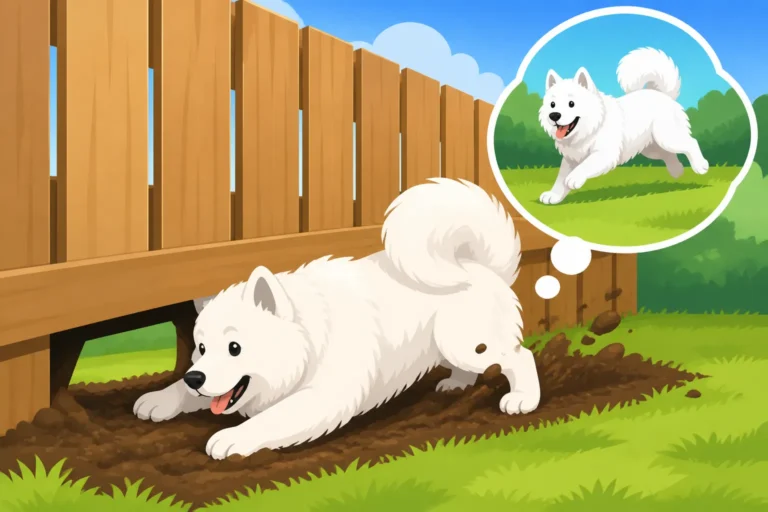
But height isn't the only concern; digging is another Samoyed specialty. These dogs were bred to live in arctic conditions, and digging a cool hollow in summer or a snow den in winter is instinctual. If your Samoyed is intact and has a mission, he'll exploit this skill. To prevent him from digging under, consider installing an L-footer: a section of wire mesh or concrete buried horizontally at the base of the fence, extending inward. Alternatively, you can bury chicken wire or hardware cloth along the fence line. Make sure to regularly inspect the fence perimeter for any weak spots, loose boards, or areas where he might have started to tunnel. Even small beginnings can turn into a grand escape. The Tunnel a Samoyed Digs Under a Fence is a real problem.
Finally, gates are often the weakest link in any fencing system. A simple latch might be child's play for a Samoyed. Some dogs learn to manipulate handles, turn knobs, or even jump up and depress lever-style latches. Consider installing sturdy, spring-loaded latches or even double-latching systems that require a more complex movement to open. Padlocks or heavy-duty carabiners can add an extra layer of security, especially on gates that are used infrequently. Every time you open or close a gate, make it a conscious effort to ensure it's securely fastened. Don't underestimate The Gate Latch a Samoyed Learns to Open. You might also want to explore durable, heavy-duty kennel panels that can be linked together for a highly secure enclosure if your yard isn't quite up to snuff. These can often be found on platforms like Amazon.
Constant Vigilance: Supervision and Leash Discipline
Even with the most robust fencing system, constant vigilance is non-negotiable for an intact male Samoyed with a history of roaming. No fence is truly 100% escape-proof against a dog whose hormonal drive is powerful enough to motivate him to dig, climb, or squeeze through seemingly impossible spaces. This means direct supervision every single time your Samoyed is outside, even in a fenced yard. You might think, "He's just sniffing around," but that's often when they discover a new weakness in the fence or decide to test the gate.
For walks and any time your Samoyed is outside of a secure, supervised area, proper leash discipline is critical. A secure harness, specifically designed to prevent slipping out, is a must. A simple flat collar can be easily backed out of if a Samoyed pulls or panics. Look for harnesses that fit snugly around the chest and behind the front legs, making it difficult for them to wiggle free. Some owners find Whether a No Pull Harness Works on a Samoyed helpful not just for training, but for added security against backing out. Always check the fit regularly, as Samoyeds can gain or lose weight, or their coat can flatten in different seasons, affecting how the harness sits.
Using a long line (a very long leash, often 15-30 feet or more) for exercise in open but non-fenced areas can give your Samoyed a sense of freedom while still allowing you control. This is a great way to let them run and explore scents without the risk of them disappearing entirely. Just be sure the line is securely attached to a well-fitting harness, and that you maintain a firm grip. Remember, an intact male Samoyed's desire to roam means that even a fleeting lapse in attention can lead to him slipping away, and once he's gone, his strong instincts will make him extremely difficult to recall.
Training a Mind on a Mission: Behavioral Approaches to Managing Roaming Instincts
While physical barriers are essential, training and mental engagement play a crucial role in mitigating the desire to roam. For an intact male Samoyed, this isn't about eliminating the instinct entirely, but rather building strong communication and providing fulfilling outlets for their energy and intelligence. A well-exercised and mentally stimulated Samoyed is often a less restless Samoyed.
Mastering Recall in a World of Distractions
Achieving a truly reliable recall for any Samoyed is a lifelong endeavor, but for an intact male, it's an absolute imperative and often the most challenging command to proof. Why a Samoyed's Recall Cannot Be Trusted becomes painfully clear the moment a tantalizing scent or a fleeting movement captures their attention. When the powerful drive to find a mate kicks in, even the most dedicated training can seem to vanish into thin air. You can literally call their name until your voice gives out, and they won't even twitch an ear.
The key is to practice recall in progressively more distracting environments, starting in your living room and slowly moving to the backyard, then a quiet park, and eventually areas with more stimuli, but always on a long line. Use exceptionally high-value rewards – not just kibble, but boiled chicken, cheese, or even tiny pieces of hot dogs. The reward needs to be more compelling than whatever distraction is vying for his attention. Make coming back to you the most exciting and rewarding thing in his world. Some owners find structured online training courses, like those offered by BAXTER & Bella, incredibly helpful for breaking down complex behaviors like recall into manageable steps, especially with the accountability and expert guidance they provide.
It's also important to understand that "come" needs to mean "come all the way to me and get a reward." Don't just call him to scold him or to put him back on the leash. That teaches him that coming to you means the fun stops. If you call him, reward him, give him praise, and then let him go back to playing, he'll learn that coming to you is a positive experience, not the end of his freedom. Remember, a fully proofed recall for an intact male Samoyed means he comes back every single time, regardless of nearby squirrels, other dogs, or, most critically, the distant scent of a female in heat. This level of reliability is incredibly difficult to achieve and maintain against such a powerful biological drive.
Mental and Physical Engagement: Draining the Drive to Wander
A bored or under-exercised Samoyed is a creative Samoyed, and that creativity often manifests in destructive behaviors, vocalizations, or, for an intact male, an even stronger inclination to seek adventure beyond your property lines. Samoyeds are working dogs, and they thrive on having a "job" to do, whether it's pulling a sled or solving a puzzle. How Much Exercise a Samoyed Needs is often underestimated; they're not content with a simple stroll around the block.
Providing ample physical exercise is crucial. This could mean daily long walks, runs (canicross is a great option if you're a runner), hiking, or even supervised play with other well-socialized dogs. Activities that engage their natural instincts, like pulling a cart or skijoring, can be incredibly satisfying for them and help burn off excess energy that might otherwise be channeled into plotting an escape. The goal is to tire them out both physically and mentally.
Mental stimulation is just as important. Engage your Samoyed with puzzle toys, snuffle mats, or by teaching them new tricks. Obedience training sessions, even short ones, can be a great way to keep their minds sharp. Consider introducing them to dog sports like agility or rally, which provide both physical and mental challenges. A Samoyed who is regularly challenged and engaged is less likely to feel the need to create his own excitement by exploring beyond your property. A strong daily routine with consistent exercise and mental enrichment can go a long way in reducing the restlessness that often precedes an attempt to roam.
The Neutering Question: When to Consider the Permanent Solution
For many owners struggling with a persistent roamer, the question of neutering inevitably arises. While it's a personal decision with various factors to consider, it's undeniable that neutering can be a highly effective solution for curbing the powerful, hormone-driven urge to roam in male Samoyeds.
Weighing the Pros and Cons: Beyond Just Roaming
The primary benefit of neutering an intact male Samoyed who is prone to roaming is the significant reduction, and often elimination, of the hormonal drive to seek out females. Once the source of testosterone is removed, the overpowering scent of a female in heat largely loses its hypnotic effect. This means your dog is less likely to suddenly become "deaf" to your commands or resourceful in his escape attempts simply because a neighborhood female is in season. While some learned roaming behaviors might persist, the fundamental biological imperative is gone, making management much easier.
Beyond roaming, neutering can offer other behavioral advantages. It can reduce marking behavior (urinating on vertical surfaces to claim territory), decrease certain types of aggression towards other intact males, and even lessen some instances of humping. It's important to understand, however, that neutering is not a magic wand for all behavioral issues. If your Samoyed is roaming out of sheer boredom or lack of exercise, neutering alone won't fix those underlying problems. It's most effective when the roaming is clearly linked to the hormonal drive for reproduction.
There are, of course, considerations and potential downsides to discuss with your veterinarian, such as the timing of the surgery, potential impacts on bone development if done too early, and slight changes to coat texture or weight gain tendency. These are all valid concerns that competent owners should discuss at length with their vet. However, for a persistent roamer, the safety and peace of mind that neutering can provide often outweigh these other factors, especially when repeated escapes put your Samoyed at risk.
Responsible Ownership: Protecting Your Samoyed and Your Community
The decision to own a dog, especially a magnificent breed like the Samoyed, comes with a profound responsibility to keep them safe and to be a good neighbor. An intact male Samoyed who roams isn't just a nuisance; he's a dog at significant risk. The dangers are numerous and severe: being hit by a car, getting into fights with other dogs, getting lost and ending up in a shelter, or even being mistaken for a stray and picked up by animal control. Furthermore, if he encounters an intact female, he could contribute to unwanted litters, adding to the already overwhelming pet overpopulation crisis.
Beyond proactive prevention, having safeguards in place for if an escape happens is crucial. Ensure your Samoyed is microchipped and that your registration information is always up to date. A microchip is permanent identification that can vastly improve the chances of a happy reunion. Your Samoyed should also wear a collar with clear identification tags that include your phone number. Think of these as safety nets, not substitutes for proper containment. Whether a Samoyed Should Be Microchipped is not really a question, it's a must.
For extra peace of mind, especially if you have a known escape artist, consider investing in a GPS tracker. There are many reliable options available on platforms like Amazon that attach to your dog's collar and allow you to monitor his location via a smartphone app. While a GPS collar doesn't prevent roaming, it can drastically reduce the stress and time involved in finding a lost Samoyed. Whether a GPS Collar Is Worth It for a Samoyed becomes a very easy 'yes' when you've experienced the fear of a missing dog. Ultimately, preventing your intact male Samoyed from roaming is not just about convenience; it's about his safety, his well-being, and your commitment to responsible pet ownership.
| Containment Method | Pros | Cons | Effectiveness for Intact Male Samoyed |
|---|---|---|---|
| Tall, Solid Fencing | Physical barrier, clear boundary | Expensive installation, requires regular inspection, Samoyeds can climb/dig | High, if properly constructed (6ft+, dig-proofed) |
| Buried Wire/L-Footers | Specifically prevents digging under fences | Labor-intensive installation, requires proper depth and material | Very High for persistent diggers |
| Double-Gated Entries | Adds security layers at common exit points | Can be inconvenient, requires consistent owner diligence | High for bolters, prevents accidental escapes |
| Invisible/Electronic Fences | Aesthetically pleasing, flexible layout, portable in some cases | Not a physical barrier, relies on aversive stimuli, Samoyeds can "run through" when highly motivated, inconsistent training effectiveness | Low (often ineffective against strong hormonal drive) |
| Constant Leash Supervision | Direct control, ideal for walks and unsecured areas | Requires constant owner attention, limits free movement, not suitable for unattended yard time | High for direct interaction, zero for unattended time |
| GPS Tracking Collar | Provides location data if an escape occurs | Does not prevent roaming, requires charging, often has subscription fees | Good for recovery, not prevention |
Disclaimer
This article is for general informational purposes only and does not constitute professional advice. Laws, prices and regulations vary by location and change over time. Consult a qualified professional for guidance on your specific situation.