Whether Buried Wire Stops a Samoyed Digging Out
Oh, the eternal struggle with a digging Samoyed! Many of us have been there, watching our beautiful, fluffy cloud of joy transform into a furry excavator, leaving craters in its wake and threatening the integrity of our yard. It’s a truly frustrating experience, especially when you’ve invested in a fence, only to find your clever companion has figured out how to go under it. This guide is going to dive deep into whether those appealing buried wire fences, often touted as a solution, actually stand a chance against a determined Samoyed's natural instinct to dig its way to freedom or simply to a cooler patch of earth.
The Samoyed's Instinct to Dig – It’s More Than Just Mischief
Let's be real, a Samoyed isn't digging just to annoy you, even if it feels that way when you see another freshly dug pit. These magnificent dogs carry the echoes of their Arctic ancestors, where digging served vital purposes. It wasn't a pastime; it was survival. Understanding this ingrained behavior is the first step to finding effective management strategies.
The Urge to Tunnel Underneath
Samoyeds hail from Siberia, a place of extreme temperatures. When summer rolled around, the ground offered respite from the heat. Digging a cool hollow was a natural, instinctive way to regulate body temperature. This isn't just a quaint historical fact; it’s hardwired into their DNA. Even in a perfectly temperate climate, the instinct to The Digging a Samoyed Does Because It Is Hot can be incredibly powerful. They aren't trying to be defiant; they're responding to an ancient drive. For a fence, this means they're not just looking for a weak spot in the fence, but often under it. Their desire to tunnel is as strong as their desire to jump or climb, making How a Samoyed Gets Out of Anything You Build a constant challenge.
Furthermore, digging can be a form of exploration. Their keen noses might pick up scents of moles, voles, or other critters underground, triggering a prey drive that culminates in a frantic digging frenzy. It's an engaging, self-rewarding activity for them. Think about it: a cool spot, a fun smell, maybe even a little critter to chase – it's a Samoyed paradise, even if it's your pristine flowerbed.
Boredom and the Search for Stimulation
Beyond instinct, a bored Samoyed is a creative Samoyed, and that creativity often manifests as digging. These are intelligent, active dogs who were bred to work closely with their human companions, herding reindeer and pulling sleds. If they aren't given enough mental and physical stimulation, they'll find their own "jobs," and those jobs frequently involve excavating your yard. What a Bored Samoyed Does to a House often includes destructive behaviors, and digging outdoors is certainly one of them.
A Samoyed who isn't getting enough exercise, isn't challenged with training, or is left alone for long periods without engaging activities is far more likely to turn to digging. This isn't about being "bad"; it's about unmet needs. They crave interaction and purpose. If they're not pulling a sled or learning new tricks, a patch of dirt looks mighty inviting for some self-directed entertainment.
How Buried Wire Fences Work (and Don't Work) for Samoyeds
Buried wire fences, often called "invisible fences" or "electronic fences," offer a tempting solution for containing dogs without the visual obstruction of a physical barrier. They rely on a simple premise: a wire buried around a designated area emits a radio signal. When your dog, wearing a special receiver collar, approaches this boundary, the collar typically emits a warning beep, followed by a static correction (a mild shock) if the dog continues. The idea is to condition the dog to avoid the boundary.
The Technology Behind Invisible Fences
At their core, these systems consist of three main components: a transmitter, a buried wire, and a receiver collar. The transmitter, usually kept indoors, sends a harmless radio signal through the buried wire. The wire itself defines the perimeter of your dog's safe zone. The receiver collar, worn by your Samoyed, detects this signal. As the dog gets closer to the wire, the signal strengthens. Most systems are designed to provide an audible warning first, giving the dog a chance to retreat, before delivering a static correction if the warning is ignored. The intensity of this correction can often be adjusted, aiming to be startling but not harmful.
Many people are drawn to these systems for their aesthetic appeal and perceived ease of installation compared to traditional fencing. Brands like PetSafe and SportDOG offer various models, often available on Amazon, with different ranges and features, including rechargeable collars and waterproof designs. They seem like a modern, high-tech answer to an age-old problem.
The Samoyed's Drive Versus the Deterrent
Now, here's where we get to the crux of the matter for our fluffy escape artists. For some dogs, a static correction is a powerful deterrent. They learn quickly to respect the boundary. For a Samoyed, however, the effectiveness can be highly variable, and often, disappointing. The Samoyed is known for its incredible drive and tenacity. Their desire to investigate, to chase, or to simply go beyond the perceived boundary can be incredibly strong, especially if they are bored, under-exercised, or catching a particularly intriguing scent.
A momentary static correction, while unpleasant, might simply not be enough to overcome the thrill of the chase or the deep-seated urge to explore. Some Samoyeds are quite stoic and may decide that the brief discomfort is a small price to pay for the adventure on the other side. They might bolt right through the correction, especially if something exciting, like a squirrel or another dog, catches their attention. Once they've crossed the boundary and experienced the "freedom," they might be even more motivated to repeat the action, ignoring the correction entirely, or only feeling it after they've already exited the perimeter. This is a common story among Samoyed owners; the temporary discomfort pales in comparison to the allure of the unknown.
The Limitations of Buried Wire for a Samoyed's Digging Habits
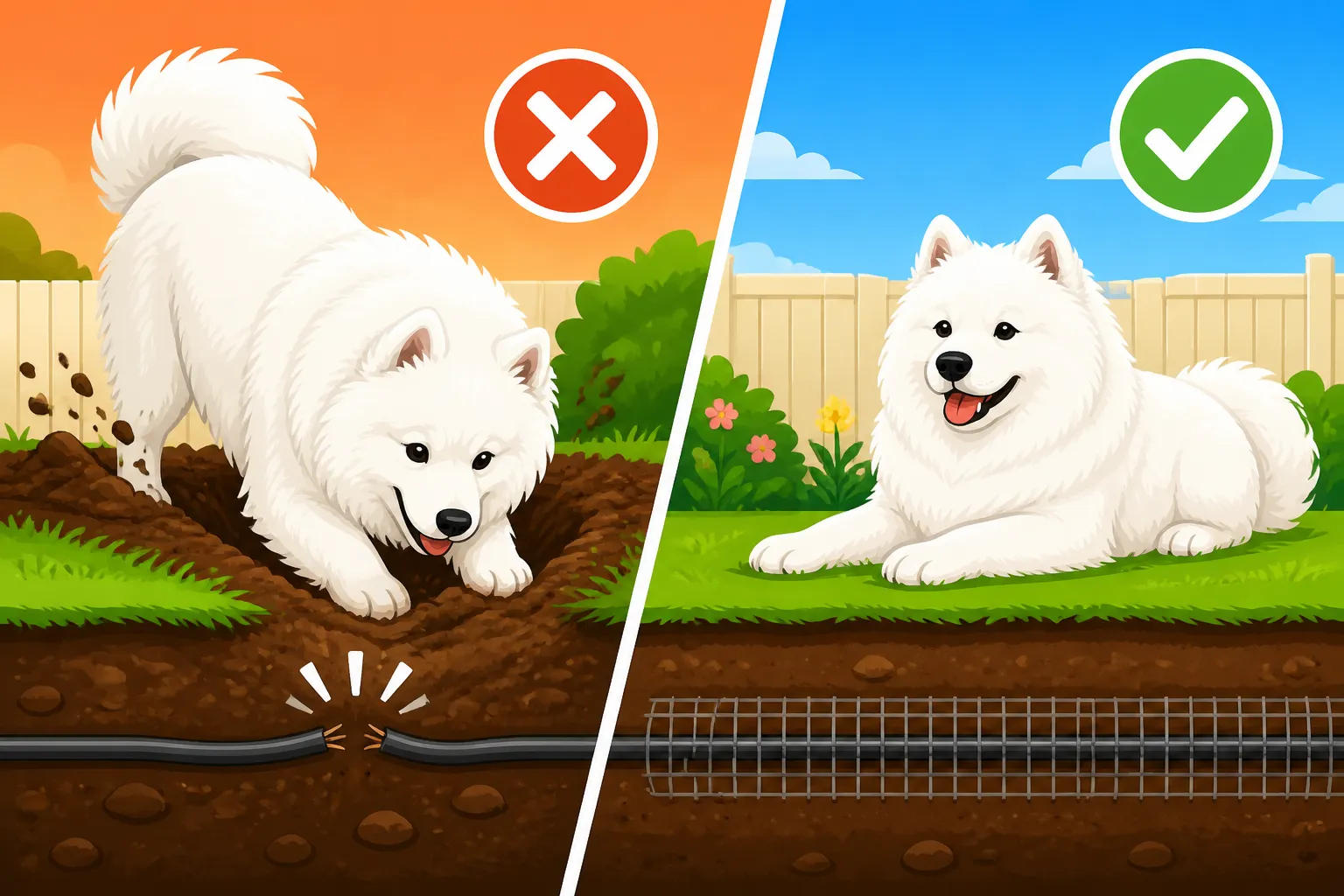
This brings us directly to the specific problem of digging. While a buried wire fence is designed to prevent a dog from walking or running over a boundary, its effectiveness against a dog that tunnels under it is severely limited.
Digging Under the Boundary Line
The fundamental flaw in relying solely on a buried wire system to stop a digging Samoyed lies in its two-dimensional nature. The wire creates a horizontal boundary, typically a few inches underground. The static correction is triggered when the collar comes within a certain range of this horizontal line. What happens when a Samoyed starts digging down a foot or two before tunneling under the wire? Often, nothing. The collar might not register that the dog is "crossing" the boundary because its body, and thus the collar, is still within the "safe" zone relative to the horizontal plane of the wire. Why a Samoyed Digs Under Fencing is often driven by a desire to explore or to find cooler earth, and they are incredibly adept at it.
Your Samoyed could be happily excavating a tunnel to China, all while their collar remains safely within the detectable range above the buried wire, or too far below it for the signal to be consistently strong. By the time they pop out on the other side, they've circumvented the entire system without ever truly triggering the corrective static. It’s a design oversight when dealing with a breed so naturally inclined to dig tunnels.
The "Worth It" Calculation
Samoyeds are intelligent, and they learn quickly. Unfortunately, what they learn isn't always what we intend. If they discover they can dig under the wire without significant consequence, or if the reward of escaping (a chase, a new sniff, seeing another dog) outweighs the momentary jolt, they'll make that "worth it" calculation in a heartbeat. It's not malice; it's pragmatism from a dog's perspective.
Think of it like this: if you really want that delicious piece of cake, a small electric shock to your finger might make you hesitate, but if the desire for the cake is overwhelming, you might just power through the discomfort. For a Samoyed, the drive to explore, to chase, or to simply find a cooler spot to lie down in their characteristic The Holes a Samoyed Digs in a Yard can easily overcome the mild static of an invisible fence. The system relies on creating an unpleasant association, but for a highly motivated Samoyed, that association often isn't strong enough when faced with a compelling urge.
Alternative and Supplementary Solutions for a Digging Samoyed
Given the limitations of buried wire fences for our digging Samoyeds, it's clear that a multi-faceted approach, often involving physical barriers and behavioral management, is usually far more effective.
Physical Barriers and Dig Guards
The most reliable way to prevent a Samoyed from digging under a fence is to install a physical barrier that they cannot dig through. This might sound obvious, but it requires thought. Simply burying your existing fence deeper isn't always enough; a determined Samoyed can dig alongside it.
One effective solution is to bury a section of heavy-gauge wire mesh (like hardware cloth) or chicken wire horizontally along the bottom of your existing fence, extending it inward by about 12-18 inches. You can secure this mesh to the bottom of the fence and then bury it a few inches under the ground. When your Samoyed starts to dig near the fence line, they will quickly encounter this impenetrable barrier, making them give up. Another option is to use concrete or pavers laid along the fence line. These solutions, while more labor-intensive initially, offer peace of mind that an invisible fence simply can't. Products for this, such as heavy-duty mesh, can be found readily on Amazon.
Addressing the Root Cause
Ultimately, the best approach for a digging Samoyed often involves addressing why they are digging in the first place. This means focusing on their physical and mental needs.
- Exercise: Samoyeds are active dogs. They need a significant amount of exercise daily. A tired Samoyed is a well-behaved Samoyed. This isn't just a leisurely stroll around the block; it's vigorous activity. How Much Exercise a Samoyed Needs is often more than new owners realize. Think long walks, runs, hikes, or even canine sports.
- Mental Stimulation: These intelligent dogs need jobs. Without them, they'll invent their own. Puzzle toys, interactive feeders, scent work, or consistent training sessions can burn mental energy. Enrolling in obedience classes or even exploring dog sports like agility or canicross can provide invaluable mental engagement. The Job a Samoyed Actually Needs is a satisfied Samoyed. Online training platforms, such as those offered by BAXTER & Bella, can provide structured programs to keep your Samoyed's mind active and engaged, teaching them new skills and redirecting their natural drives toward acceptable outlets.
- Dedicated Digging Spot: If your Samoyed absolutely loves to dig, consider creating a designated "dig pit" in your yard. Fill a sandbox or a corner of the yard with sand or loose soil, hide some toys or treats in it, and teach your Samoyed that this is the acceptable place to dig. This provides an outlet for their natural behavior without destroying your entire yard. Giving a Samoyed Its Own Digging Pit can be a game-changer.
- Supervision: When outside, especially initially, supervise your Samoyed closely. Interrupt any unwanted digging with a verbal correction and redirect them to an appropriate activity or their digging pit. Consistent supervision and redirection are key elements in Training a Samoyed That Finds Obedience Negotiable.
- Enrichment: Ensure your Samoyed has plenty of engaging toys, especially when left alone. Durable chew toys, treat-dispensing toys, and other enrichment items can help prevent boredom-induced digging. What a Samoyed Needs Every Day includes mental stimulation just as much as physical.
By combining physical barriers with a dedicated effort to meet your Samoyed's inherent needs for exercise and mental engagement, you'll find far greater success in managing their digging habits than by relying solely on a buried wire system.
Here’s a quick overview of options:
| Deterrent Type | How It Works | Pros | Cons | Effectiveness for Digging Samoyeds |
|---|---|---|---|---|
| Buried Wire Fence | Emits static correction when dog crosses horizontal boundary. | Invisible, aesthetically pleasing. | Ineffective against digging under the wire; easily "power-throughable" by motivated Samoyeds. | Low |
| Physical Dig Guard | Mesh, concrete, or pavers buried along fence line. | Physically blocks digging, no escape route. | Installation can be labor-intensive; visible if not perfectly buried. | High |
| Increased Exercise | Burns physical energy, reduces boredom and pent-up drive. | Improves overall behavior and health. | Requires consistent time and effort from owner. | Moderate to High |
| Mental Stimulation | Puzzle toys, training, scent work, dog sports. | Engages intelligence, reduces boredom. | Requires owner involvement; Samoyeds can get bored of repetition. | Moderate to High |
| Dedicated Dig Pit | Provides an acceptable outlet for natural digging instinct. | Redirects behavior, saves your yard. | Requires teaching where to dig; might still dig elsewhere if not supervised. | Moderate |
| Professional Trainer | Tailored advice and training techniques for specific issues. | Expert guidance, consistent approach. | Can be an investment; requires owner commitment to follow through. | High |
Ultimately, while a buried wire fence might seem like a simple fix, for a cunning and determined Samoyed with a strong digging instinct, it's often more of a suggestion than a true barrier. Investing in physical modifications and addressing your Samoyed's deep-seated needs will provide much greater peace of mind and a happier, more contained furry family member.
Disclaimer
This article is for general informational purposes only and does not constitute professional advice. Laws, prices and regulations vary by location and change over time. Consult a qualified professional for guidance on your specific situation.