Why a Samoyed Makes a Poor Watchdog
It's a common misconception, especially for first-time dog owners or those new to the Samoyed breed, to assume that a large, fluffy, and vocal dog will naturally make an excellent watchdog. You see their impressive size and hear their expressive vocalizations, and you might think, "Ah, here's my built-in security system!" But if you're looking for a canine protector who will stand guard, deter intruders, or even just bark a truly menacing warning, you might be in for a significant surprise with a Samoyed. This guide is here to realistically explain why your beloved cloud dog, despite their formidable appearance, is far more likely to roll over for belly rubs than stand firm against a threat, and what that means for your home security expectations.
Deep-Rooted History: A Breed Built for Companionship, Not Confrontation
To truly understand why a Samoyed isn't cut out for guard dog duty, we need to take a step back in time and look at their origins. These beautiful dogs weren't bred to be aloof protectors or fierce defenders; their historical role was entirely different.
From Ancient Tents to Modern Homes: A History of Trust
The Samoyed breed hails from the Arctic regions of Siberia, where they lived and worked alongside the nomadic Nenets people. Their existence was intertwined with human survival in harsh conditions. They were herders of reindeer, pulling sleds loaded with supplies, and, crucially, they slept inside the family tents. Imagine that: sharing the most intimate space with humans, providing warmth and companionship through the long, brutal Arctic nights. This isn't the history of a dog bred to keep strangers at bay. Instead, their very survival depended on a deep, unwavering bond and trust with humans. They were an extension of the family, cherished and essential. You can learn more about their unique heritage in The Nenets of the Yamal Peninsula Bred the Samoyed and The Samoyed Slept in the Tent to Keep People Alive. This ancient partnership ingrained in them a profound love for people, a trait that continues to define the breed today. They learned from generations that humans, even unfamiliar ones, were a source of warmth, food, and companionship, not a threat.
The Samoyed Smile: A Welcoming Beacon, Not a Warning
One of the most endearing and recognizable features of a Samoyed is their famous "Samoyed smile." This isn't just a charming quirk; it's a direct reflection of their temperament and, ironically, a major reason they make poor watchdogs. That upturned mouth and perpetually happy expression make them incredibly approachable. Think about it: a dog bred to intimidate often has a more serious, watchful, even slightly menacing facial structure. A Samoyed, on the other hand, looks like they're ready to invite you in for a cup of tea. Their eyes crinkle with joy, their tails wag with an almost absurd enthusiasm, and that smile is just irresistible. How can a potential intruder feel deterred by a dog that looks like it's perpetually thrilled to see them? This physical characteristic is a direct manifestation of their friendly nature. They truly do always look happy, and that happiness extends to almost everyone they meet. It's a fundamental part of Why the Samoyed Smiles, and it works against any notion of them being intimidating sentinels.
Instinct Over Training: Why Their Nature Prevails
When it comes to watchdog duties, a dog's inherent instincts play a much larger role than many owners realize. While training can shape behavior, it's incredibly difficult, and often ethically questionable, to completely override centuries of selective breeding.
The Innate Desire to Greet: Everyone is a Friend
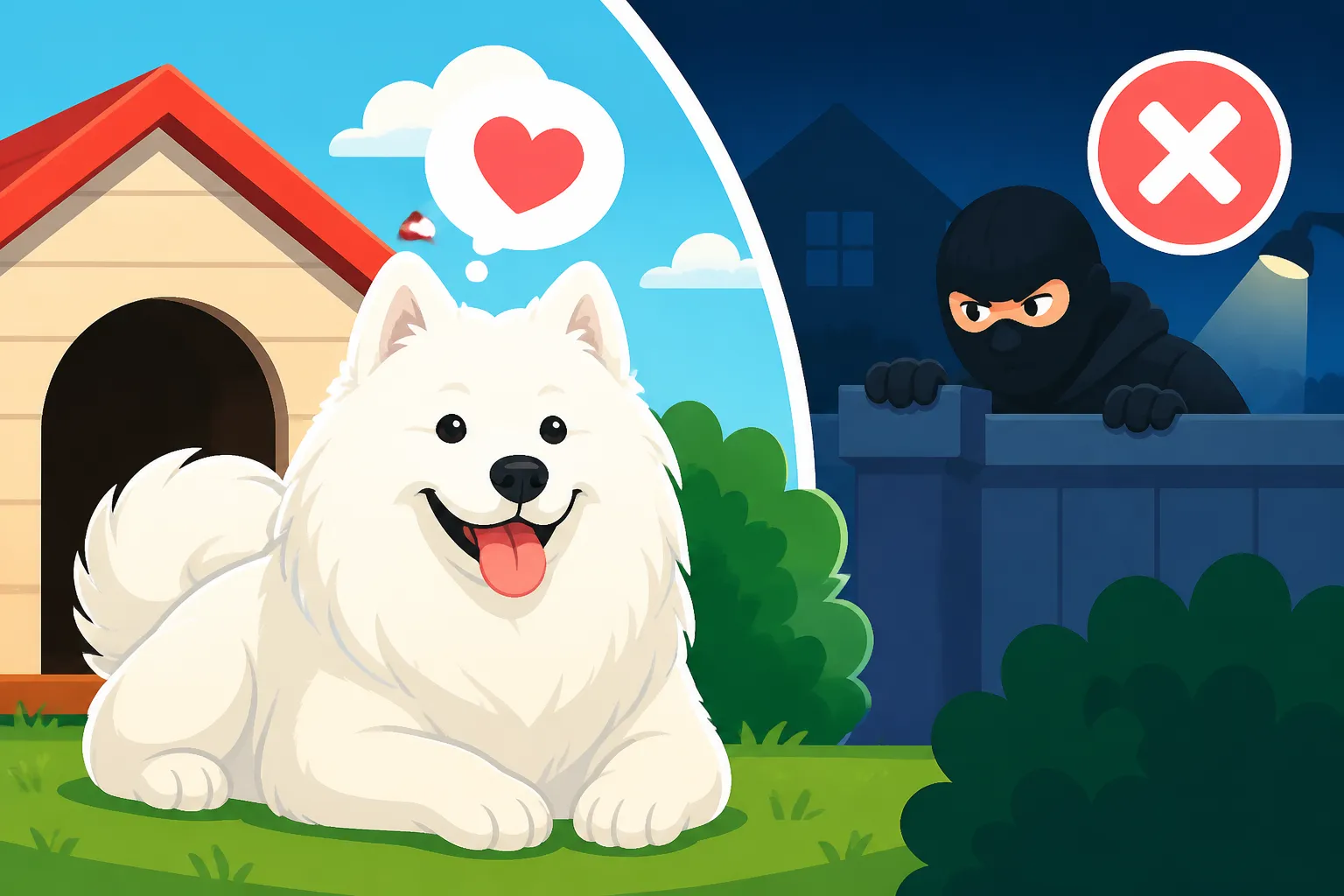
Samoyeds possess an unparalleled sociability. Their default setting for any human interaction is "friend." This isn't something you can easily train out of them because it's woven into the very fabric of their being. Imagine the postman arriving at your door. A typical watchdog might bark aggressively, posture, or even try to block entry. A Samoyed, however, is likely to bound to the door, tail wagging furiously, emitting excited yips and "woo-woos," convinced that this new person has arrived solely to offer ear scratches and perhaps a treat. They genuinely believe that every stranger is simply a friend they haven't made yet. This can be delightful for visitors but utterly useless for security. We explore this further in Why a Samoyed Welcomes Everyone. They just don't possess the natural suspicion or territoriality that forms the bedrock of a good watchdog's temperament. Their instinct is to connect, not to challenge. This means that an intruder might find themselves greeted with a flurry of white fur and a happy smile, rather than a formidable growl.
Vocalizations That Don't Intimidate: The "Samoyed Scream"
Samoyeds are undeniably vocal dogs. They have a wide repertoire of sounds, from barks and howls to their famously distinct "Samoyed scream" – a high-pitched, excited noise that can sound quite dramatic. However, these vocalizations, while loud, rarely carry the tone of a true warning or threat. Their barks are more often expressions of excitement, boredom, or a plea for attention. The "scream" is usually reserved for moments of extreme joy, anticipation (like dinnertime or walkies), or playful exasperation. An actual intrusion, for many Samoyeds, might simply trigger an even more excited version of their normal happy noises, rather than a deep, guttural bark of alarm. They are alerting you, yes, but to the presence of someone, not necessarily to a danger.
Consider the difference in these vocal cues:
| Characteristic | Traditional Watchdog Bark | Samoyed Vocalization |
|---|---|---|
| Tone | Deep, resonant, persistent | Higher pitched, varied, enthusiastic |
| Context | Perceived threat, territorial defense | Excitement, greeting, attention-seeking, play |
| Body Language | Stiff, forward, hackles raised | Loose, wiggly, tail wagging, "smile" |
| Intention | Deterrence, warning | Communication, invitation to interact |
This table clearly illustrates why a loud Samoyed isn't necessarily a secure Samoyed. While their noise might alert you that something is happening outside, it's far more likely to be a declaration of "Yay, a visitor!" than a genuine "Intruder alert!" You can delve deeper into their unique sounds in The Samoyed Scream and Why It Is Not Barking and What a Samoyed Sounds Like When It Talks. Their loud nature is a feature, but not one that translates to security.
The Practical Reality: What a Samoyed Actually Guards (and Doesn't)
So, if they're not guarding against intruders, what do Samoyeds do, and what can you realistically expect when that doorbell rings?
The Doorbell Dilemma: Excitement, Not Alarm
When the doorbell rings or there's a knock, most Samoyeds don't immediately go into defensive mode. Instead, they typically launch into a full-body wiggle of anticipation, letting out a chorus of joyful barks, yips, and happy "woo-woos." Their minds instantly go to, "Who's here to see me? Is it a new friend? Will they bring treats?" This isn't the sharp, territorial bark of a dog assessing a potential threat; it's the excited fanfare of a welcoming committee. For a Samoyed, the doorbell is an invitation to a party, not a call to arms. This behavior, while adorable, means they are unlikely to intimidate anyone with ill intentions. If anything, their enthusiastic greeting might even encourage someone to interact with them, which is the exact opposite of what you want in a watchdog.
Protecting Their Pack: A Different Kind of Vigilance
While a Samoyed may not guard your house in the traditional sense, they do have a profound loyalty to their human family. Their "protection" manifests differently. They want to be with you, always. This means they are inherently vigilant about your presence. If you're out of sight, they might vocalize or follow you from room to room. Their awareness is focused on the internal dynamics of the home, not external threats. They might alert you to an unfamiliar sound, but it's often more out of curiosity or a desire to share the "news" with you than a protective impulse. They will certainly let you know if a squirrel is in the yard or if the trash truck is coming down the street, but that's very different from standing guard against a human intruder. The reality is that How a Samoyed Reacts to an Intruder is usually with curiosity and a wagging tail, rather than aggression. They truly don't possess the inherent aggression or suspicion towards strangers that define an effective guard dog, reinforcing the idea that Why a Samoyed Will Never Guard Your House is simply due to their loving nature. It's a common trait that Why a Samoyed Deters Nobody because they tend to befriend everyone. Furthermore, when considering Whether a Samoyed Is Ever Aggressive, the answer is almost universally no, especially towards humans.
Setting Realistic Expectations and Finding Alternative Solutions
So, if your Samoyed isn't going to be your personal security detail, what should you expect, and how can you ensure your home is protected?
Embracing the Samoyed's True Strengths
It's vital to adjust your expectations and appreciate your Samoyed for what they truly are: exceptional companions. Their strengths lie in their unwavering loyalty, boundless affection, playful spirit, and their incredible ability to bring joy and laughter into your home. They excel at being furry best friends, eager participants in family activities, and the most charming members of your pack. They are fantastic with children and other pets when properly socialized, making them wonderful family dogs. Their "job" is to love you, make you smile, and remind you to embrace life with enthusiasm. They thrive in an environment where they are considered integral family members, which is why The Household a Samoyed Was Built For prioritizes companionship and active family life. Don't let the lack of guarding instinct diminish their immense value as a pet. They fulfill a different, but equally important, role in your life.
Modern Security for Modern Samoyed Homes
Since your Samoyed will likely greet a burglar with a happy dance, it falls to you, the human, to provide actual home security. For those who truly need home security, investing in a robust alarm system (perhaps even one you can monitor remotely through a service like those found on Amazon) is a far more reliable strategy than relying on your Samoyed. Consider motion-activated lights, sturdy locks, and even a well-placed "Beware of Dog" sign (even if it's more of a humorous warning about copious shedding than a real threat).
Training, even with positive reinforcement programs like those offered by BAXTER & Bella, can certainly help manage a Samoyed's excitement at the door, teach them a "place" command, or prevent nuisance barking. These efforts can create a more orderly home, but they will not fundamentally alter a Samoyed's inherent desire to make friends with every person they encounter, nor will they instill a protective guarding instinct where none exists. Focus your training on manners, recall, and channeling their energy positively. Remember, Whether a Samoyed Barks at Strangers is often more a sign of excitement than aggression. Instead of trying to force your Samoyed into a role they weren't designed for, focus on their strengths and provide security through other, more effective means. They might be a fluffy deterrent simply by their presence and size, but don't count on them for serious defense. For this reason, leaving them alone for extended periods without proper training and entertainment can lead to other behavioral issues, as explored in Whether a Samoyed Can Be Left Alone.
Disclaimer
This article is for general informational purposes only and does not constitute professional advice. Laws, prices and regulations vary by location and change over time. Consult a qualified professional for guidance on your specific situation.